
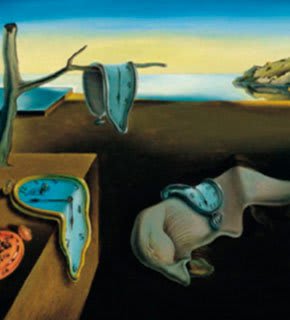
The Persistence of Memory: Salvador Dalí's Masterpiece
Discover the mystery behind Salvador Dalí's iconic painting, The Persistence of Memory.
The Persistence of Memory is a painting by Salvador Dalí, undoubtedly one of the most important and memorable works of the Catalan master, which serves as a symbol of the surrealist movement.
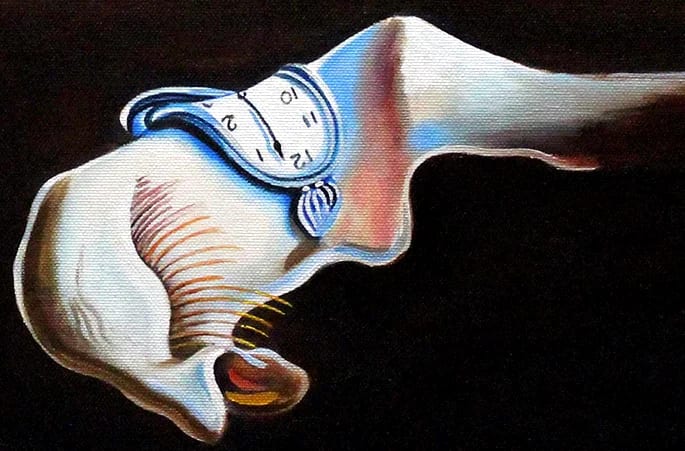
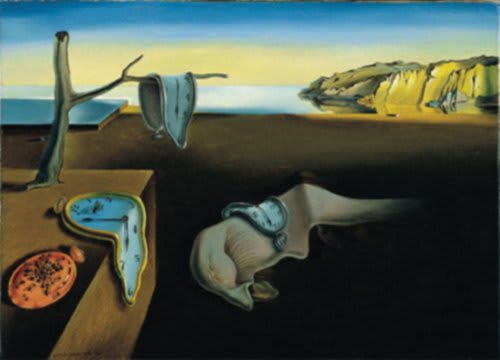
Measuring a bit over 30cm in height, the painting presents a typical landscape in the style of Dali, with the rocks of Cabo Creus in the background, to the right. We observe that the clock in the foreground, there is an author's self-portrait of the artist that seems to be superimposed. The images of the three melted clocks are secondary, they function as an escape that the painter used to show how the passage of time is irrelevant.
The Inspiration and Melted Clocks
It was on a summer afternoon, the artist was in his studio with his wife Gala, he realized how short the time was being with his muse, for him it had lost its meaning. It was when in one of his hallucinations, observing a piece of Camembert cheese that was melting due to the heat that it made there, it was enough for the inspiration to paint the melted clocks and associate the passage of time to this scene.
The Dinner that Changed Art: Dali told that the idea for the melted clocks did not come from complex theories, but from a piece of Camembert cheese. After a dinner with Gala, while observing the cheese melting on the table in the heat of the summer, he had a "surrealist epiphany." He abandoned the idea of going to the cinema, ran to the atelier and, in a few hours, transformed the landscape he was already painting into one of the most iconic scenes in the history of art, where time loses its rigidity and becomes edible.
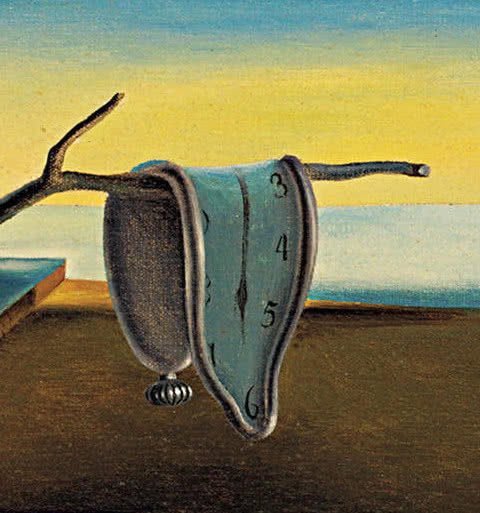
The contrast between the blue sky and the color of the sand creates a scenic illusion. Melted clocks, one suspended by a branch, another folded at the angle of a pothole, the third in the form of an assembly, and finally, a clock that is hard covered with ants. These insects for the artist, represent the decomposition in his works, reminding that for him the ordinary object becomes worthless, just like the realistic painting that had lost its sense after photography.
What are the Ants Eating? While the melted clocks represent the fluidity of subjective time, the only rigid clock in the scene — painted in a vibrant orange tone — appears turned upside down and covered with ants. For Dalí, these insects were symbols of putrefaction and anxiety. By placing them devouring a mechanical clock, the artist suggests the decomposition of chronological time and the finitude of matter in the face of the eternity of the unconscious.
The Oneiric Symbolism
The distinction between hard and soft objects highlights Dalí's desire to invert reality by lending his subjects characteristics opposite to their generally inherent properties, a frequent unreality found in our oniric landscapes. They are surrounded by a swarm of famished ants by the organic processes of putrefaction and decomposition with which Dalí had an unshakeable fascination. As the melted flesh in the center of the painting resembles the artist, we can see this piece as a reflection of the artist's immortality among the rocky cliffs of his house in Catalonia.
A Pocket-Sized Masterpiece: Those who see the visual force of The Persistence of Memory in gigantic reproductions are often surprised by the original: the canvas is tiny, measuring only $24 imes 33$ cm — slightly larger than an A4 paper sheet. This reduced size highlights Dalí's technical precision, who used fine brushes to create a near-photographic sharpness, inviting the viewer to approach physically to decipher each detail of his dream.
The three clocks are marking a different time, symbolizing the relativity of time and space. The existence of a fly on one of them reminds us that time does not stop, it flies.
The importance of this work lies in several aspects:
- Artistic Innovation: Dalí was one of the main artists of the surrealist movement, and "The Persistence of Memory" is a striking example of his innovative approach to art. Surrealism seeks to explore the unconscious and liberate creativity beyond the conventional limits of logic. The melted clocks in the painting are a visually impressive representation of the distortion of time and reality.
- Expression of Time: The melted clocks in the painting have been interpreted as a representation of malleable and subjective time. The image evokes the idea that time is not rigid and can be perceived in different ways. This approach to time is central to surrealist philosophy, which often seeks to challenge traditional and linear notions.
- Exploration of the Unconscious: The painting reflects the influence of Sigmund Freud's psychoanalytic theory on surrealism. Dalí was interested in exploring the unconscious and dreams in his art. "The Persistence of Memory" can be seen as a visual manifestation of an oniric world, where everyday logic is subverted.
- Enduring Legacy: The image of the melted clocks has become iconic and is immediately associated with Salvador Dalí. The work is often reproduced in art books, posters, and referenced in popular culture. This contributes to Dalí's enduring legacy as one of the most influential artists of the 20th century.
- Influence on Popular Culture: The surrealistic image of "The Persistence of Memory" has transcended the art world and influenced popular culture. Elements of the work appear in films, television programs, album covers, and other media, demonstrating Dalí's ability to impact beyond conventional artistic boundaries.
Dalí and the MoMA: Although it was painted in Europe, the work crossed the ocean shortly after its creation. In 1934, just three years after being completed, the canvas was anonymously donated to the Museum of Modern Art in New York (MoMA). Since then, it has become one of the pillars of the museum's collection and the main destination for millions of visitors seeking to understand the peak of surrealism in American soil.
But history holds a bizarre detail:
The Persistence of Memory is a work that transcends art and has become an icon of popular culture. Its importance is not limited to its visual beauty or its influence on the surrealist movement, but also to its ability to inspire and influence generations of artists and creators.


