
Surrealism, Artistic Movement: Origins, Fundamentals and Great Names
Discover the history of Surrealism, a revolutionary artistic movement. Learn about its origins in Paris, the influence of Freud, automatism, and the great names like Dalí and Max Ernst.
The Surrealism was an artistic and literary movement that emerged in the early 1920s with the manifesto of the poet André Breton.
During the International Surrealist Exhibition of 1936, held in London, the guest speaker Salvador Dalí addressed his audience dressed from head to toe in an antique diving suit, with two dogs in one hand and a billiard cue in the other. In the middle of the lecture, constrained by the diving mask, the Spanish artist began to suffocate and waved his arms for help. The audience, unruffled, assumed that his gestures were part of the performance. As the legend of art goes, the surrealist poet David Gascoyne rescued Dalí, who, after his recovery, commented: "I just wanted to show that I was diving deep into the human mind". Dalí concluded his speech - and his accompanying slides, without any surprise, all were presented upside down.
This anecdote highlights the absurd elements, synthesized by Dalí - who was considered a kind of joke by the art establishment of the early 20th century. But the artistic movement was, in fact, much more diverse than it is widely known, encompassing various areas and lasting from 1924 to the end of 1966.
What is Surrealism?
Founded by the poet André Breton in Paris in 1924, Surrealism proposed that the Enlightenment - the influential intellectual movement of the 17th and 18th centuries that advocated reason and individualism - had suppressed the superior qualities of the irrational and unconscious mind. The goal of surrealism was to liberate thought, language, and human experience from the oppressive boundaries of rationalism.
Surrealism aimed to transcend the realistic representation of scenes available to common perception. Under the influence of the new discipline of psychoanalysis, the surrealists used techniques such as dream analysis to discover the functioning of the unconscious mind and the symbols with which the unconscious works.
Breton had studied medicine and psychiatry and was well-versed in the psychoanalytic writings of Sigmund Freud. He was particularly interested in the idea that the unconscious mind - which produced dreams - was the source of artistic creativity. A devoted Marxist, Breton also intended for surrealism to be a revolutionary movement capable of liberating the minds of the masses from the rational order of society. But how could they achieve this liberation of the human mind?
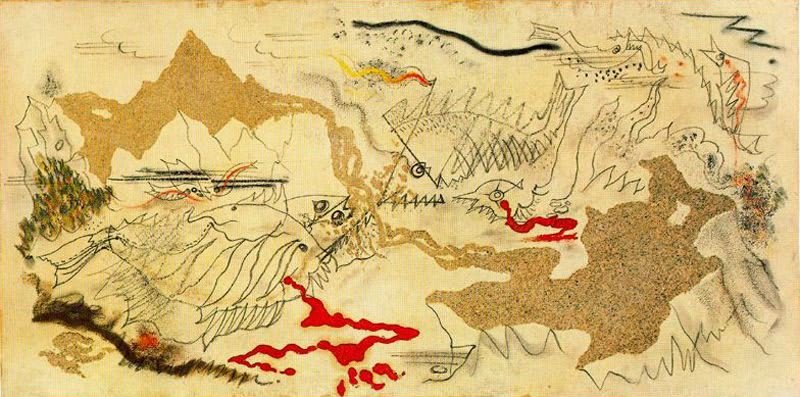
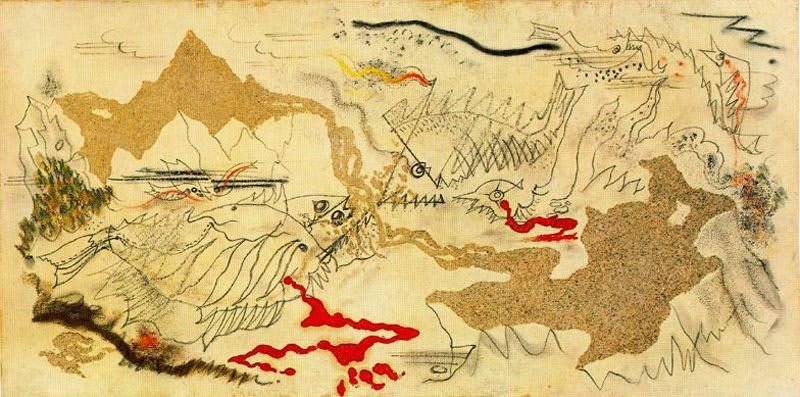
AUTOMATISMO - a practice similar to free association or a flow of consciousness, gave the surrealists the means to produce unconscious works of art. The artist André Masson, for example, is one of the first examples of automatic painting. To begin, Masson picked up plaster - a sticky substance typically used to prepare surfaces for painting - and let it fall freely onto his canvas. He then threw sand on it, leaving the grains stick to the plaster randomly, and scribbled and painted around creating a resulting composition. The final product of Masson presents two prehistoric fish, with bleeding jaws, fighting in the primordial mud: an unconscious demonstration of the inherent violence of nature.
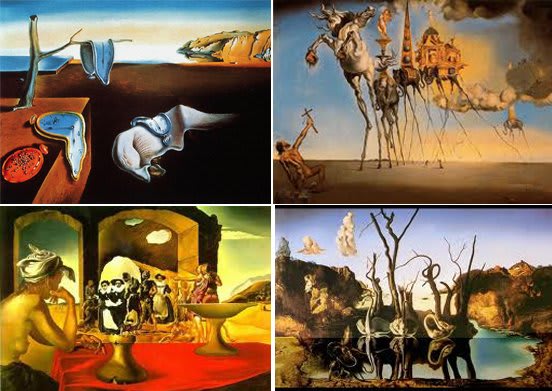
Many surrealists recognized that the representation of the real appearance of a thing in the physical world could combine more effective associations for the viewer, in which a deeper unconscious reality was revealed. Artists like Salvador Dalí and the Belgian painter René Magritte, created hyper-realistic and oneiric visions that are windows to a strange world beyond waking life. La Clairvoyance, by Magritte (1936), for example, in which an artist paints a flying bird while looking at an egg sitting on a table, suggests a dream landscape or an hallucinatory state.
Main artists
Although Surrealism is indeed more associated with such extravagant and irreverent figures as Dalí, Breton recruited a broad group of artists and intellectuals already active in Paris to write and exhibit under his banner. Based on the anti-rational tradition of Dadaism, Surrealism counted among its members prominent figures of Dadaism such as: Tristan Tzara, Francis Picabia, Andre Masson, Jean Arp, Max Ernst and Marcel Duchamp.
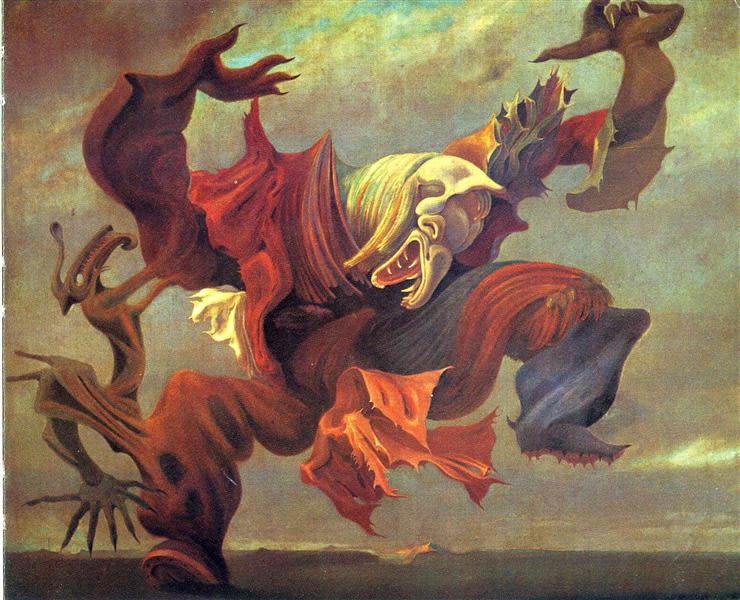
In this famous painting by Max Ernst, the composition presents a creature as one of the most menacing, as its dynamic form commands the entire canvas against the backdrop of a threatening sky. The title, which positions this figure as a representation of an angel and also the triumph of the surrealist movement and a testament to Ernst's intelligence.
In 1924, this group was joined by other artists and literary figures, including the writers Paul Éluard, Robert Desnos, Georges Bataille and Antonin Artaud; the painters Joan Miró and Yves Tanguy; the sculptors Alberto Giacometti and Meret Oppenheim and the filmmakers René Clair, Jean Cocteau and Luis Buñuel. Breton was notoriously inconsistent about who he admitted to the movement, and he had the habit of excommunicating members he no longer shared his particular vision of surrealism. Desnos and Masson, for example, were expelled from the group through the "Second Manifesto of Surrealism", by Breton, in 1930, for their reluctance to support his political goals. Bataille, whose surrealist viewpoint differed significantly from Breton's, went on to form his own influential dissident group, the College of Sociology, which published periodicals and exhibitions throughout the 1930s.
To understand the rest of this journey, continue to our next article: Surrealism, Artistic Movement: Global Expansion and Contemporary Artists.


