
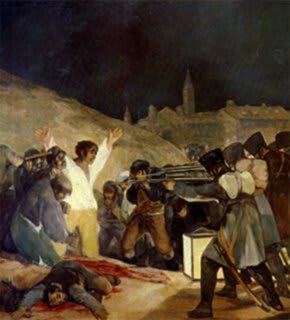
The Third of May 1808 - Francisco de Goya
Discover the significance of The Third of May 1808, a masterpiece by Francisco de Goya
I invite you to explore The Third of May 1808 by Francisco de Goya, one of the most impactful works in the history of art.
Painted in 1814, this masterpiece depicts the execution of Spanish rebels by French soldiers during the French occupation of Spain.
Goya employs his masterful technique to create a scene of great dramatic intensity and emotion, highlighting the brutality of conflict and the vulnerability of individuals in the face of military power.
Upon observing The Third of May 1808, we are confronted with the cruelty of war and invited to reflect on themes such as violence, resistance, and historical memory.
One of the most impressive works in Francisco de Goya's career
Notably for its immense dramatic charge.
The painting describes the firing squad of Spanish citizens who had rebelled against the French occupation liberated by Napoleon Bonaparte in 1808.
According to Goya, this painting aimed to "perpetuate with the brush the most heroic and notable actions of our glorious insurrection against tyranny."
At night, a line of soldiers whose faces are not visible, prepares to fire.
Between the condemned to death, the expressions range from defiance to desperation.
But the most striking figure is that of a man kneeling, opening his arms awaiting his tragic fate.
Goya does not show his compatriots in giantism, nor does he exaggerate by showing caricatured French soldiers.
The strength of the canvas lies in its own content.
The horror of the scene itself perpetuates the bravery of the men who will be killed and condemns the bestiality of the French military.
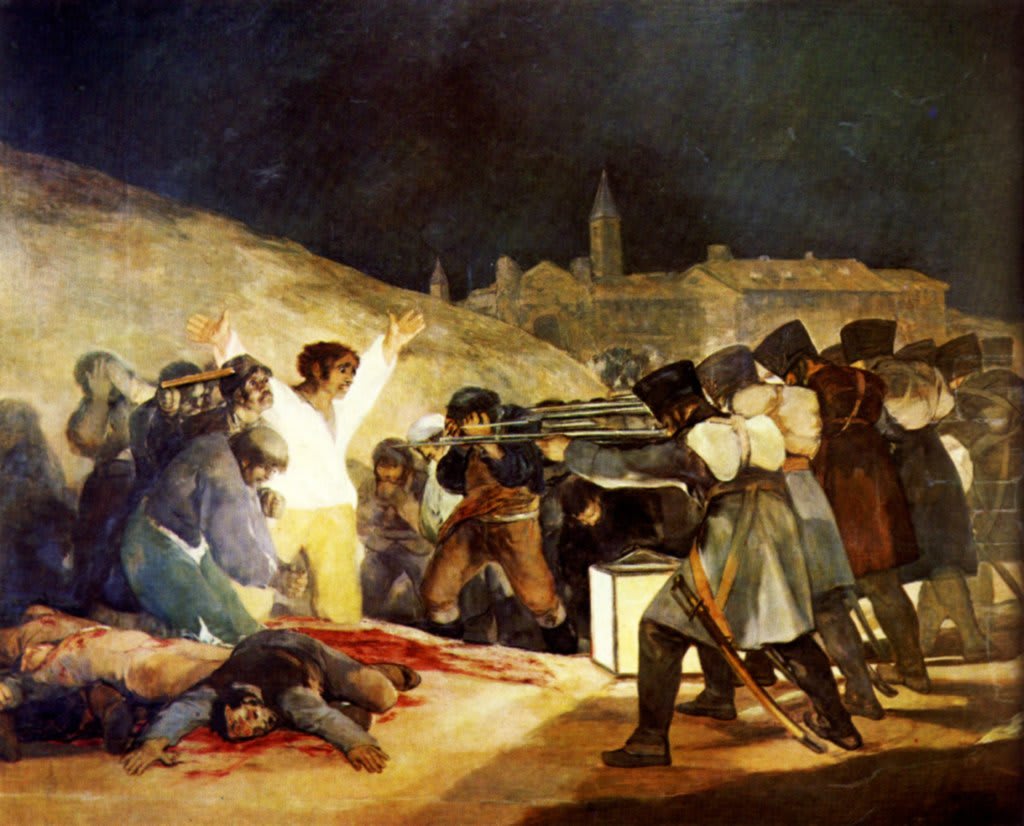
The strongest and most expressive brushstrokes are notably revealed in the clothes of the Spanish.
Especially in the figure of the central martyr and his companion with his head between his hands.
The French are painted with neutral and more uniform colors.
In this way, Goya shows his sympathy for the Spanish.
A historical document
Follow a video to complete the reading of this work, which, like Guernica, by Pablo Picasso, is also a historical document.
The Spanish Francisco José de Goya y Lucientes was born on March 30, 1746.
In Fuendetodos, the city of Aragão.
One of the most important painters of the 19th century, of the movement known as Romanticism.
He died in April 1828, in the city of Bordeaux.
Follow a video to complete the reading of this work:


