
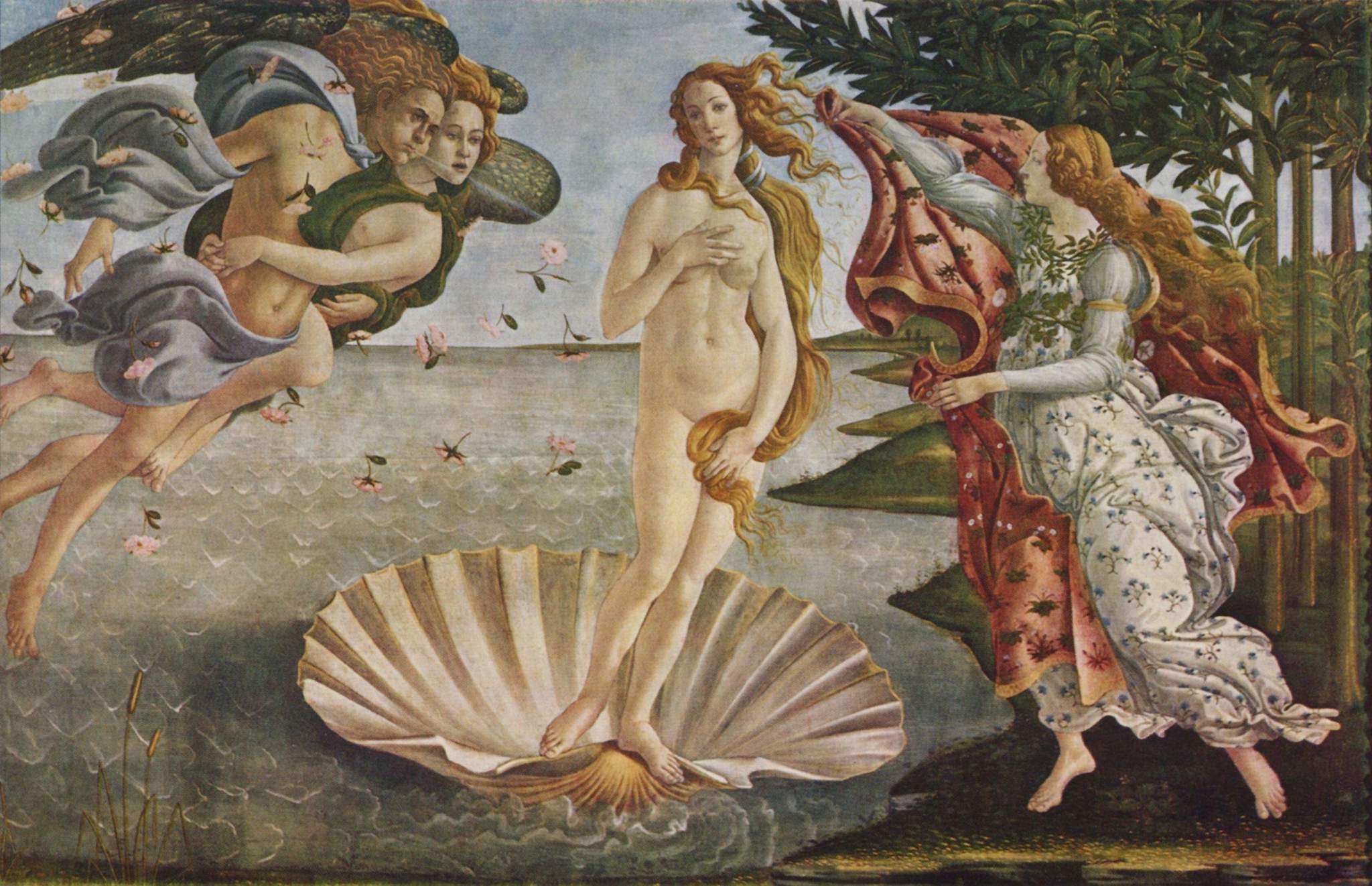
The Birth of Venus - Sandro Botticelli
The Birth of Venus - Sandro Botticelli
Article Index
The Birth of Venus is an important work produced during the Renaissance, a period that marks the transition from the Middle Ages to the Modern Age.
The work pays a clear homage to classical art. Botticelli's reference to classical sculpture in the pose of Venus is evident, as she stands in counterpoint to the weight of one foot, a preference of classical Greek and Roman art and imitated by the first artists of the Italian Renaissance.
Its author, Alessandro di Mariano di Vanni Filipepi, was born in Florence, Italy. As he was a bit chubby, he earned the nickname of Sandro Botticelli, because Botticella means small barrel in Italian. He learned painting very early and stood out from the artists of his time, who saw art as a science, as did Leonardo da Vinci for example. In his works, he revealed the beauty and harmony of nature.
READING THE WORK - The Birth of Venus
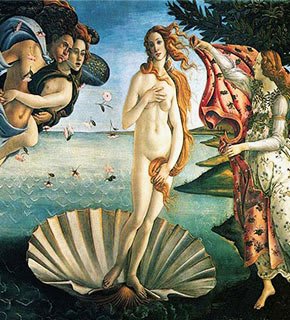
The Birth of Venus presents the story of the creation of the goddess of beauty and love. Venus emerges from the sea and is carried to the shore by the Greek gods of the winds and received on land by a nymph, goddess of the forest. The female figure emerges naked trying, but in vain, to preserve her modesty with her hands and her long hair that covers her genitals.
The painting describes a moment of the Greek myth in which Cronus cuts the genitals of Uranus and throws them into the sea.Venus, or Aphrodite, emerges fully formed from the foam of a wave carried by a shell, the goddess arrives at the coast in Cyprus.
In the work of Sandro Botticelli, which extracts its images from a 15th-century poem by Agnolo Poliziano, describes Venus who is driven by the gentle breeze of Zephyr, the west wind, and balances on a giant scallop shell. A young woman, perhaps Hour of Spring or one of the Three Graces, runs to meet her, offering a cloak sprinkled with flowers.
The Birth of Venus has become a reference for a standard of beauty. The image has been used infinitely as a marketing tool, parodied and leveraged to mean quality and culture.
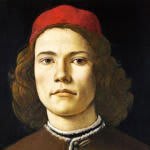
Sandro Botticelli, born around 1445. He had his first mural completed with Fra Filippo Lippi, one of the main painters of Florence. The young man quickly became the favorite of the Medici family around 1470.
The Pope Sixtus IV hired him to decorate the newly completed Sistine Chapel in Rome.
In his last years, his work became entirely religious and stylized, losing his idealized naturalism previously. It was during this time that the artist became a devoted follower of a fanatical reformist preacher; he may have even renounced his previous non-religious paintings.
He died in Florence on May 17, 1510.


