
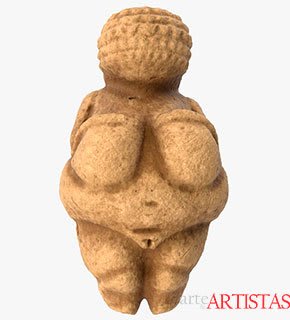
Venus of Willendorf
Venus of Willendorf
The Venus of Willendorf, also known as the Woman of Willendorf, is a female sculpture dating back to the Upper Paleolithic period. It earned its name after being discovered in Willendorf, a village in Austria, in 1908.
This sculpture stands as a prime example of Upper Paleolithic art, a period marked by significant artistic and cultural evolution for humanity.
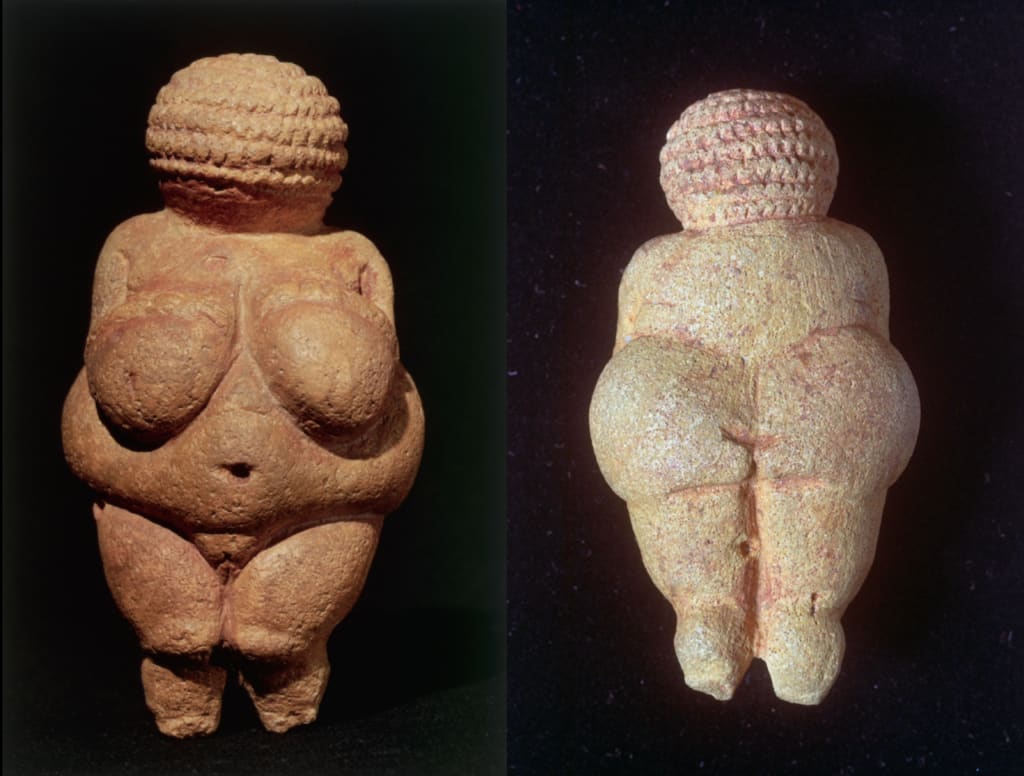
The material from which it was crafted (oolitic limestone stained with red ochre pigment) is not typically found in the region.
Measuring around 11 cm (4.4 inches), it could easily fit in the palm of a hand, suggesting that its sculptor, or perhaps its owner, could carry it during their frequent nomadic journeys in search of food, which is how it eventually came to Willendorf.
Much of the art from this period was created in caves, where people sought refuge from invasions and attacks by wild animals.
Beyond cave paintings, they also crafted decorated objects and sculptures, particularly those depicting voluminous female forms.
The materials employed included rocks, bones, or wood.
It is believed that these sculptures were used in rituals associated with fertility and sexuality.
There are no facial features depicted on the Venus of Willendorf, and this absence is as enigmatic as the lack of attention to limbs; eyes, nose, ears, and mouth are entirely absent.
Although a head is present, the only discernible detail is a pattern thought to represent braided hair or a cap.
Her arms, though visible, are remarkably insignificant, seeming to disappear beneath the voluminous breasts. Her feet have not been found and likely were never part of the original design.
The Paleolithic sculptor may have intentionally created this faceless figure not as a specific individual, but rather as a representation of a woman's reproductive aspects. The exaggerated breasts, belly, and vulva lead us to believe that the true purpose of the Venus of Willendorf is deeply connected to fertility.
Regardless of the piece's specific function, it's crucial to acknowledge that the peoples of the Paleolithic era were aware of women's importance, and the Venus of Willendorf holds a significant place in the Universal History of Art.
This sculpture serves as a testament to the skill and creativity of Paleolithic peoples, embodying the vital role art plays in expressing human culture and identity.
Indeed, the Venus of Willendorf is one of the world's most renowned sculptures, widely regarded as an icon of prehistoric art.


