
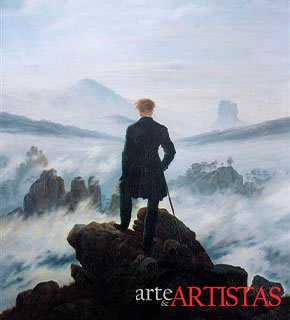
Wanderer above the Mist - Painting by Caspar David Friedrich
Wanderer above the Mist - Painting by Caspar David Friedrich
This is the magnum opus of German painter Caspar David Friedrich, considered one of the most important works of Romanticism. Friedrich is known for making political statements in his paintings, often encoded in subtle ways.
With a career marked by works that reflect his passion for nature, he became one of the leading representatives of German art in the 19th century.
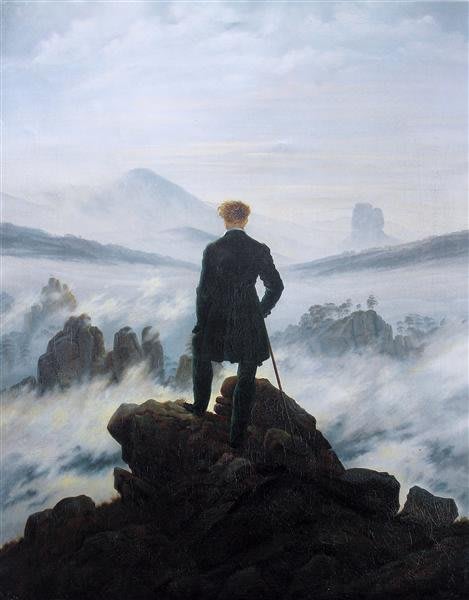
The famous painting is sometimes also known simply as Fog Sea, depicts a solitary man, formally dressed and holding a staff, standing on a rocky outcropping looking out at an expanse that is difficult to explore.
As the man contemplates the vastness before him, the sublimity of nature is demonstrated not in a calm and serene view, but in the pure power of what natural forces can achieve.
By deliberately depicting the figure in this attire, he made a visual statement, although discreet, against the current government, as the represented attire was worn by students and others during the Wars of German Liberation. At the time the painting was created, this attire was prohibited by the new German government.
This painting is a perfect example of how art can be used as a tool of political expression, without necessarily being explicit.
The political nature of this work did not stop there. His works, especially this painting, were adopted and abused by the Nazi regime as symbols of intense German nationalism.
As Friedrich substituted the more literal illustration with merely suggestive messages, his paintings were easily reinterpreted to fit new political intentions.
It was only in the second half of the 20th century that his work was seen and appreciated without the taint of Nazism.


