
Carybé: His Life and Work — Consolidating a Legacy in Bahia
Carybé: His Life and Work — Consolidating a Legacy in Bahia
Deeply enamored with Bahia, painter Carybé established Salvador as his permanent home in 1950, a city that would become the vibrant canvas for his most beautiful and significant works.
This marvelous city nurtured many of his masterpieces, works that continue to captivate admirers across the globe.
In 1952, he received an invitation for a significant project in São Paulo: collaborating on Lima Barreto's classic film, 'O Cangaceiro', where Carybé served as artistic director, draftsman, and even an extra.
This experience proved pivotal for his career, propelling him towards even more ambitious projects.
In 1953, his second daughter, Solange, was born in Salvador.
Carybé's personal and professional life flourished, and he continued to craft artworks that captivated all who beheld them.
In 1955, he showcased his work at the III Bienal de Arte de São Paulo, earning the 1st National Drawing Prize. Six years later, at the VI Biennial in 1961, he was celebrated with a Special Room dedicated to his oeuvre.
His journey mirrors the paths of other iconic figures who shaped the country’s modern aesthetic after arriving on Brazilian shores. Tomie Ohtake - Biography and Art: A Journey from Immigration to Abstraction
Far from resting on his laurels, these accolades only spurred him to push artistic boundaries further, achieving new pinnacles of excellence.
The 1960s were a period of remarkable output: he published the books As Sete Portas da Bahia and O Olho do Boi; exhibited his work in Baghdad and Rome; created numerous panels across Salvador, Rio de Janeiro, and Recife; and embarked on a significant collaboration with writer Gabriel Garcia Marques, becoming the official illustrator for his books from that point forward.
This partnership with Gabriel Garcia Marques proved to be one of Carybé's most celebrated achievements, cementing his reputation as one of the author's foremost illustrators.
The 1970s saw the artist participate in and win a gold medal at the 1ª Exposição de Belas Artes Brasil-Japão (1st Brazil-Japan Fine Arts Exhibition), held across São Paulo, Rio de Janeiro, Brasília, Tokyo, and Osaka. He also published his inaugural album of woodcuts, began illustrating books for Jorge Amado, and completed two sculptures for Rio de Janeiro's Galeão International Airport.
These accomplishments further elevated Carybé's renown, establishing him as a preeminent figure in Brazilian art.
The 1980s were replete with awards and honors, kicking off in 1981 with a major celebration for his 70th birthday in Salvador's iconic Largo do Pelourinho.
In 1982, the Universidade Federal da Bahia (Federal University of Bahia) bestowed upon him the prestigious title of Doutor Honoris Causa. That same year, he collaborated with Rubem Braga to publish 'Uma Viagem Capixaba'.
These further accolades only fueled his creative drive, inspiring him to explore new realms of artistic excellence.
In 1984, he exhibited his work in Mexico and the United States. Two years later, in 1986, Salvador hosted a significant 50-year retrospective of his oeuvre, spanning from 1936 to 1986.
This retrospective stood as a monumental achievement for Carybé, cementing his status as one of Brazil's most pivotal artists of all time.
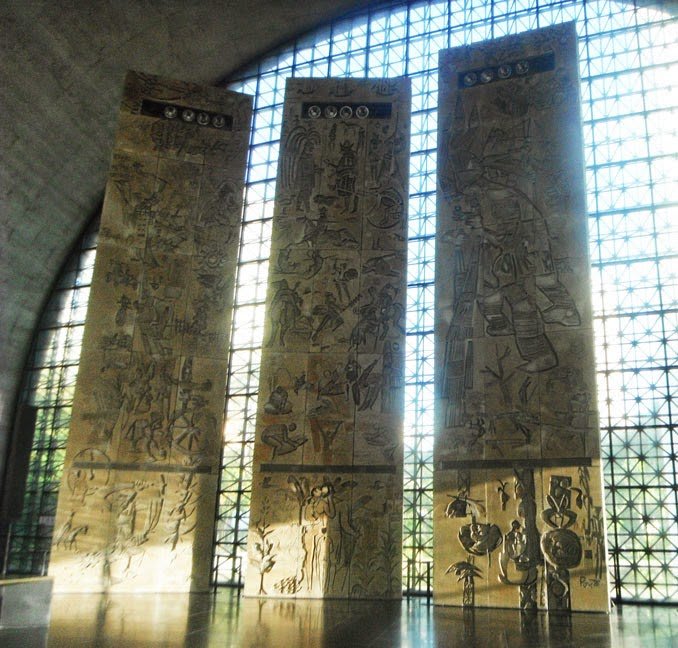
In 1988, alongside artist Poty, he created a series of six panels that form an integral part of Portinari's mural decoration commemorating Tiradentes. These panels are housed in the Assembly Hall of the Memorial da América Latina (Latin America Memorial) in São Paulo. Each of the six exposed concrete panels, meticulously carved in bas-relief and measuring 4.00 x 15.00m, powerfully depicts the Pre-Columbian Peoples, Afro Peoples, Conquistadors, Immigrants, Liberators, and Builders.
These iconic panels are considered among Carybé's paramount masterpieces and rank among Brazil's finest artistic achievements.
The roots of this shared legacy can be better understood through the trajectory of his notable collaborator on these monumental murals. Biography of Candido Portinari: Childhood, Art, and the Roots of Brodowski
In 1989, he mounted a significant solo exhibition at the Museu de Arte de São Paulo (MASP), coinciding with the launch of his book, 'Carybé'.
This solo show marked another crowning achievement for Carybé, further solidifying his place as one of Brazil's most influential artists.
Throughout the 1990s, even in his eighties, Carybé continued to exhibit and travel extensively. Notably, he contributed to the numerous tributes celebrating Jorge Amado's 80th birthday, participating in exhibitions honoring his dear friend and collaborator.
Carybé's life was a testament to prodigious achievements and widespread acclaim, securing his legacy as one of Brazil's most enduring artistic figures.
During this era of intense cultural growth in Brazil, other visionary artists were also redefining the limits of contemporary expression. Hélio Oiticica and His Main Works
In 1992, he journeyed to Germany with his wife, Nancy, for a solo exhibition at the Festival de Hamburgo (Hamburg Festival). That same year, he showcased ten Orixás panels at the Centro Georges Pompidou, and his painting "São Sebastião" was acquired by the prestigious Museu do Vaticano (Vatican Museum).
These international exhibitions represented significant milestones for Carybé, further cementing his place among Brazil's most celebrated artists.
He passed away in his beloved Salvador on October 1, 1997.
To delve further into this remarkable journey, explore our next article: Carybé: His Life and Work — A Detailed Look at His Major Creations.


