
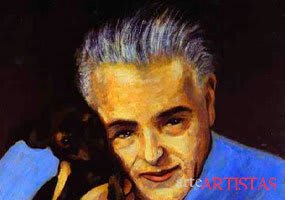
Francis Picabia
Francis Picabia was a prominent French avant-garde artist, painter, and poet, a key figure in various 20th-century art movements, including Cubism, Dadaism, and Surrealism.
Article Index
Francis Picabia was a prominent French avant-garde artist, painter, and poet, a key figure in various 20th-century art movements, including Cubism, Dadaism and Surrealism. He effortlessly shifted between abstraction and figuration in an era when artists adhered to a single approach, and his cheerful disregard for modern art conventions encouraged notable innovations later in his career.
BIOGRAPHY
Francis Picabia was born on January 22, 1879, in the city of Paris, France. He came from a wealthy family and received early artistic education of high quality. His artistic talent manifested itself from a very young age. His uncle was an art lover and collector who facilitated the young Picabia's interests by surrounding him with works by French classical painters. His grandfather, an amateur photographer, taught his grandson photography, which he would later use to assist his work.
In 1894, at 15, he began studying at the Paris Decorative Arts School. His artistic style evolved over his career, and he experimented with various forms and movements.
In the first decade of the 20th century, Picabia adhered to the Cubist movement and developed friendships with important figures like Pablo Picasso and Georges Braque. However, he did not limit himself to a single style and instead adopted an eclectic approach to art. He actively participated in Parisian artistic life and collaborated on various avant-garde magazines.
During World War I, he joined the Dadaist movement, a group of artists challenging conventions and advocating for anti-art. He actively contributed to Dadaist publications, such as the "291" and "Dada", and produced works that defied established norms.
Picabia left France to seek refuge first in Barcelona, then in New York, and later in the Caribbean. The war led him to find a new style representing the era of industrialization.
In the 1920s, Picabia distanced himself from Dadaism and began exploring surrealism. His style became more figurative, and his work was characterized by often ironic representations of contemporary society and culture.
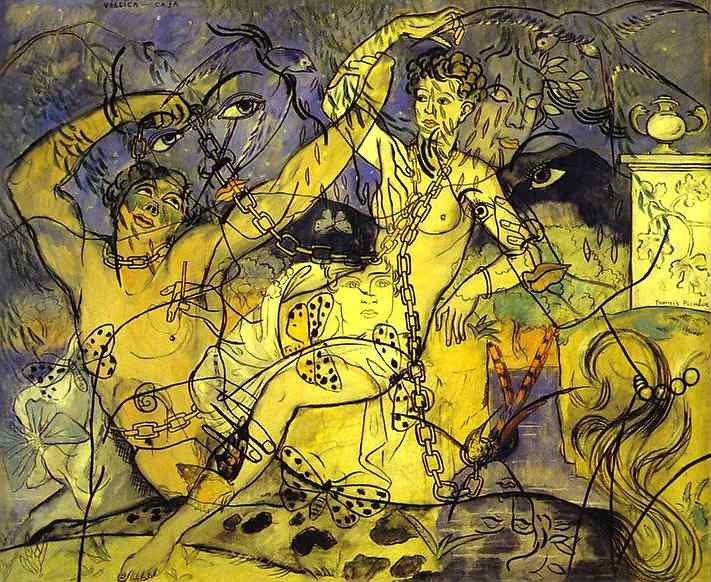
In 1928, Picabia presented his paintings Transparency at the Theophile Briant Gallery. The series received warm praise from his peers, especially from Marcel Duchamp. His then art dealer, Leonce Rosenberg, described it as "the association of the visible and the invisible... It is this notion of time added to that of space that constitutes precisely the doctrine of his art. Beyond instantaneity towards infinity, that is his ideal."
While living in Cannes, he was a celebrity among local residents, receiving frequent visits from famous friends. During this period, he also enjoyed his wealth, taking pleasure in giving lavish parties, playing, and collecting luxury cars and yachts.
In 1939, when World War II began, the devastation affected him, and his lifestyle became quite modest. For the first time in his life, his primary source of income came from selling his paintings.
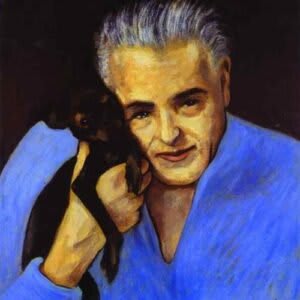
In 1940, Picabia married Olga Mohler. As always, a significant event in his life led to a change in his painting style. Many say that his paintings from this period had purely commercial value. He painted popular images from women's magazines of movie stars and romanticized couples in a realistic style.
After the war, he was arrested by French authorities on allegations that he was a friend of the Nazi French government during the war. He was soon released and never convicted, but his reputation was damaged. There were several statements made by him during the war that could be considered fascist, but as he was always a playful personality, it is difficult to determine his position at the time.
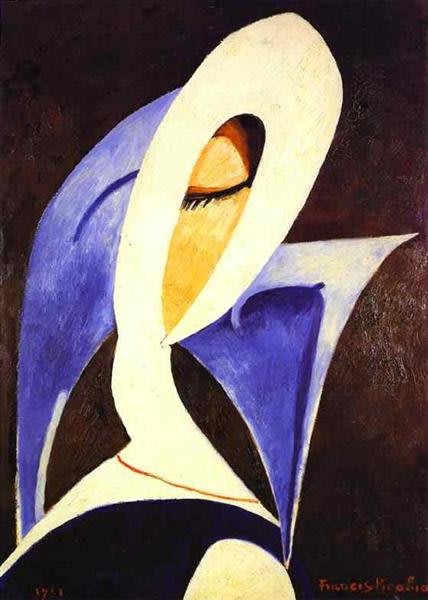
At the end of his long career, Picabia changed his style once more, painting in abstract forms. He continued to exhibit his work in important Parisian galleries and published his writings until 1951, when he suffered from arteriosclerosis and could no longer paint. Before his death in 1953, he referred to the writing of Friedrich Nietzsche "Where art ends, where life begins, I am the poet of my life."
Throughout his life, Francis Picabia continued to evolve artistically and challenge the expectations of the art world. He learned early on that abstraction could be used to evoke not only qualities of machines but also mystery and eroticism. This ensured that abstract painting would be one of the pillars of his career. He returned to it even in his later years, attributing his inspiration to the obscure recesses of his mind, as he always had.
He died on November 30, 1953, in Paris. His legacy endures as an example of diversity and experimentation in artistic creation, and Picabia continues to be revered by contemporary painters as one of the most intriguing and enigmatic artists of the 20th century.
GALLERY
ART WORK READING
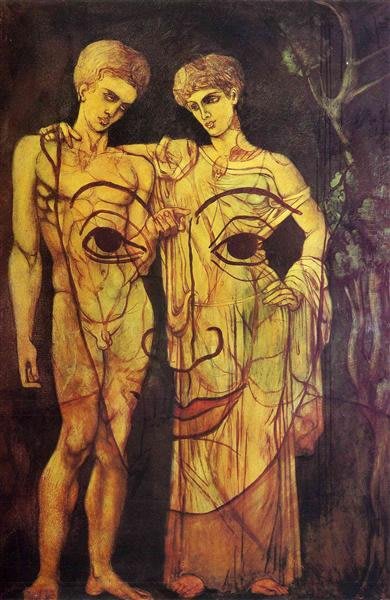
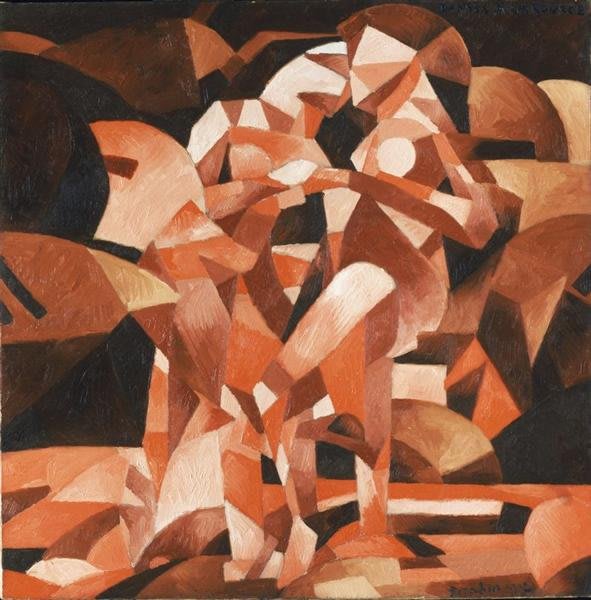
This enigmatic painting is part of Picabia's Transparency series, whose dreamlike quality derives from layers of images that vaguely suggest strange narratives. Although the title of this painting is Adam and Eve, it was inspired by Orestes and Electra, a classical Greek sculpture from the Naples Museum, depicting Electra and her brother considering revenge against their mother and stepfather for the murder of their father, Agamemnon. Classic themes like this were popular during the interwar period, but most artists tried to give new life to Classicism by adapting it to modern times. Picabia rejects this temptation, leaving the statue enigmatically covered with a smiling face and leaving us with a mystery. This shock of images from seemingly different sources would be a great inspiration for later artists.


