
Monte Sainte-Victoire - Paul Cézanne
Monte Sainte-Victoire - Paul Cézanne
Monte Sainte-Victoire is one of the most important works by the French artist Paul Cézanne. His painting influenced many artists of the 20th century, such as Pablo Picasso for example.
By painting numerous landscapes, Cézanne realized that these natural forms could be reduced to just three basic shapes: the cone, the cube, and the cylinder.
Paul Cézanne is the precursor to cubism.
The emotional ties of Paul Cézanne with the landscape gave new meaning to the representation of objects.
His vision of the imagined thing is recreated in the luminous and transparent representation.
A Journey Within
The peak of Monte Sainte-Victoire near Aix attracted Cézanne throughout his life.
He identified with it as the ancient people did with a sacred mountain where they established the dwelling or birthplace of a god.
Only for Cézanne, it was an inner god that he revealed on this mountain peak - his struggle, exaltation, and desire for rest.
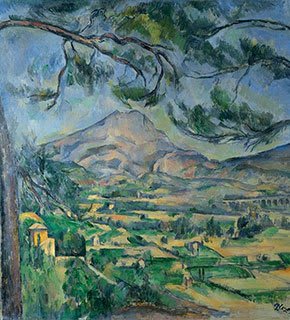
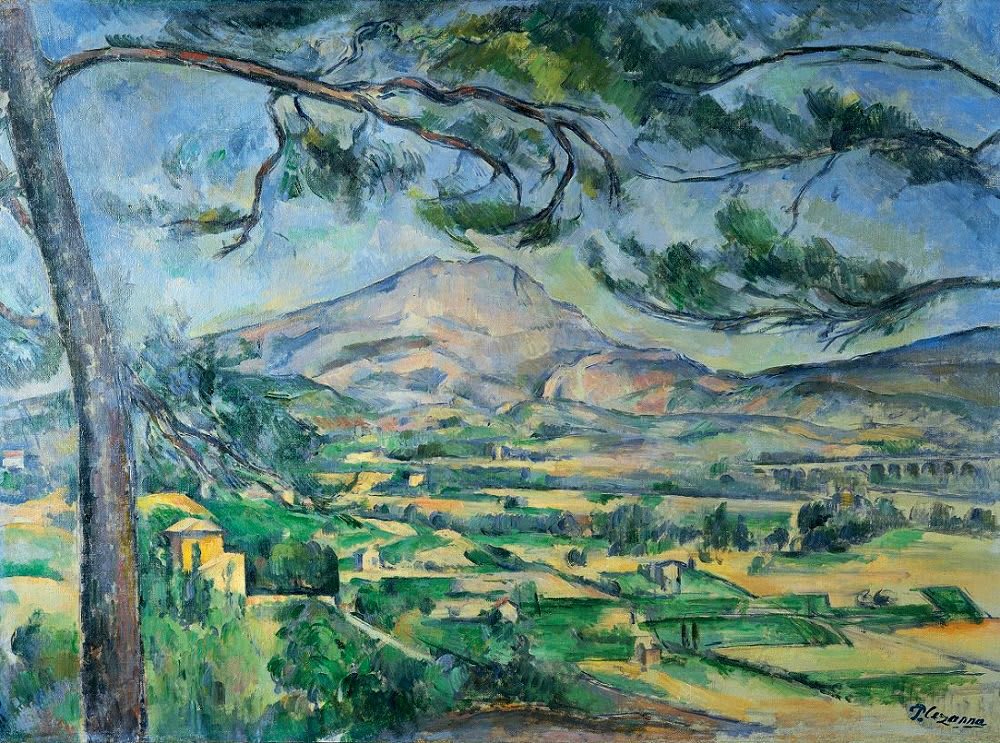
In this work, the mountain is diminished by the trees in the foreground and the large expanse of the valley to the right.
The stable mountain is framed by Cézanne's tormented heart, and the peak itself, though serene, is traversed by restless forms, like the swaying branches in the sky.
An Innovative Technique
This intimate connection of Cézanne with nature is evident in his paintings, where he sought to capture not only the physical form of objects but also the emotional and spiritual essence he saw in them.
His carefully planned brushstrokes and unique use of color and light transformed the way the world viewed art, influencing generations of artists to come.
The technique of leaving areas blank in his paintings, far from being a flaw, was a conscious choice to create a sense of depth and luminosity.
These empty spaces served as a kind of bridge between the different parts of the painting, inviting the viewer to immerse themselves in the scene and experience the same sense of awe and reverence that Cézanne felt for nature.
A Symbol of Identity
The Monte Sainte-Victoire was not just a mountain for Cézanne, it was a symbol of his own inner journey.
He saw in the mountain not just a physical object, but a reflection of his own soul, with its peaks and valleys, its areas of light and shadow, its stable and restless parts.
By painting the Monte Sainte-Victoire repeatedly, Cézanne was not only capturing the beauty of the landscape, but also exploring the mysteries of his own mind and heart.
Thus, each brushstroke of Cézanne was not just an act of artistic creation, but also an act of self-expression and self-discovery.
His paintings were not simple representations of nature, but rather windows into his own soul, inviting us to contemplate not only the beauty of the world around us, but also the inner beauty that we all carry within us.


