
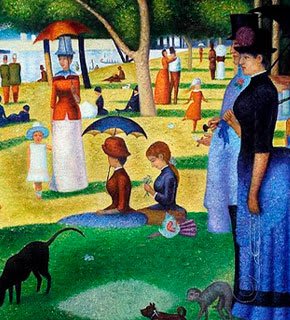
Sunday Afternoon on the Island of La Grande Jatte
Sunday Afternoon on the Island of La Grande Jatte, Georges Seurat
Sunday Afternoon on the Island of La Grande Jatte is the most important painting by the French artist Georges Seurat. Gigantic, the oil on canvas measures 2.08 x 3.08 meters, belonging to the neo-impressionist movement.
When Georges Seurat first presented this work to the public at the Maison Dorée in 1886, the commotion was immediate. The theme of the canvas was not new: a group of Sunday excursionists from various social classes. What caused the most surprise was the technique developed by the artist.
Many painters, including Camille Pissarro and Paul Signac, showed great enthusiasm for the new technique, which, however, was not very simple.
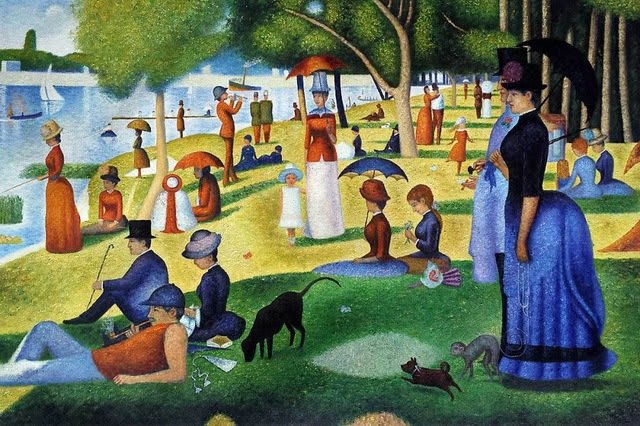
Seurat sketched outdoors and then, in his studio, patiently observed the colors produced by light on objects. Finally, he juxtaposed the color points meticulously, one next to the other. Thus, when contemplating the work from a certain distance, the observer could witness the optical phenomenon of chromatic fusion.
Specialists considered it the most correct demonstration of a new pictorial current. His partnership with Signac in the in-depth studies for the new technique led to the foundation and development of neo-impressionism, also known as pointillism or divisionism. Seurat himself preferred the term divisionism.
Dividing colors to produce special effects was attempted by many artists. Seurat was the first to fill meticulously every inch of his paintings with a whirlwind of small colored points. Seurat's visual language, his innovative and thoughtful interaction of colors, has the ability to synchronize our minds in a special state of consciousness, allowing us to see the fullness of images in the visual feast of this wonderful world.
Seurat profoundly influenced modern art with his scientific approach to color and light. His work not only transformed artistic technique but also influenced subsequent movements, such as Fauvism and Cubism. His meticulous technique and pursuit of optical perfection distinguish him as one of the most innovative and visionary artists of his time.
A New Pictorial Current
Neo-impressionism, also known as pointillism or divisionism, was a pictorial current that emerged at the end of the 19th century. Seurat was one of the main exponents of this current, characterized by the division of the canvas into small points of color.
This technique allowed for the creation of special effects and a sense of movement in the painting. Seurat was the first to fill meticulously every inch of his paintings with a whirlwind of small colored points.
Seurat's visual language, his innovative and thoughtful interaction of colors, has the ability to synchronize our minds in a special state of consciousness, allowing us to see the fullness of images in the visual feast of this wonderful world.
The Influence of Seurat on Modern Art
Seurat profoundly influenced modern art with his scientific approach to color and light. His work not only transformed artistic technique but also influenced subsequent movements, such as Fauvism and Cubism.
His meticulous technique and pursuit of optical perfection distinguish him as one of the most innovative and visionary artists of his time.
Conclusion
Seurat was one of the main exponents of neo-impressionism, a pictorial current that emerged at the end of the 19th century. His technique of dividing the canvas into small points of color allowed for the creation of special effects and a sense of movement in the painting.
His work profoundly influenced modern art and continues to inspire artists and art lovers to this day.


