
The Arnolfini Portrait - Jan Van Eyck
Explore the enigmatic Arnolfini Portrait by Jan Van Eyck, a masterpiece of the Early Netherlandish painting style.
Article Index
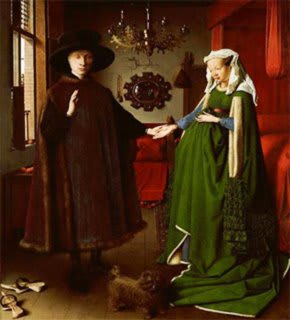
We invite you to appreciate the 'Arnolfini Portrait' by Jan van Eyck, one of the most iconic paintings of the 15th century.
Created in 1434, this masterpiece of the Flemish Renaissance depicts the Arnolfini couple in a richly decorated interior.
Van Eyck employed innovative oil painting techniques to create a highly detailed and realistic work, replete with symbolism and meaning.
The 'Arnolfini Portrait' is a landmark in art history, representing not only a portrait but also a testament to the life and customs of the time.
Upon observing this work, you will be transported to the sophisticated and intriguing world of 15th-century Europe, uncovering the mysteries and stories behind this fascinating image.
The Importance of the Arnolfini Portrait
The Arnolfini Portrait is an important painting by the Flemish artist Jan van Eyck, and also his most famous work.
It belongs to the period of the Renaissance.
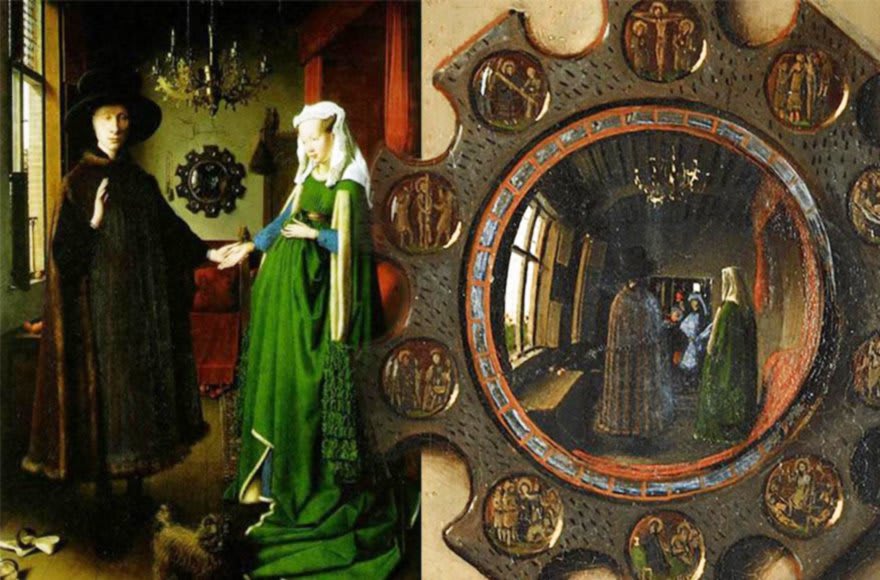
The painting depicting a couple in a room, sparks a lot of curiosity as it is heavily loaded with symbols, a resource used extensively during the period in which its author lived. It is also considered very ahead of its time, as it presents new concepts related to the perspectives explored in different planes in the painting in question.
With less than a meter in height, it is finely painted in radiant colors, and with a large number of artificial details, the canvas is saturated with hidden meanings.
Note the mirror in the background of the composition in which the entire scene appears inverted, just like the image of the artist himself. Check:
- By holding the young woman's hand in his and raising the other hand in the gesture that means taking a solemn oath, she in turn, places her hand in his, reciprocating the commitment;
- A single lit candle in full daylight is meant to symbolize Christ all-seeing;
- The dog is not just a pet, but represents loyalty;
- The crystal beads hanging on the wall and the mirror signify purity;
- The fruits on the window sill signify prosperity;
- The shoes indicate that the couple is treading on sacred ground and, consequently, they have removed their shoes;
- Although witnesses were not strictly necessary, they were present, and this is proven by the existence of the painting itself, which serves, to some extent, as a document attesting to the marriage;
- Above the mirror, the painter testifies to his presence in the scene, by writing "Jan Van Eyck was here", adding the date.
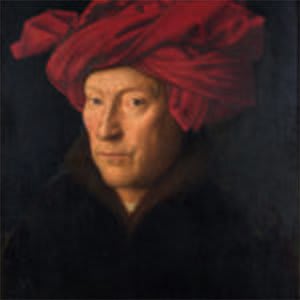
Jan Van Eyck was born in Belgium on July 9, 1390.
An important painter, also the founder of the late Gothic style, having great influence by the Northern Renaissance.
Specialist in detailing meticulous details and vibrant colors, as well as extreme precision in textures and the search for new systems of representation of three-dimensionality, or in other words, perspective.
He was the inventor of oil painting.
He died in Bruges, Belgium at the age of 51 in 1441.


