Wassily Kandinsky: The Legacy and Pioneering Works of Abstract Art
Discover the enduring legacy of Wassily Kandinsky, the 'father of abstract art', his philosophy on art, and explore a gallery of his most iconic works, understanding his revolutionary influence on modern painting.
Article Index
The genius dedicated his soul to painting the ceiling of the world's most famous chapel.

Surprisingly, he took over 4 years working in almost asphyxiating conditions.
GALLERY OF SOME WORKS
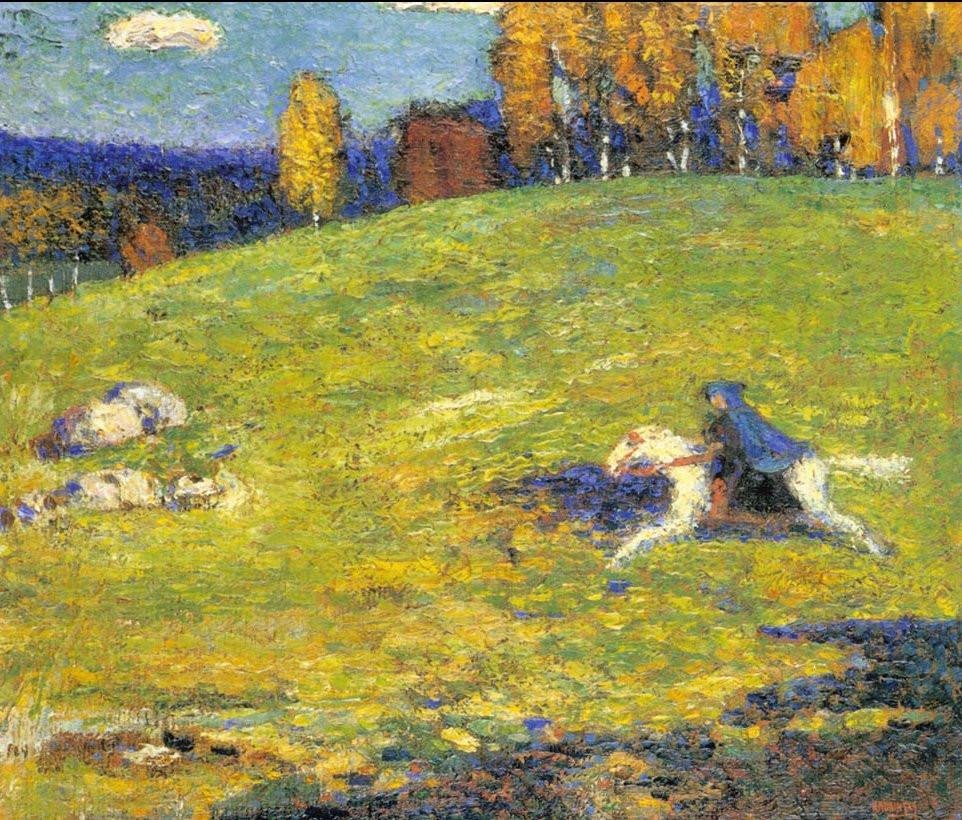
THE BLUE KNIGHT - This famous painting dates back to the Munich years, when the Russian artist was researching new image and color structures. The romantic image of the knight and his white horse galloping over the hill is the symbol of energy and dynamism. From it, he initiated the 'Der Blaue Reiter' (The Blue Rider) movement
Kandinsky’s creative shift during this era was shared by other influential artists of the German avant-garde. Gabriele Münter
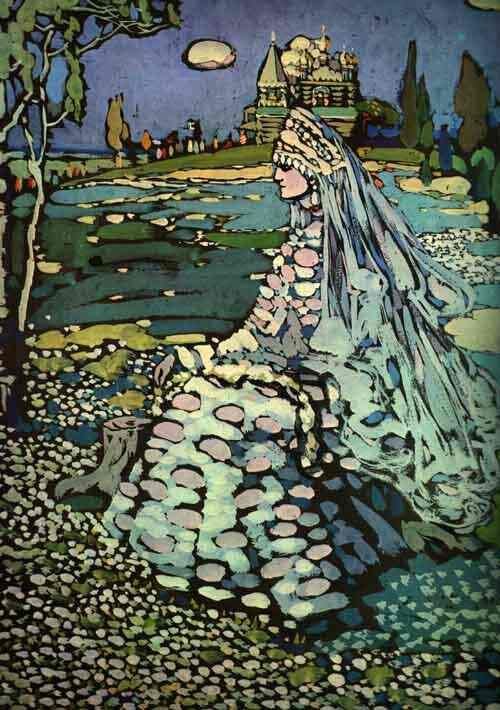
RUSSIAN BEAUTY IN A LANDSCAPE - From the II World War onwards, Kandinsky began to divide his paintings into three groups: Impression – Improvisation – Composition
This canvas, where romantic elements are found, belongs to the group of works from the early years of his career. The artist confesses: "At that time, I sought to express the musicality of the Russian landscape through straight lines and numerous small color patches".
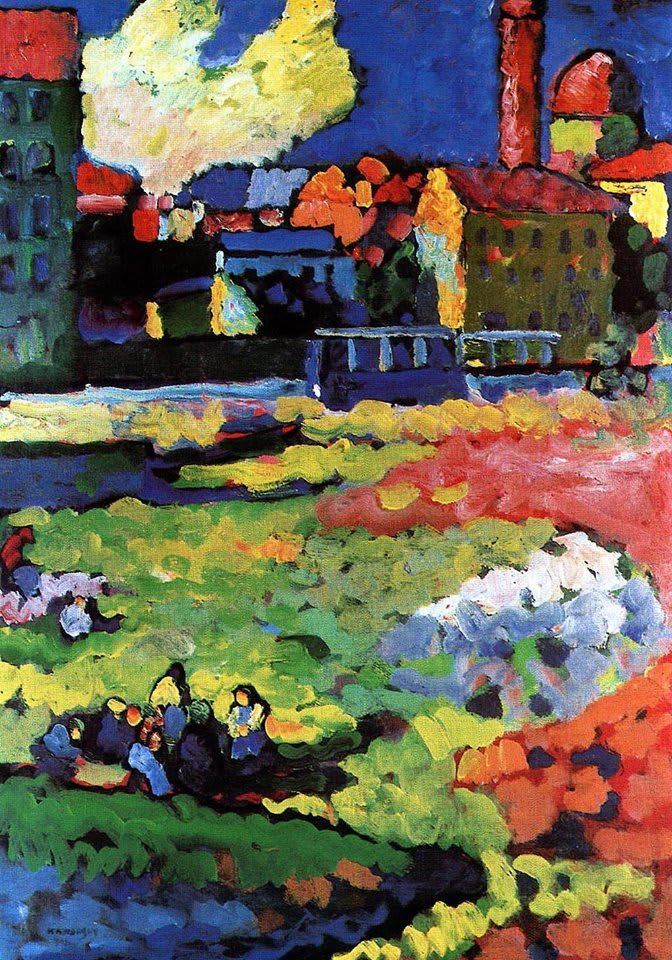
MUNICH WITH ST. URSULA CHURCH - At a time when traditional critics turned up their noses and considered impressionist paintings mere splatters of paint on canvas, Kandinsky was fascinated. The works of the impressionists and the so-called post-impressionists led him to create a new form of art. Thus, the seed of abstract art was planted, a form of expression that would have Kandinsky as a pioneer and one of its most ardent theorists.
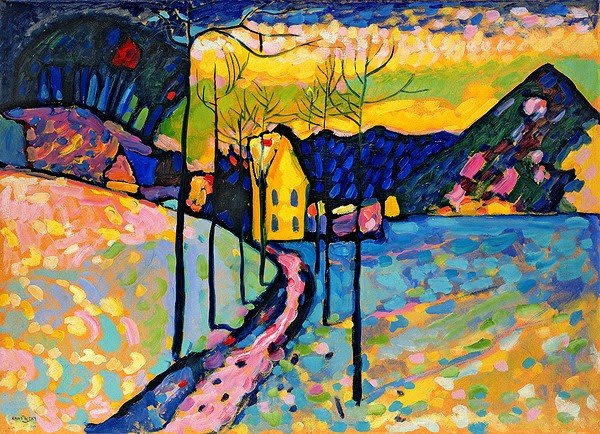
WINTER LANDSCAPE - Showing the influence of fauvist color in his early works, Kandinsky includes strong lines and contours, essential elements of his later abstract works.
This radical approach to color was part of a broader shift in European art that prioritized expression over representation. Fauvism
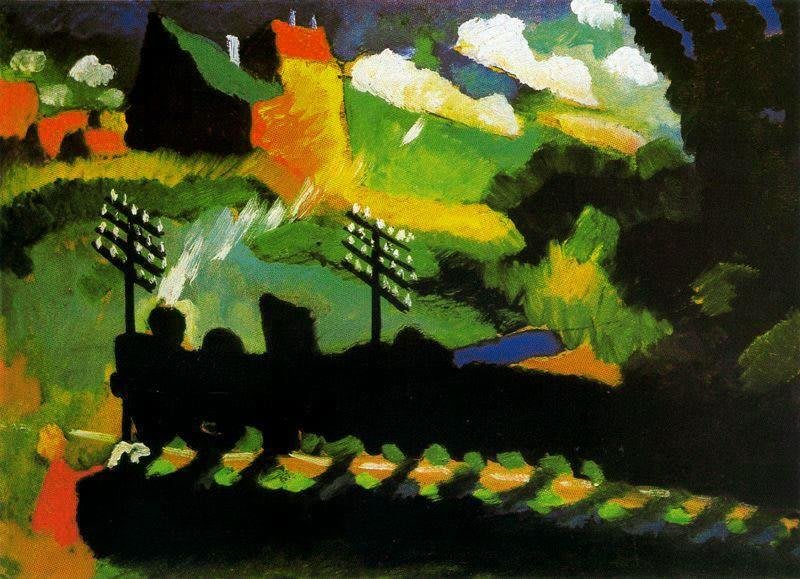
RAILWAY IN MURNAU - This is a work where we can observe the artist's progressive tendency towards abstract art. The houses, trees are no longer than lines; the color seems to want to stand out from its illustrative function to open up to improvisation. The movement is communicated by the black train that cuts through the multicolored landscape.
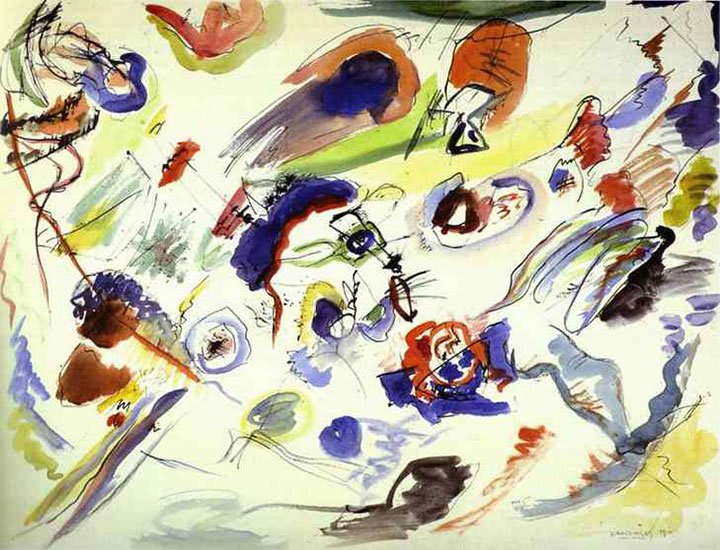
THE FIRST ABSTRACT WATERCOLOR - Through this watercolor by Kandinsky, he inaugurates definitively the historical cycle of non-figurative art. Some argue that, without a doubt, the artist had proposed to reproduce the first contact with the human being with the world that was unknown to him. The work results in a set of lines, colors, and shapes that refer to things without identity, but convey a perfect harmony between these elements used.
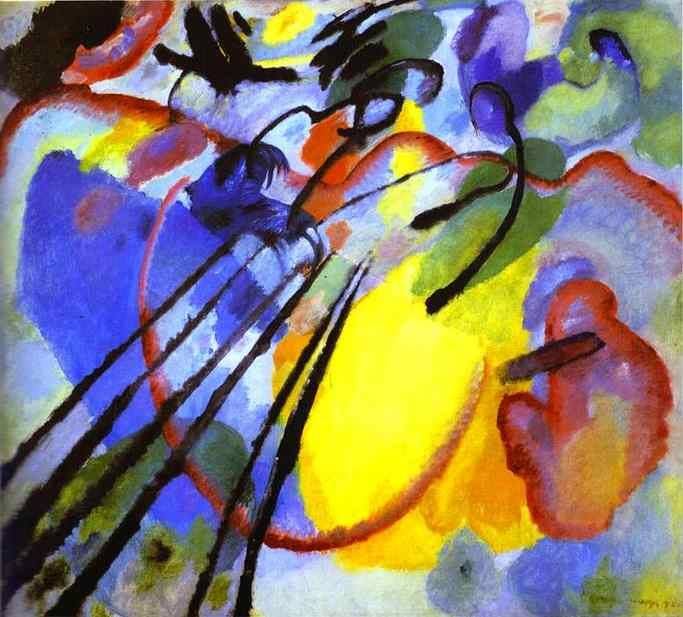
IMPROVISATION - You can follow, through the paintings made by Kandinsky between 1909 and 1912, the artist's progression towards abstraction. The known forms are translated into formulas, then into autonomous compositions, which open up and allow for the most varied associations. The mountains and trees become curved and sinuous lines; the animals, dynamic entanglements; the men, houses, fantastic figures. And although the color loses its illustrative function, representation gives way to 'composition' and 'improvisation'. The title itself is replaced by a simple number or a general indication.
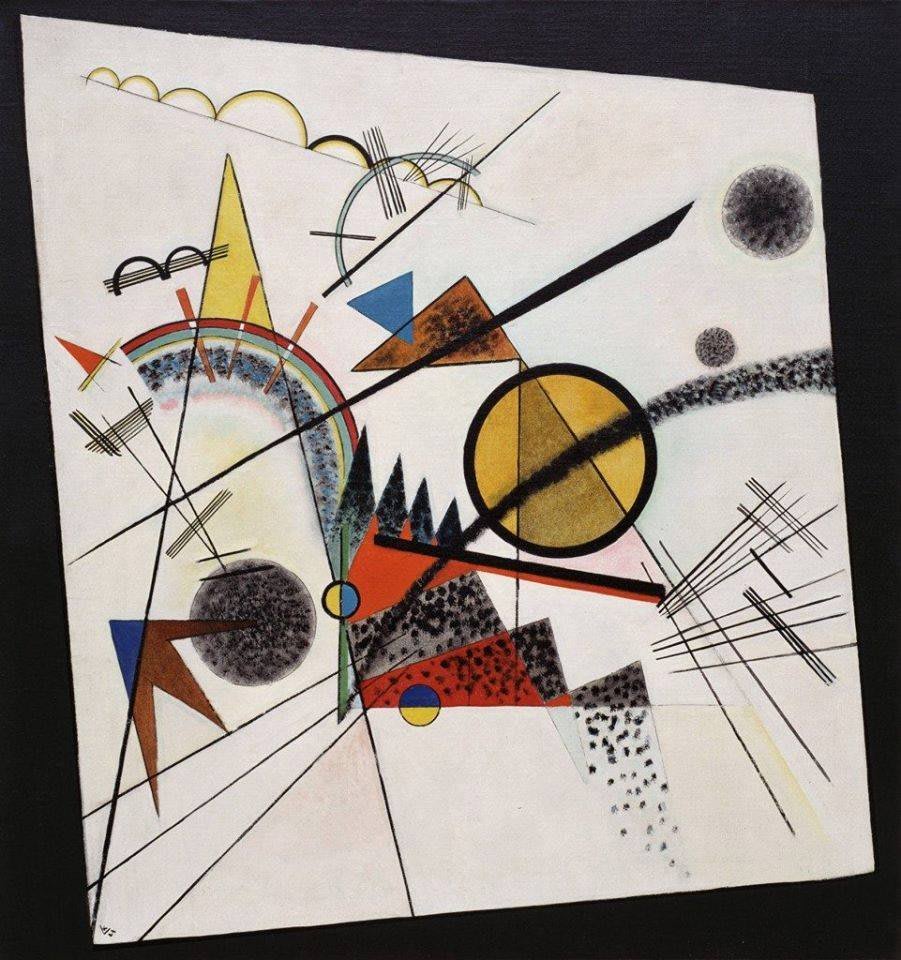
IN THE BLACK SQUARE - Around 1920, Kandinsky moves away from the dramatic manner of the previous period to explore a very different world: that of pure forms and clearly articulated colors. Elements more or less geometric become instruments.
Click here and get to know his most famous painting: YELLOW, RED, AND BLUE of 1925
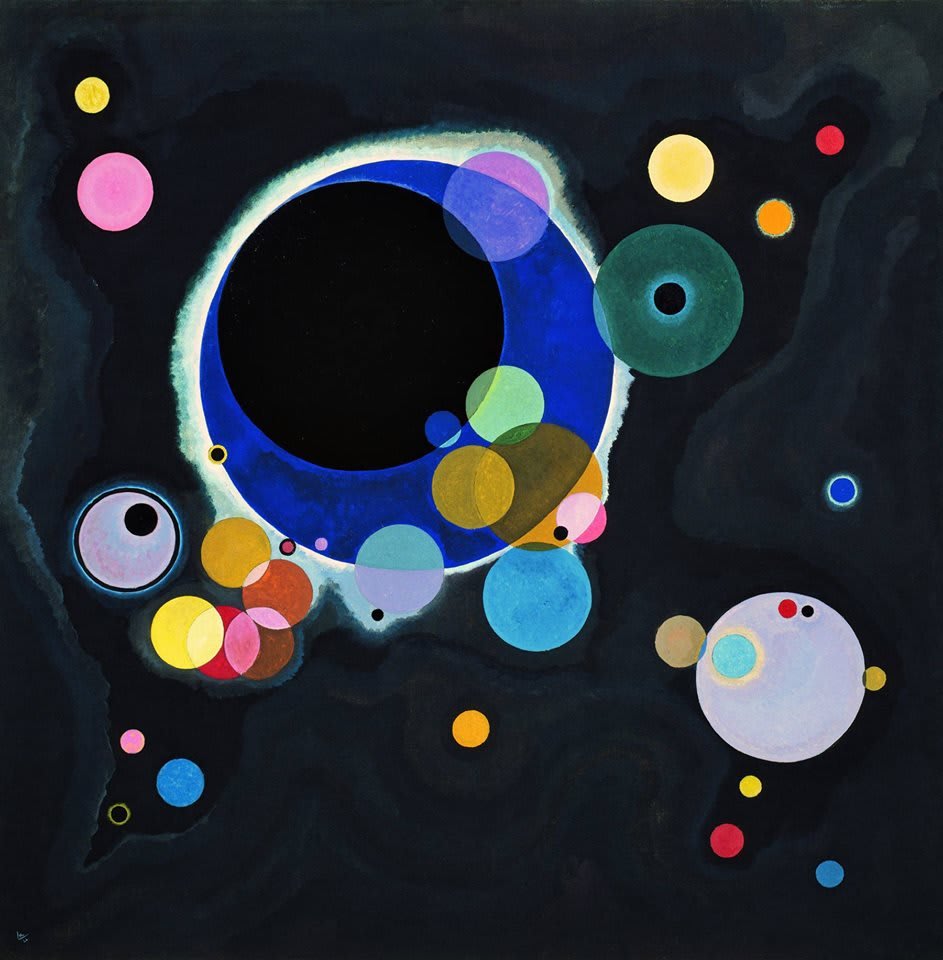
SOME CIRCLES - Theories of the Bauhaus research group privileged the study of the circle as "the symbol of eternity and the infinite", whose fundamental colors were red, blue, yellow, and violet. Regarding this, addressing a critic, Kandinsky wrote:
"... you noticed my preference for the circle. This simple, essential, and flexible form fascinates me because of its infinite possibilities...".
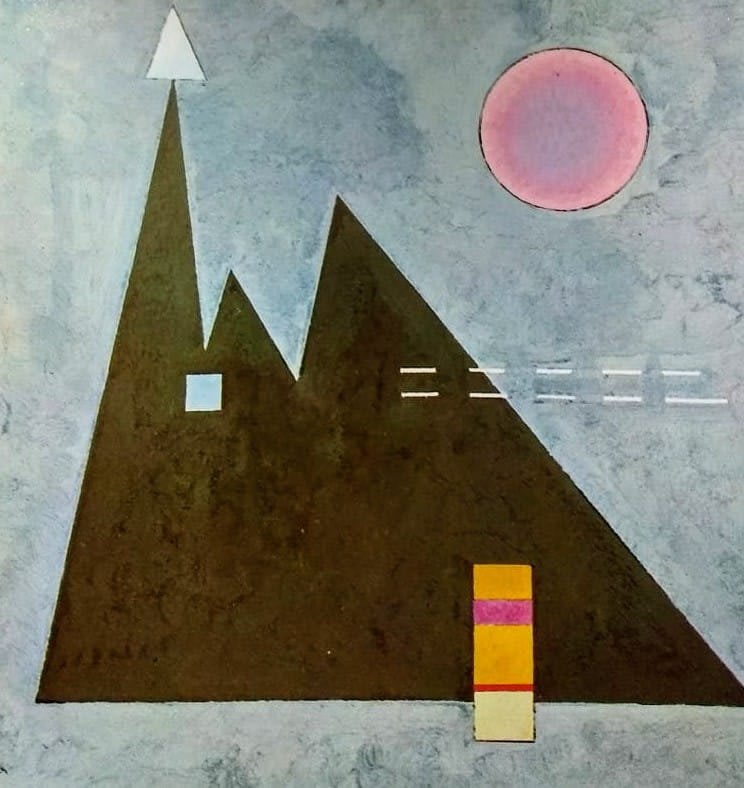
CUT IN SERENITY - Dark background, geometric forms, sober colors: these are the elements that characterize this canvas. This is a work that records once again the particular attention devoted to colors, which, for the artists of the Bauhaus, could be warm or cold, dynamic or passive, violent or sweet, having a beneficial or subversive effect on the observer,
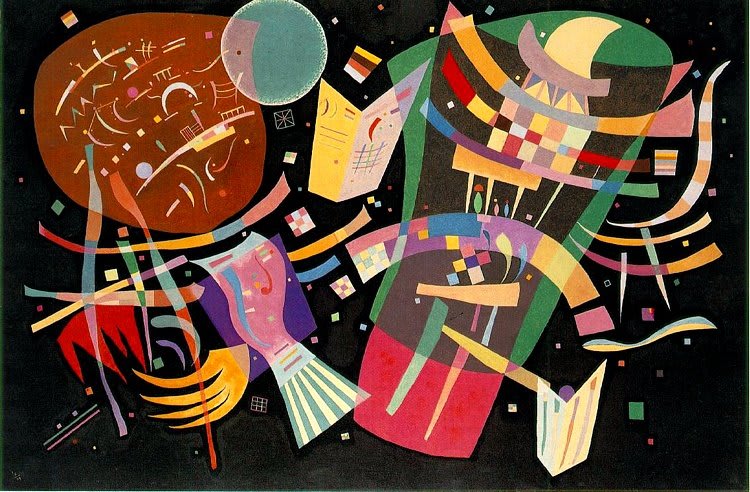
COMPOSITION X - Executed in France, this monumental painting features a black background to highlight the visual impact of the wavy forms of bright colors in the foreground. The presence of the black expansion is significant, as Kandinsky used color sparingly; it is evocative of the cosmos as well as the darkness at the end of life. The wavy planes of color evoke the mind's organisms, but also express the emotional and spiritual feelings that Kandinsky experienced near the end of his life.
The emotional and spiritual depth found in these final works mirrors the psychological intensity seen in the evolution of other great masters. Van Gogh's Self-Portraits
MODERATE COURAGE - This was the last work made by Kandinsky where we can observe an apparent sense of melancholy in the colors used: the violet background combines with the shades of reds, blues, and greens used in the fantastical composition. The largest of them occupies the entire surface of the canvas.