The Dance - Henri Matisse
The Dance - Henri Matisse
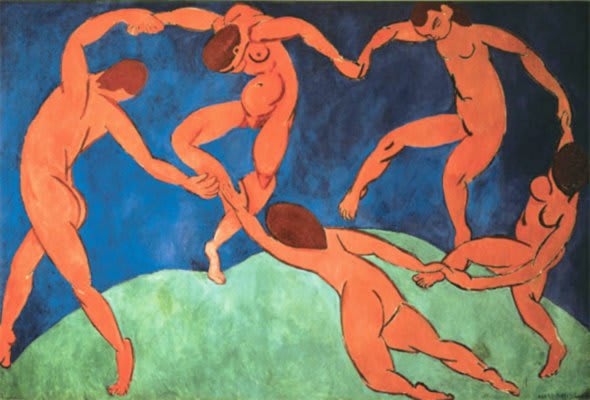
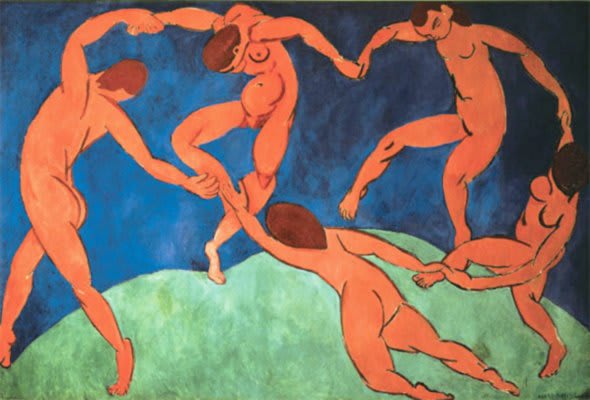
The Dance, is one of the most important works of the French artist Henri Matisse and also his most popular work, contributing to revolutionizing Art History.
Along with Pablo Picasso and Marcel Duchamp, Matisse is considered one of the three most innovative and daring artists of the 20th century, being also responsible for a significant evolution in visual arts, especially in painting. The Dance is an example of this.
Two versions were produced by Matisse of this painting. The first, from 1909, which is located at the MOMA, was probably a project for the definitive work that is located in Russia. The painting was commissioned by the Russian collector Sergei Schukin, a great admirer of his work and of some artists, such as Paul Cézanne, Claude Monet, Paul Gauguin and other painters, especially the impressionists.
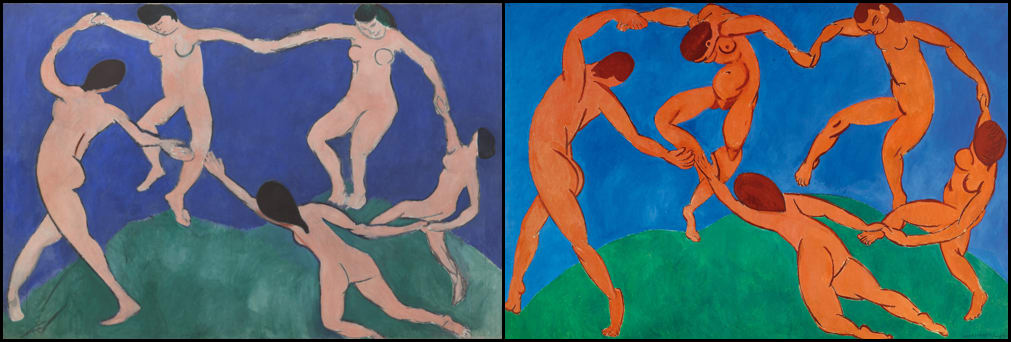
The author wrote about his work: “The first element of the construction was the rhythm. The second was the broad surface of the color, the blue. The third was the dark green tone. Following these elements, the characters could be red, to obtain a luminous concordance.” (HENRI MATISSE)
Like the movement of a clock, in a clockwise direction, Henri Matisse represented The Dance, by the union of the bodies, acquiring each figure a different posture. The faces are hidden, except for one of the dancers, which induces the observer to imagine the same face in the other characters of the work. This sensation is to cause the impression of rhythmic speed provided by the movement of the dancers.
But history has a bizarre detail:
It's hard to imagine in today's days that one of the most reproduced works for different segments, and one of the most important paintings in Art History have been so ridiculed. At the time, in the Autumn Salon, the critics called it “demonic cacophony”.
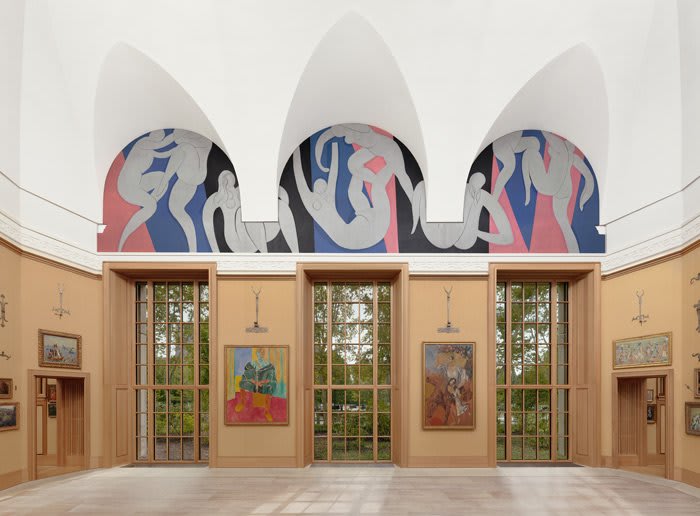
In 1931, the doctor and art lover Albert Barnes, hired Matisse to paint a mural for the main corridor of his gallery with works by Vincent van Gogh, Paul Cézanne and others. Matisse created a maquette for the mural on cut paper, which he could reorganize while determining the composition. However, the final work was too small for the space due to incorrect measurements. Instead of adding a decorative border, Matisse decided to re-compose the entire piece, resulting in a dynamic composition, in which the bodies appear to jump through an abstract space of pink and blue fields.