
The Baroque Style: Origin, Definition, and Early Expressions
The Baroque Style: Origin, Definition, and Early Expressions
Article Index
The Baroque style is one of the most fascinating periods in the history of art, known for its extravagance, drama, and grandeur.
Emerging in late 16th-century Italy, the Baroque spread throughout Europe and European colonies, leaving a lasting legacy in architecture, sculpture, painting, and music.
Characterized by its dynamic forms, ornate details, and dramatic use of light and shadow, the Baroque reflected the profound spirituality and fervent religiosity of the time.
Origins of the Baroque
The Baroque style is an artistic style that began around the 1600 period in Rome, Italy, and spread throughout most of Europe during the 17th and 18th centuries.
In informal use, the word Baroque describes something that is elaborate and highly detailed.
Definition and Characteristics
For art critics, the word Baroque came to be used to describe anything irregular, bizarre, or that, in some way, deviated from established rules and proportions.
It emerged from a twisted idea that came to denote any involutive process of thought.
Another possible source is the comparison made with the Baroque pearl, used to describe an irregular or imperfect pearl, making a depreciation.
This biased view of 17th-century art styles was carried out with few modifications by critics Johann Winckelmann to John Ruskin and Jacob Burckharsdt, and by the end of the 19th century, the term always carried the implication of strange, grotesque, excessive, and overly decorated.
It was only with the pioneering study of Heinrich Wölfflin in Renaissance und Barock of 1888 that the term Baroque was used as a stylistic designation and not as a veiled term of abuse.
Characteristics of the Baroque
The work that distinguishes the Baroque period is stylistically complex, even contradictory.
Generally, however, the desire to evoke emotional states by appealing to the senses, often in a dramatic way, lies behind its manifestations.
Some of the qualities most frequently associated with the Baroque are grandeur, sensual richness, drama, vitality, movement, tension, emotional exuberance, and a tendency to obscure the distinctions between the various arts.
The Baroque and the Catholic Church
The most important factors during the Baroque era were the Reformation and the Counter-Reformation, with the development of the Baroque style considered closely linked to the Catholic Church.
The popularity of the style was indeed encouraged by the Catholic Church, which had decided at the Council of Trent that the arts should communicate religious themes and direct emotional involvement in response to the Protestant Reformation.
The Baroque art manifested itself differently in various European countries due to their unique political and cultural climates.
Conclusion
The Baroque style is characterized by exaggerated movements and clear details used to produce drama, exuberance, and grandeur in sculpture, painting, architecture, literature, dance, and music.
The Baroque iconography was direct, obvious, and dramatic, aiming to appeal primarily to the senses and emotions.
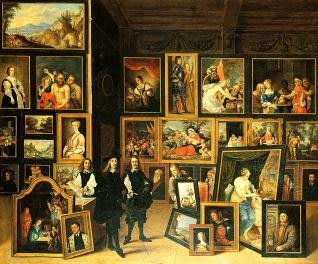
David Teniers, the Young (thus known for belonging to a family of painters) initiated at the end of the second half of the 17th century, reproductions of paintings from the collection of the archduke Leopold Guillermo.
CURIOSITY: During this period, among aristocrats and bankers, the fashion of collecting in general and artistic collecting in particular spread.
Something that, not by chance, occurs in the Baroque period, where one of the characteristics of the style is overloading, accumulation.
Read More
To understand the rest of this journey, continue to our next article: The Baroque Style: The Grandeur of Painting and Its Masters.


