
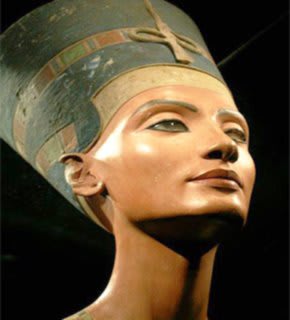
The Bust of Nefertiti
Discover the enigmatic beauty of Nefertiti, one of the most famous and stunning works of ancient Egyptian art.
I invite you to explore the Bust of Nefertiti, one of the most iconic and breathtaking works of ancient Egyptian art.
Created around 1345 BC during the reign of Akhenaton, this bust portrays Queen Nefertiti with a unique blend of beauty and serenity.
Discovered in 1912 in Amarna, Egypt, the bust is an extraordinary example of Amarna period art, characterized by its realism and naturalism.
The soft expression and fine details of the Bust of Nefertiti make it one of the most admired sculptures in the world.
As you gaze upon this work, you will be captivated by its elegance and mystique, and the ability of ancient Egyptian artists to capture the essence of beauty and life in stone.
Nefertiti: A Queen of Beauty and Mystery
Nefertiti was born in 1380 BC, a famous queen of the Old Kingdom of Egypt.
She was the wife of Amenhotep IV, the only monotheistic pharaoh who worshipped a single god, the sun god Aton.
She belonged to the 18th dynasty, also known as the Reign of Akhenaton. They had six daughters.
Her name already foreshadowed her beauty - Nefertiti means "The Most Beautiful".
To this day, Nefertiti remains a symbol of beauty that fascinates everyone with her charm and mystery.
Very little is known about her life, but we do know that when Akhenaton's reign ended, Nefertiti mysteriously disappeared, with few images and documents depicting that period of her life.
It is believed, according to estimates by Egyptologists, that Nefertiti died in 1345 BC, during her husband's nine-year reign.
The Beauty of Nefertiti
Nefertiti received a high status, almost equal to that of her husband.
Some scholars believe that she was the driving force behind the new religion and that she ruled as co-regent for some time.
It seems that she was never completed, "her beauty could have caused envy among the gods".
It was carved in several stages over a limestone base covered with layers of stucco of different thicknesses and has fissures on the shoulders, lower back, and rear of the crown.
The image of the bust is elongated, the face is very symmetrical, with prominent cheekbones and a perfect nose.
The skin is delicate and dark, without expression marks or wrinkles, well-defined eyes and dark eyeliner, soft mouth tone matching the skin.
On the head, apparently shaved (a common habit among ancient Egyptians) is a blue crown, symbolizing nobility.
In a general context, the sculpture exhibits a youthful expression and a beauty standard equivalent to, if not superior to, that of the most beautiful women of the time.
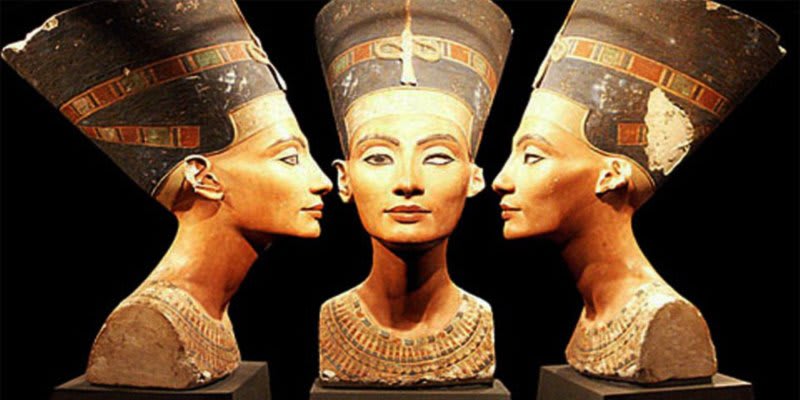
With a height of around 50 centimeters, fortunately, it was found in almost perfect condition, with some imperfections on the earlobes that were destroyed, perhaps due to time.
What catches the most attention is that it is only with one visible and complete eye and the other empty, without the cornea inscribed, which makes it seem that the work is unfinished.
For mystical reasons, it is believed that it was never completed, "her beauty could have caused envy among the gods".


