
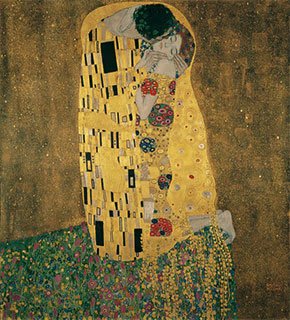
The Kiss, by Gustav Klimt
The Kiss, by Gustav Klimt
Article Index
I invite you to appreciate the work "The Kiss" by Gustav Klimt, one of the most iconic paintings in the history of art.
Created between 1903 and 1909, this masterpiece of Symbolism depicts a couple embracing in a passionate kiss, surrounded by characteristic golden and ornate patterns of Klimt's style.
The Kiss is a unique representation of love and intimacy, capturing the beauty and complexity of human relationships in a sublime way.
One of the Masterpieces of Gustav Klimt's Career
The Kiss, is one of the masterpieces of the career of the artist Gustav Klimt, as well as one of the most sensual in the history of art.
Acclaimed immediately after its first exhibition, it was acquired by the Austrian government.
Klimt, master of linear rhythms, immortalized himself with The Kiss.
The Pictorial Phase of Klimt's Golden Period
Qualified as masterpiece, the painting constitutes the climax of the so-called golden period of the painter.
Developed between 1903 and 1909, the pictorial phase was characterized by the abundant use of gold leaves, the sumptuousness of the ornamental motifs and the treatment of the surface in the style of the Bizantine mosaics of Ravenna that so impressed him during his stay in Italy.
Here your love for decorative splendor reaches an extreme, with beautiful floral motifs.
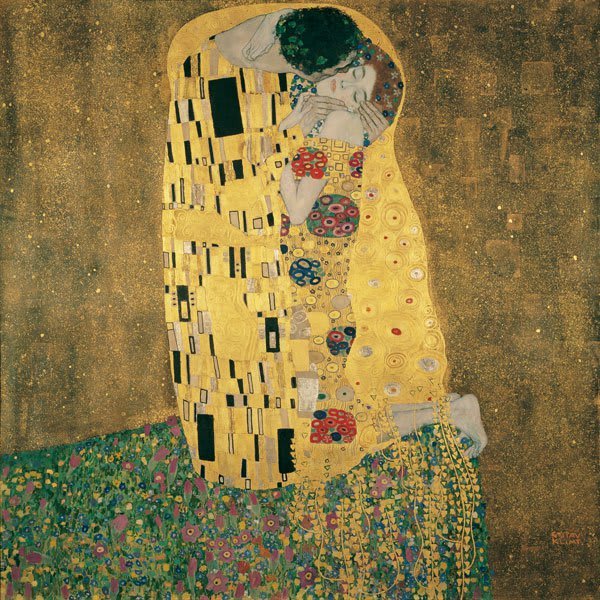
Figures entwined highlight all the feminine sensuality in a few and vigorous strokes.
During this phase, composed of artists and thinkers who would produce revolutionary theories about sexuality and aesthetics, Gustav Klimt developed this work promoting a challenge to the established concepts about behavior.
This is the work that brings his most powerful representation of the theme of carnal union.
Located in the center of the painting, the couple configures a triangular structure set on a diagonal ascending line parted abruptly.
The compositional proposal created a sense of emptiness and instability behind the couple, which contrasts with the tenderness of the scene.
The man does not appear from behind, but from the front and in perspective.
His head with a crown of ivy is visible, but his face is not identifiable.
The woman's body, on the other hand, is in profile and her face turns to the viewer.
She is kneeling, which leads one to imagine that her lover also holds the same position, although her feet seem to be out of plane.
On a sloping surface, full of flowers, the two figures merge in the embrace.
The man holds the woman's head, while giving a loving kiss on the flushed cheek.
The woman circles her right hand around the man's neck and with her left hand caresses his hand.
The face, with closed eyes and eyelids, is reclined on the man's left shoulder.
The attitude is serene, almost dreamy.
Her hair seems to be part of a floral aura.
The couple isolates itself from the background by a golden aura, which falls in a cascade at the woman's feet and is formed by concentric circles.
The brilliant loving union releases a fine golden dust that extends over the dark background, illuminating it and giving it a mystical dimension.
Although the canvas represents the sublimation of physical love, the erotic charge is noticeably inferior to other works by Klimt.
Surrounded by a sumptuous, sensual and brilliant decorativeism, the decorative elements of the couple seem to emphasize more the feelings of tenderness than those derived from the sexual impulse.
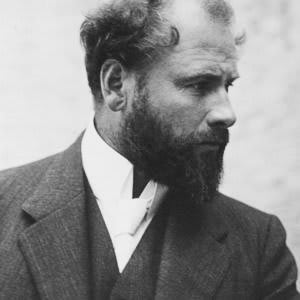
Carried out in a revolutionary, but still conservative Vienna, it is a masterpiece that still exercises a huge fascination over everyone today.
Gustav Klimt, was born in Vienna (Austria) on July 14, 1862.
He studied decorative design at the Decorative Arts School. Associated with Symbolism, he stood out within the Austrian Art Nouveau movement and was one of the founders of the Vienne Secession movement, which rejected academic tradition in the arts.
Klimt was also an honorary member of the universities of Munich and Vienna.
His main works include paintings, murals, sketches and other objects of art, many of which are on display at the Vienna Secession Gallery.
He died in Vienna (Austria) on February 6, 1918.


