
The Life and Legacy of Giorgio de Chirico: Metaphysical Painting and Its Impact
Discover the enduring influence of Giorgio de Chirico on Surrealism and the analysis of pivotal works that defined Metaphysical Painting.
Article Index
De Chirico was an extremely prolific artist in his 80 years of life.
In 1974, he was elected a member of the French Academy of Fine Arts.
He died in Rome on November 20, 1978.
The most substantial impact of De Chirico on Art History was his acceptance by the surrealists as a pioneer in his field.
Among the artists who openly acknowledged his influence were Max Ernst, Salvador Dalí, and René Magritte.
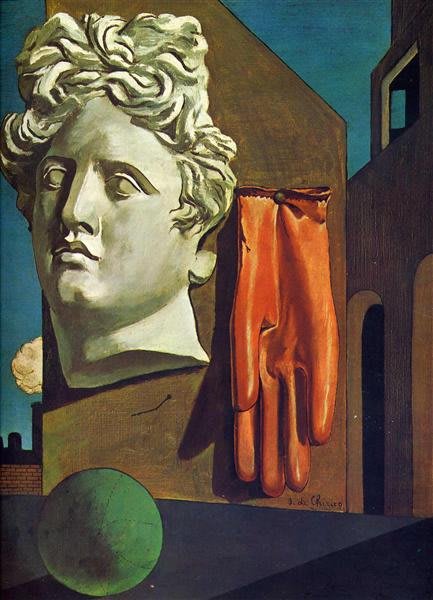
This last one said that his first view of "The Song of Love", by De Chirico, was "one of the most exciting moments of my life: my eyes saw it for the first time".
Even filmmakers recognized the impact of his metaphysical paintings on their work.
The Italian director Michelangelo Antonioni created dark and empty urban landscapes that reflect some of De Chirico's most notable paintings.
Alfred Hitchcock and Fritz Lang also owe a debt to the works created by Giorgio de Chirico.
GALLERY - COMMENTED ART
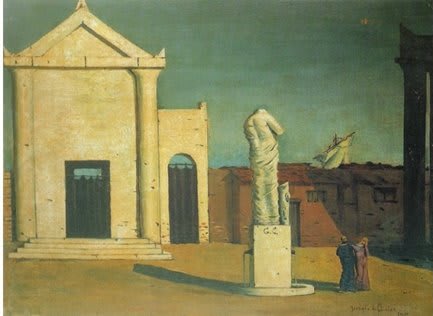
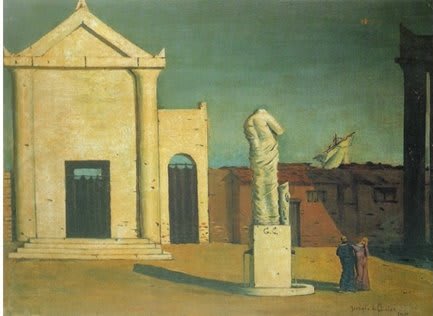
The Enigma of an Autumn Afternoon - De Chirico presents in this work, a tranquil and simplified scene of a city square.
In this case, it is in Florence, Italy's Piazza Santa Croce, where the artist claims to have had a moment of clarity where the world appears as if for the first time.
The almost empty square includes a statue and the classical façade of a building.
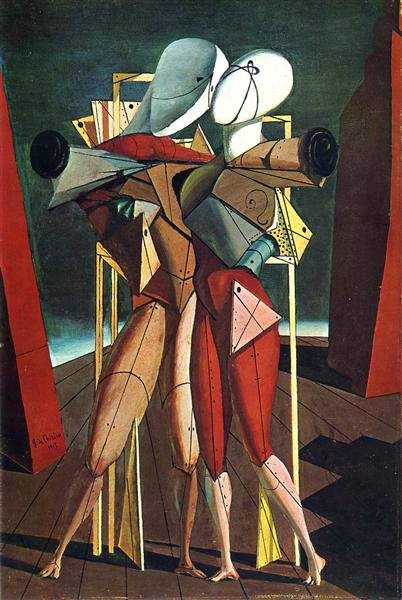
Heitor and Andrómaca - Clique here and learn more about this famous painting
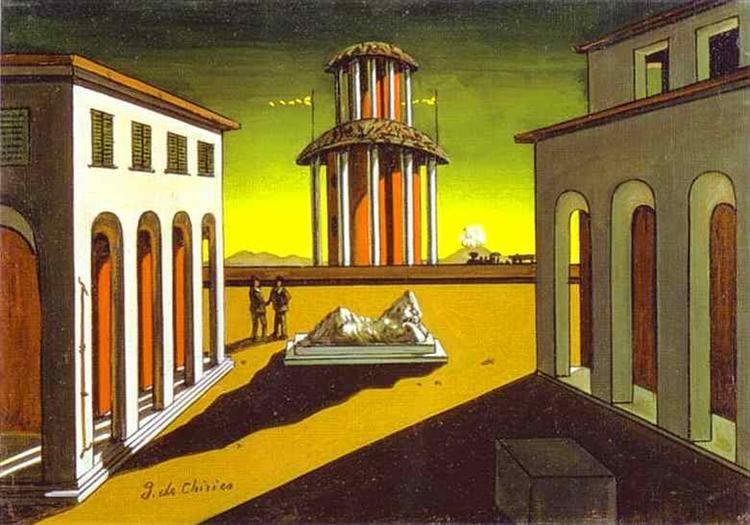
The Melancholy of Departure - This is one of De Chirico's most famous works.
In reality, he did not create it to represent a particular place, instead, he borrowed architectural elements like a stage designer using props.
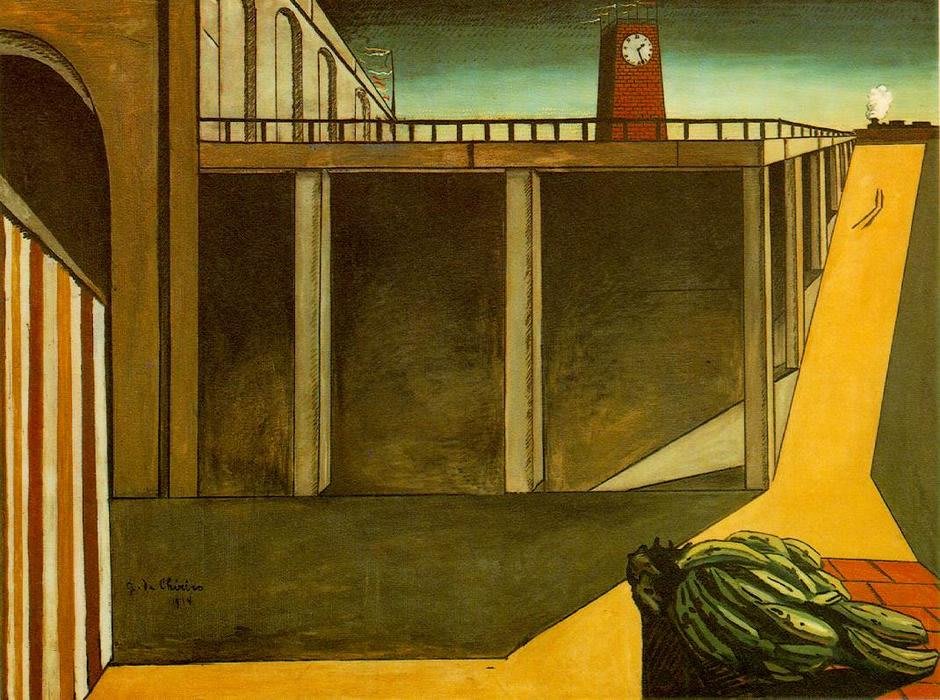
The Song of Love - We can see the profile of a locomotive in the background of this painting, which was used as a tribute to the artist's father, a railwayman, so the train becomes a nostalgic element.
The composition presents a green ball in the foreground, but what draws attention is the head of Apollo of Belvedere placed next to a red glove leaning against an inclined wall.
It's common to find empty architectures in dark passageways in this phase of his work.
The oniric silence, the solitude with human presence vestiges, evoke the profound absurdity of a universe that would eventually be torn apart by World War I.
To understand the rest of this journey, continue to our next article: The Life and Legacy of Giorgio de Chirico and Metaphysical Painting: Masterpieces and Visionary Philosophy.


