
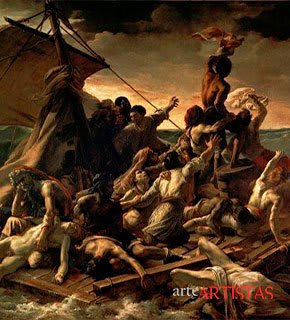
The Raft of Medusa, by Théodore Géricault
The Raft of Medusa, by Théodore Géricault
Article Index
The Raft of Medusa has become one of the most legendary paintings of the modern period.
Considered the masterpiece of Théodore Géricault, it is one of the most representative works of Romanticism.
When creating the painting, the artist presented a complex composition and a nearly unsettling portrait of reality that referred to everything that had been seen before.
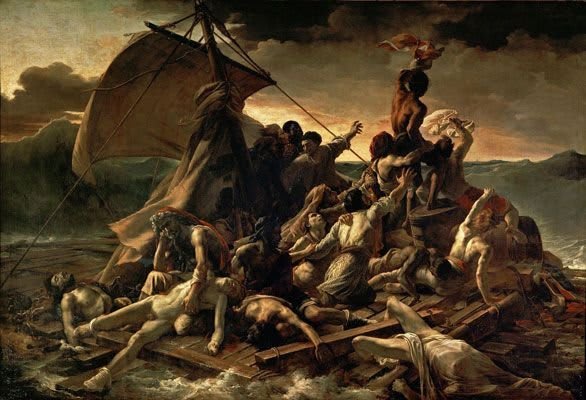
Central figure of the work: the improvised raft transports the horror scene, with floating bodies and struggles for life.
The artist paid great attention to the details in this work, he even sketched parts of the cut bodies to make the work, as authentic as possible.
The painting presents a set of figures floating in the sea, some dead, some struggling for life in a tangled mass positioned on an improvised raft.
At the highest point, we find a single figure waving a cloth on top of a pile of men who are struggling to attract the attention of a ship in the distance, located at the far right of the horizon line.
The sail of the raft is swaying in the wind while being thrown over a turbulent ocean.
The Dramatic Composition
The composition presents the artist's dramatic interpretation of a French naval frigate that fell in its path to create colonies in West Africa on July 2, 1816.
The appointed governor of the colony and the high-ranking officers of the group left in the six lifeboats of the ship, leaving the remaining 147 passengers to be crowded onto a hastily made raft.
When the balsa proved too heavy, in a horrific act of cowardice and fear, the ship's leader cut the balsa's ropes.
Left to their own devices, the passengers eventually resorted to cannibalism.
When rescued thirteen days later by a British ship passing by, only fifteen men remained alive, of which five died before they could return to the continent.
When made public, the occurrence became an international tragedy and a severe accusation against the current French government.
The Public Reaction
The painting shocked the public and divided the critics at the Paris Salon in 1819.
For the artist, the decision to paint a scene from a recent history, immediately drew attention to this fact, mainly because Géricault translated it in a way consistent with the characteristics of classical art.


