
The Sleeping Gypsy, Reading the Work of Henri Rousseau
The Sleeping Gypsy, Reading the Work of Henri Rousseau
The Sleeping Gypsy is an intriguing work by French artist Henri Rousseau, completed in 1897.
Rousseau, a self-taught artist known for his naive and fanciful style, depicts a mysterious and enigmatic scene.
In the painting, a sleeping gypsy woman lies amidst lush nature, while several mysterious figures and animals observe around her.
The work is characterized by a vibrant color palette and Rousseau's distinctive technique, combining realistic details with a dreamlike sensitivity.
The Sleeping Gypsy is one of the main paintings by French artist Henri Rousseau, known as a primitivist painter for his pure expression reflecting the innocence of a child unencumbered by academic restrictions.
The departure of this painting from its usual theme led many to declare it a forgery, with some even attributing it to André Derain.
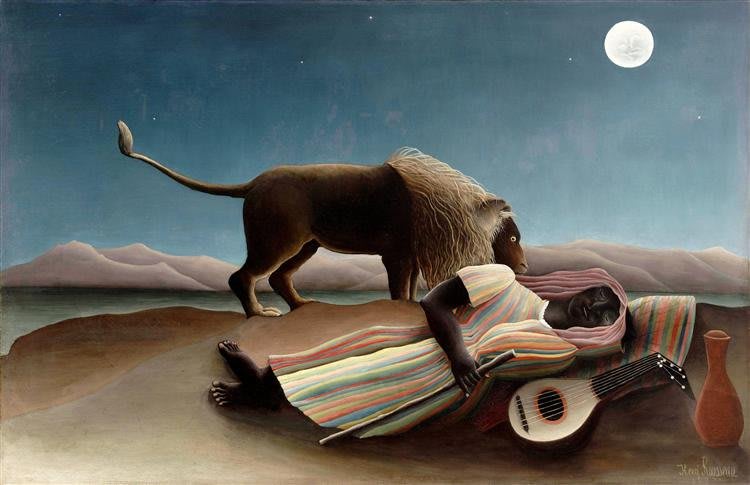
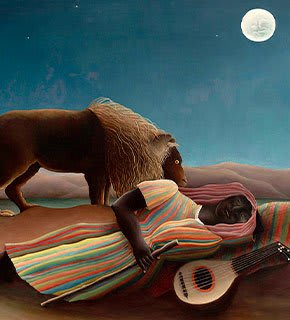
The moonlit scene takes place in a desert on a full moon night, where a woman with African features sleeps with a guitar and a jar beside her, undisturbed and unharmed by a curious lion investigating her closely.
The hard lines, flat perspective, meticulously executed infantile anatomy, and distinct color palette confer the painting its characteristic as a work of surrealism.
But the story holds a bizarre detail: the woman suggesting to be a gypsy is wearing oriental attire, leading us to believe that Rousseau may have drawn inspiration from the story of One Thousand and One Nights, which was translated into various integral versions from the mid-1880s.
When Rousseau completed this painting in 1897, he attempted to sell it in his hometown, Laval, located 320 kilometers southwest of Paris.
It wasn't until 1924, 14 years after the artist's death, that the work was rediscovered in a coal shop in Paris – an unlikely place to store an oil painting.
Having passed through several owners since its first appearance at the 13th Salon of Independents, the painting was eventually purchased by Alfred H. Barr Jr., an art historian, for the Museum of Modern Art in New York (MOMA).
At the time the MoMA acquired the work in the 1930s, art dealers and previous owners had cleaned, repaired, and varnished the painting.
When it joined the MoMA collection, the canvas was sent to the painting conservation studio for inspection.
During the first major treatment in decades, painting conservator Michael Duffy took on the roles of detective, scientist, and artist, scouring the archives for records of previous treatments, radiographing the painting for the first time to uncover hidden compositions beneath the surface, and removing nearly a century of discolored varnish to reveal Rousseau's original colors.
Today, it is one of the most iconic and sought-after works during visits to this famous art museum.


