
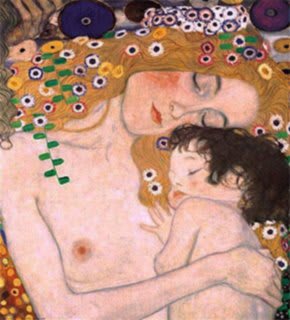
The Three Ages of Woman - Gustav Klimt
The Three Ages of Woman - Gustav Klimt
Let us appreciate 'The Three Ages of Woman' by Gustav Klimt, a work that portrays life in its different stages with beauty and sensitivity.
Created in 1905, this painting presents three female figures that represent childhood, maturity, and old age.
Klimt uses his characteristic combination of decorative forms, vibrant colors, and elaborate details to express the passage of time and the beauty of each stage of life.
Upon observing 'The Three Ages of Woman', we are invited to reflect on the cyclical nature of existence and appreciate the unique beauty of each stage of life.
The Three Ages of Woman is a work by the Austrian painter Gustav Klimt, belonging to the Art Nouveau, artistic movement that occurred at the beginning of the 20th century.
The theme of the life cycle is shown directly in this work by Klimt.
For many art scholars, the artist was inspired by the painting “The Three Ages of Woman and Death”, work by the German Renaissance painter Hans Baldung.
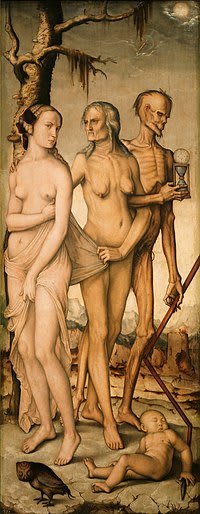
The work by Hans Baldung that Klimt was inspired by, ( image located on the left), was executed in the 16th century, is part of a set of paintings in which the author used similar themes to compose the series.
In Baldung's figures, while death takes the arm of the elderly woman who is in the center, it seems to want to move away and at the same time want to continue with the young. It presses the shoulder with the right hand and pulls the cloth that the young woman carelessly wrapped around her waist.
At that time, all the people depicted, were shown with a scarf or veil, as was the custom at the time, to hide more or less their shame.
The posture of the young woman, who turns to the left edge of the image, while the body of the old woman and death are turned to the right corner - expresses a turn towards life. The posture of the heads of the two women oppose this. The young woman looks worried at the viewer, while the old woman looks conscious and severely at the young woman. The young woman has a much paler skin compared to the other people in the image, which makes her the main character of the group shown.
Death holds an hourglass in his right hand, whose sand has already fallen halfway.
A child can also be seen in the painting. It is connected to death by a broken lance that it holds in its sleeping hand. In this way, the painter emphasizes the connection between birth and death that is inherent in all life.
The fact that the child appears to be sleeping in the painting can be seen as a preliminary stage of the approach of death.
This is to remind that infant mortality was very high in the 16th century.
The figures of Klimt are arranged vertically: an old woman, a young woman, and a little girl, all naked, with the aim of showing the passage of time.
The old woman is in profile, with her hair covering her face.
In addition to the fallen breasts, the flaccid skin, the curved back, and the prominent belly, the attention is drawn to the veins that spread over the right arm, hand, leg, and feet of the elderly woman.
Next to her, is the young mother, with her rigid body and rosy skin, with her sleeping daughter in her arms.
The enchantment that is seen in the figure of the young woman contrasts with the isolation in which the old woman is.
As in all the artist's paintings, the decoration fulfills its role.
Mother and daughter seem to be united under the same cloak.
Klimt does not attribute to the figure of the mother the sensuality characteristic of his women, although she possessed the same attributes of these: red hair, plump lips, and a carmine face.
The presence of the child and its closeness to its mother, as well as the closed eyes of the young woman, inhibit any type of sensuality.
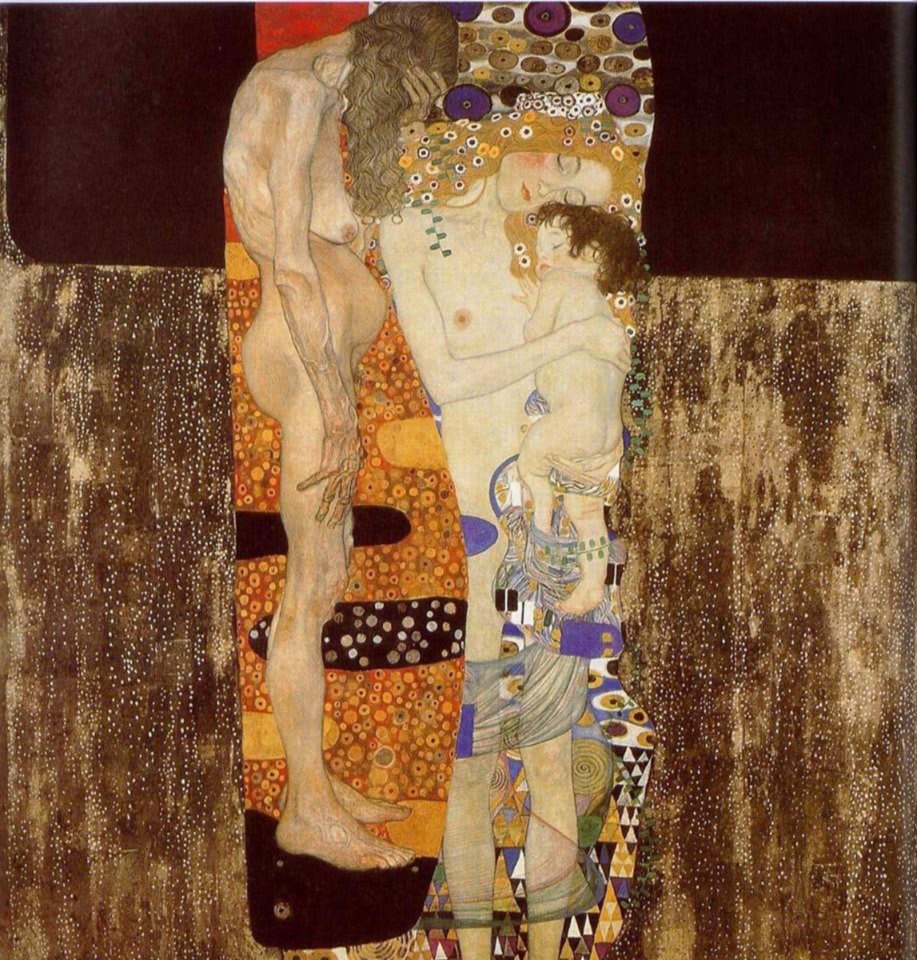
THE THREE AGES OF WOMAN
Year: 1905
Technique: oil on canvas
Dimensions: 180 x 180 cm
Location: Galleria Nazionale d’Arte Moderna, Rome, Italy
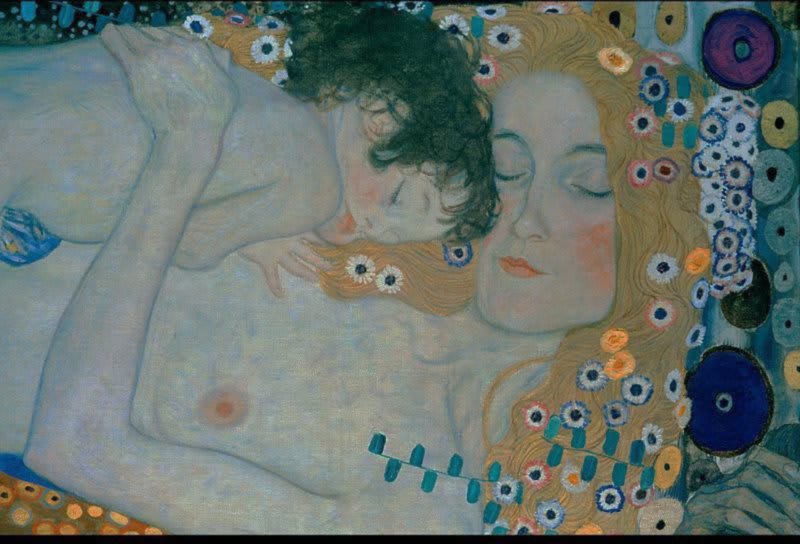
Maternity, is a detail of the painting where the painter portrays mother and daughter


