
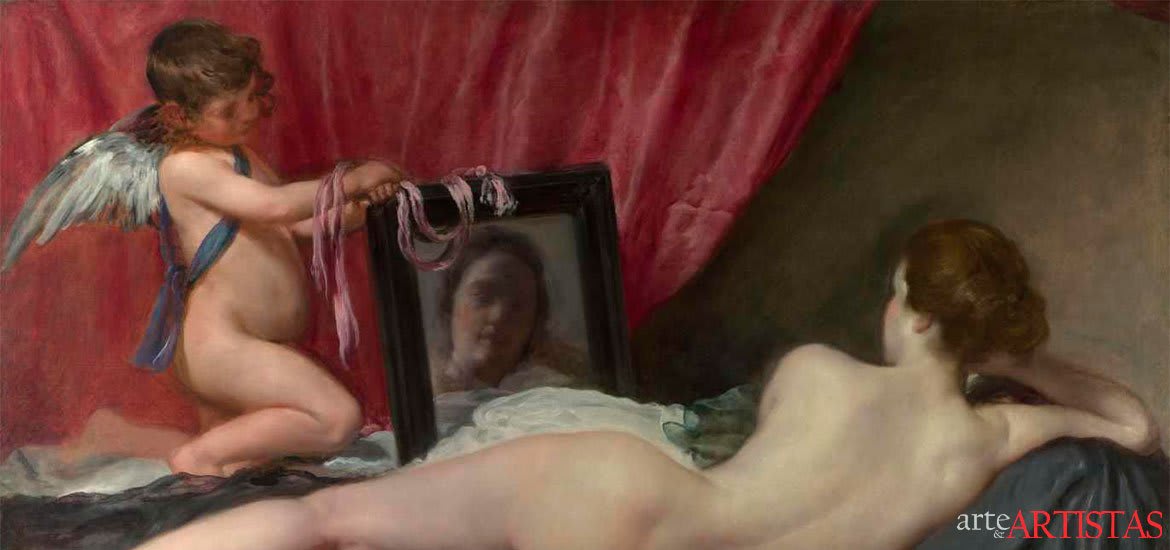
Venus at the Mirror, by Diego Velázquez
Venus at the Mirror, a masterpiece by Diego Velázquez
Article Index
Considered one of the most famous and important paintings in Art History, Venus at the Mirror by Diego Velázquez is also the principal work of the artist in the Baroque style.
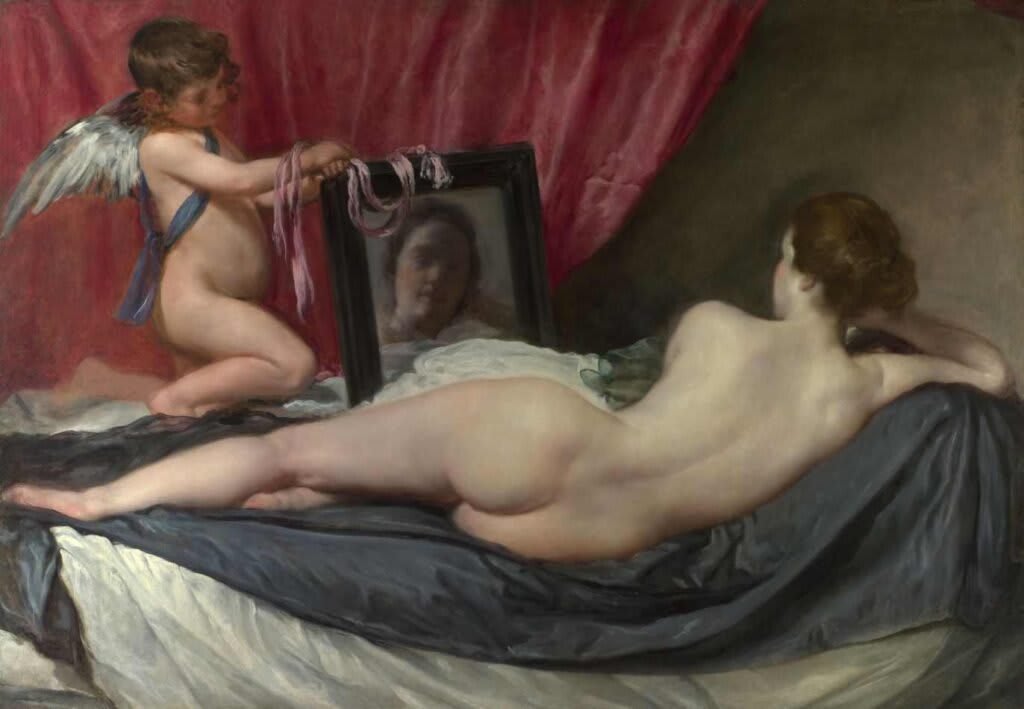
Surprisingly, the painting was commissioned by King Philip IV, who had a collection of mythological nudes by Titian and Rubens.
The Spanish Inquisition had a significant influence on the artist's life, as images of nude bodies were strictly prohibited at the time.
In ancient mythology, the goddess Venus personified the symbol of love, as well as the sublime and beautiful beauty of a woman.
The artist focused on looking at the beauty of the female body, deliberately avoiding the luxury of curtains and eliminating decorations such as flowers and jewelry.
The second character in the image is Cupid, the son of the goddess, who holds a mirror facing his mother.
King Philip IV was the main patron of many artists, and Velázquez would have felt safe when receiving the commission to paint the same theme.
As the painting was probably painted in Rome, a more liberal city than Madrid, it is believed to have been painted with a live model.
Some scholars claim that the model was Velázquez's mistress and that she is the same person who appears in many of the artist's paintings.
Venus by Velázquez: A Forbidden Painting
Velázquez, constrained by the dogma of the church, could not exhibit his painting to the public. Therefore, for a long time, it was only seen in closed circles.
It was not until the 19th century that the canvas was transported to England, becoming part of the collection of the National Gallery in London.


