Victory of Samothrace
A monumental sculpture that embodies the essence of ancient Greek art and mythology.
Article Index
The Victory of Samothrace is more than just a sculpture; it's a work of art that transcends time and space, captivating the viewer with its beauty and mystery.
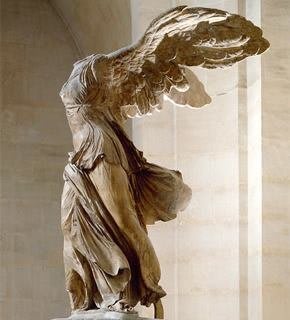
Discovered in 1863 on a Greek island, this marble sculpture represents the Greek goddess Nike in a triumphant pose, her wings outstretched and her drapery fluttering, evoking a sense of movement and dynamism.
The Victory of Samothrace is a testament to the artistic skill of the ancient Greeks and continues to be one of the most revered sculptures of antiquity, enchanting and inspiring all who behold it.
The Origin and Importance of the Victory of Samothrace
The Victory of Samothrace is a famous sculpture of antiquity, created around 190 BC and standing 3.28 meters tall. The dating is uncertain, but the work has many characteristics attributed to the Hellenistic period. Some of the characteristics of this period include dramatic, theatrical, and emotional art.
Carved from white marble from Paros, the work that represents the form of a winged woman is at the same time intriguing, perhaps due to the fact that the sculpture does not have the key pieces (head and arms) causing a sense of mystery.
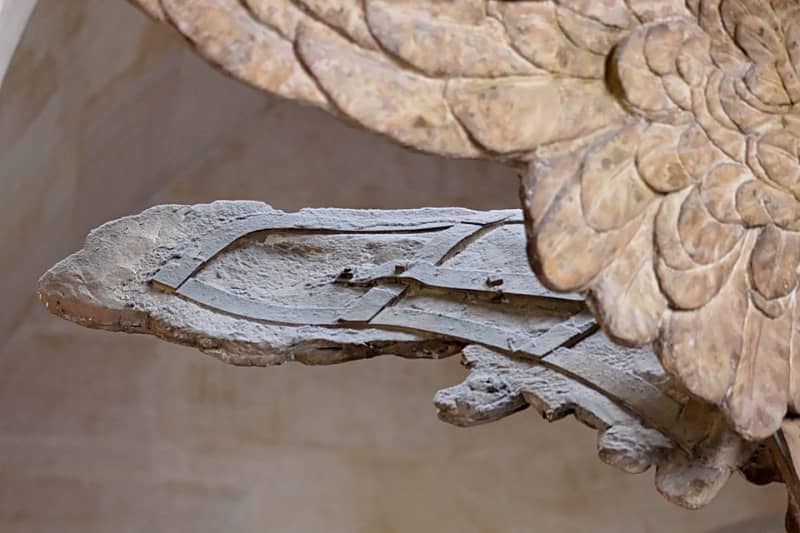
The movement of both wings and the flowing drapery, give the work an inspiring element. It is believed that this statue, represented a figure on the prow of a warship to commemorate the victory of a naval battle.
The Mythology and Significance of the Victory of Samothrace
In Greek and Roman mythology, Nike (Nice) was the goddess of victory, depicted as a winged figure who flew from the Mount Olympus. While the Winged Victory of Samothrace is the most well-known representation, besides being the largest, many figures and smaller statues of Nike were sculpted in the ancient world.
The Victory of Samothrace was built from the joining of six marble blocks, it remained lost for many centuries. In 1863, the archaeologist Charles Champoiseau found it on a hill on the Island of Samothrace, which gives sense and reason to its title. Without signs of how the work was destroyed by time, the archaeologist found it fragmented into 118 pieces.
The Preservation and Exhibition of the Victory of Samothrace
In 1864, when it was acquired by the Louvre Museum, the sculpture was reassembled from what was found. Unfortunately, its head remains a mystery, because it will remain in the imagination of each one, how it would be, which seems to have been lost forever.
This beautiful sculpture, is in a prominent place on a staircase of the Louvre Museum, which provides a perfect point of view to visualize it. It is positioned outside the Grand Gallery, which houses all the paintings of the Italian Renaissance. The view that the visitor has of the work while climbing the staircase, only increases the majestic sense of the work.