
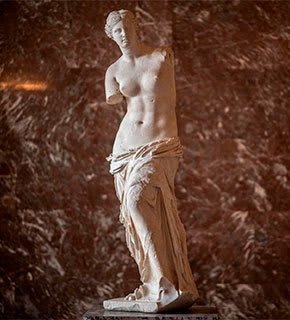
Venus of Milo: The Mystery and Beauty of the Goddess from Melos
Discover the enigma and allure of the Venus of Milo, a masterpiece of ancient Greek art.
The Venus of Milo, is an ancient statue, commonly considered to represent Aphrodite, the Greek goddess of love and beauty - which was sculpted during the Hellenistic Period.
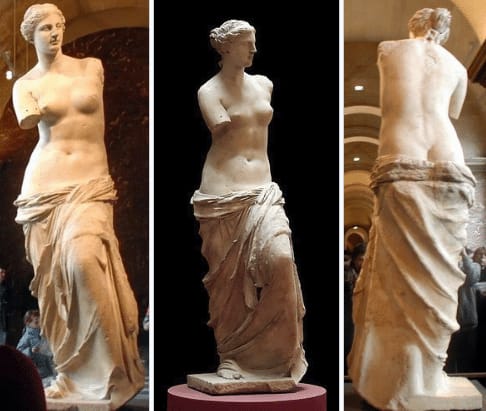
A little larger than life-size, it is believed to be the work of the sculptor Alexandre de Antioquia , by the inscription on its pedestal that attested to this, unfortunately lost.
This elegant figure of a goddess has fascinated art lovers for almost two centuries, since its discovery in the 19th century on the small Greek island of Melos, in the Aegean Sea.
The fertile soil of Milos
The choice of the island of Milos for the rest of this divinity was not a coincidence.
Located in the Cyclades archipelago, in the Aegean Sea, the island was a vibrant center of culture and commerce in Antiquity.
It was in a cave in this volcanic landscape that a farmer, in 1820, rediscovers the statue.
More than a geographical address, Milos gave Venus her own identity, combining the aesthetic perfection of classical Greece with the spirit of discovery that marks the modern era.
On April 8, 1820, it was found in pieces on the Island of Melos. Although it was rebuilt for a standing posture, the arms were never found.
The work was found in a field by a young farmer, buried in a wall niche within the ruins of the ancient city of Milos.
The stone sculpture consisted of two main pieces, the upper torso and legs, covered with fabric.
Several other sculptural fragments were discovered in the vicinity, including a severed left arm (and hand) holding an apple and an inscribed pedestal "...sandros de Anchiochia no Meandro", with a clear reference to a sculptor called Alexandre de Antioquia.
When the news of the discovery spread, a second French officer, Jules Dumont d'Urville, notified the French ambassador in Greece, the Marquês de Rivière, He, in turn, arranged for the dispatch of the statue to France, where it was presented to the King Luís XVIII, who properly donated it to the Louvre Museum.
To value its new acquisition, it was decided to ignore the inscription found at the base of the sculpture, identifying Alexandre de Antióquia as the sculptor, to attribute the statue to Praxíteles (375 -335 BC), one of the greatest sculptors of the classical period.
The enigma of the lost arms
What did the Venus of Milo hold? This is the question that echoes through the corridors of the Louvre for centuries.
Although time has silenced its gestures, archaeologists and historians suggest three fascinating paths.
The most romantic theory bets on an apple, a symbol of her victory in the Judgment of Paris.
Others, focused on her upright posture, believe she could hold a bronze shield or even a spindle and a distaff, spinning the human destiny.
Without hands, the work gained something greater: the mystery that made it eternal.
The sculpture was made using Parian marble and is about 211 cm high, without the pedestal.
It is believed to represent Aphrodite, the ancient Greek goddess of love and beauty.
Unfortunately, the statue's arms and original base were lost almost since its arrival in Paris in 1820.
This is partly due to identification errors, because when it was remounted, it is believed that the fragments of the left hand that accompanied it and the arm did not belong to it due to their much more rustic appearance.
The left arm, on the other hand, held an apple at eye level.
Experts remain divided on whether the goddess was looking at the apple she held or looking away.
Specialists in sculpture reconstruction estimate that the right arm of the Venus of Milo, sculpted separately, was crossed over her torso, with her right hand resting on her left raised knee, supporting the fabric around her hips and legs.
Goddess of love or lady of the sea?
Although the world knows her as Venus (or Aphrodite), there is a current that flirts with another identity for the sculpture.
Given its discovery on a port island, some experts raise the hypothesis that it could be Anfitrite, the goddess of the sea and wife of Poseidon, who was widely revered in Milos.
This duality between love and the ocean only reinforces the magnetic aura of the work, which floats between terrestrial seduction and the indomitable power of the waters.
According to the majority of specialists, the Venus of Milo represents the mythological Greek goddess Aphrodite and the story of the Judgment of Paris.
In this story, a young Trojan prince named Paris received an apple of gold from the goddess of Discord and said to give it to the most beautiful of the three candidates: Aphrodite, Atena and Hera .
Aphrodite won the beauty contest by bribing Paris with the love of the most beautiful mortal, Helena of Sparta, and was awarded the apple.
During the 19th century, the sculpture of the Venus of Milo was praised by various art critics as one of the greatest treasures of Greek art: that which represents the epitome of beauty and feminine aesthetics, due to its notable fusion of grandeur and grace.
Although times and tastes change, the goddess maintains much of her mystery.
Although it is believed that she represents Aphrodite, due to her sensual and feminine curves, she could be alternatively the goddess of the sea Anfitrite, who was worshipped on the Island of Milo.
Actually, according to the Louvre, given its similarity to the Aphrodite of Cápua, it may even be a Roman replica of a Greek original sculpture from the end of the 4th century.
Hellenistic sculptures can be seen in some of the world's best art and sculpture museums, especially the Louvre in Paris, where the important and majestic Venus of Milo is located.


