Albrecht Dürer: Biography and Major Works
Discover the life and art of Albrecht Dürer, a renowned German artist of the Northern Renaissance.
Despite living over 500 years ago, Albrecht Dürer remains the most famous artist of the Northern Renaissance, successfully integrating an elaborate style with the ideals of balance, coherence, and monumentalism of Italian Renaissance.
BIOGRAPHY
Albrecht Dürer was born on May 21, 1471, in Nuremberg, Germany. He was the third son of Albrecht and Barbara Dürer, and his father was a successful goldsmith who moved to Nuremberg in 1455. He changed his surname from the Hungarian Ajtósi to the German Türer, meaning porter. Due to local pronunciation, the surname eventually became Dürer.
Albrecht began his apprenticeship in his father's workshop at the age of 13 but showed exceptional talent as a draftsman, starting to work as an apprentice to the painter Michael Wolgemut at 15.
From 1490 to 1494, he spent time as a journeyman, aiming to expand his knowledge and skills by working with various other artists. In July 1494, Dürer returned to Nuremberg to marry Agnes Frey, the daughter of a lute maker. The arranged marriage was not particularly happy, and the couple remained childless, but Agnes played a crucial role in her husband's success, selling his works at stalls and fairs, accompanying him on some of his travels, and managing his workshop during his absences.
In 1495, the artist traveled to northern Italy for the first time, finding much inspiration in the local art scene. Upon returning to Nuremberg in the same year, he opened his own workshop.
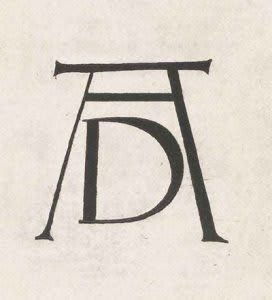
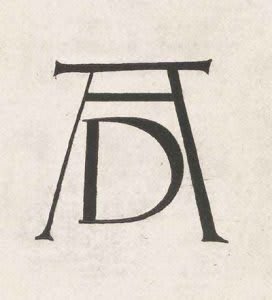
In 1498, driven by the success of his Apocalypse series, Dürer's reputation as a printmaker spread rapidly across Europe. He was highly aware of his artistic image, evident in his bold signature monogram. As his art became increasingly valuable, the Dürer manufacturer's mark was forged repeatedly, leading him to register a complaint with the Venetian government against the engraver Marcantonio Raimondi, who repeatedly copied his works and manufacturer's marks, selling them as originals. Ultimately, the court decided that Raimondi could continue making copies of Dürer, as long as he did not reproduce the artist's monogram.
In 1509, he was appointed a member of the Great Council, highlighting his social status as a renowned citizen. Dürer maintained close contact with the humanists of Nuremberg, including Willibald Pirckheimer, with whom he frequently discussed his work. Pirckheimer was his closest friend and advisor. As a lawyer and humanist, he was a member of the city council of Nuremberg and had powerful connections across Europe.
From 1519, Dürer's health began to decline, particularly his vision and he also suffered from arthritis in his hands. Despite this, he continued to travel to nearby countries such as the Netherlands and Brussels.
In 1521, he returned to Nuremberg, having contracted an unknown disease, possibly malaria, which left him with recurring fevers, significantly reducing his artistic activity. Even so, he began a series of large-scale religious works, which remained unfinished. One example of this is his last major work, The Four Apostles, which was donated to the city of Nuremberg.
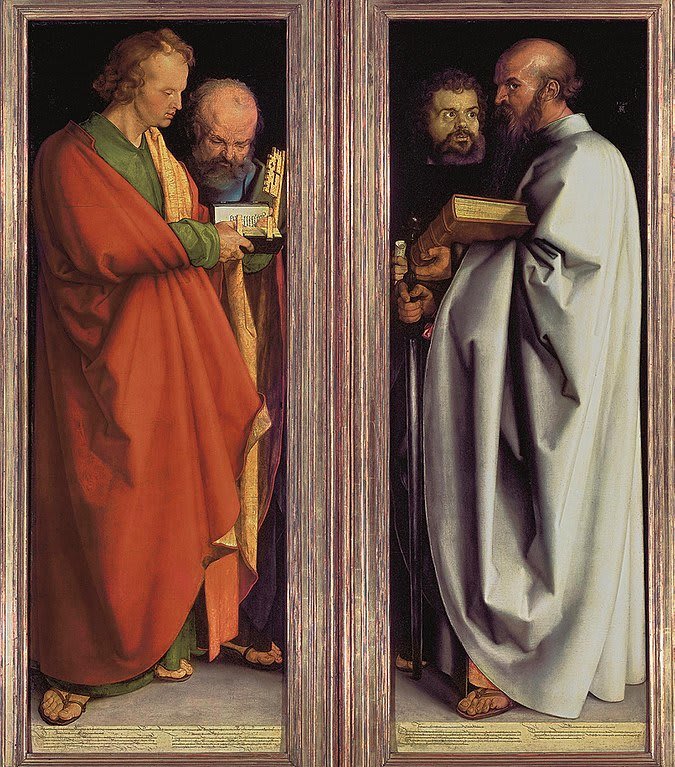
In the last years of his life, the artist became increasingly involved in scientific themes, publishing treatises for which he also designed and engraved illustrations.
DEATH AND LEGACY
Dürer died at 56 in Nuremberg on April 6, 1528, and was buried in the Johannisfriedhof cemetery.
Albrecht Dürer dominated various artistic disciplines, including painting and drawing, but it was as an engraver that he became most famous. His reputation spread across the continent as his prints were widely disseminated. The promotion of his name through this relatively new medium at the time inspired, especially the Italian masters, including Rafael Sanzio and Titian, who frequently hired engravers to create copies of their works. Other followers copied Dürer's originals, as mentioned earlier, Marcantonio Raimondi. Other artists, such as Giulio Campagnola and Benedetto Montagna, included elements of Dürer's landscapes as backgrounds in their works.
His works were mainly admired in Germany between 1870 and 1945, as they were seen as a synthesis of German artistic achievement. After the Second World War, the German Democratic Republic took his art as inspiration for Socialist Realism.
GALLERY - COMMENTED ART
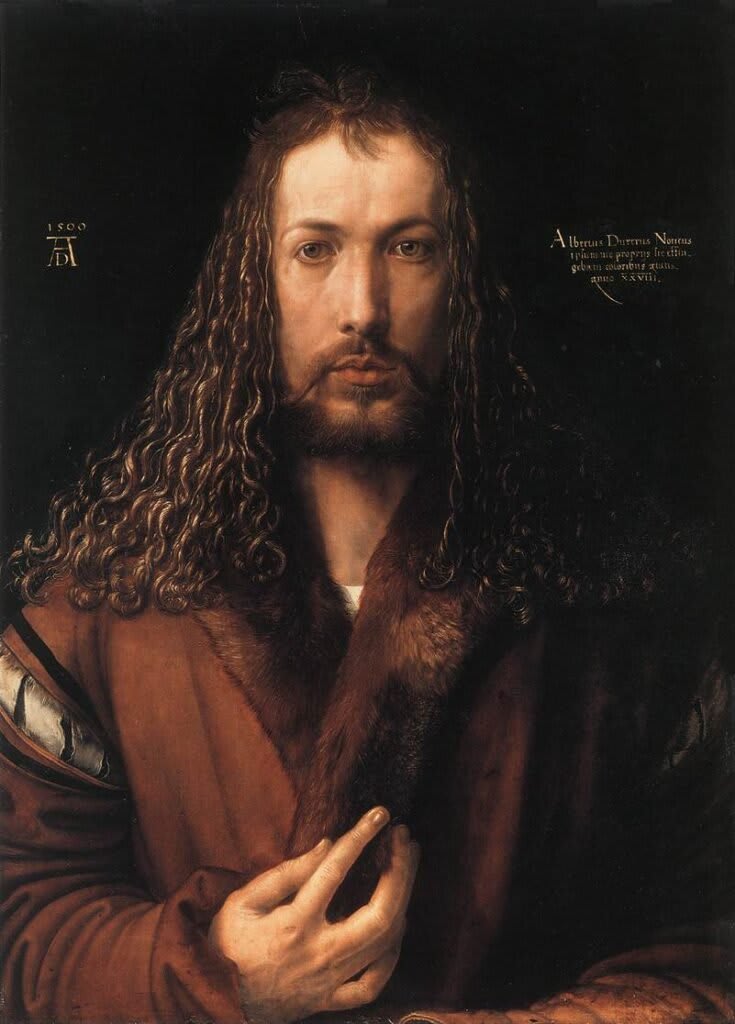
Self-Portrait with Fur - By choosing a frontal view and a dark, undefined background, Dürer evokes images of medieval religious art. With a blessing gesture, long, dark brown hair, and idealized features, the artist clearly portrays himself as Christ. Created in an apocalyptic year, the painting would have been a strong expression of the artist's devotion as a Christian. To his left is an inscription in Latin that translates to "Thus I, Albrecht Dürer of Nuremberg, painted myself with durable colors at 28 years," and his monogram is prominently displayed to his right.
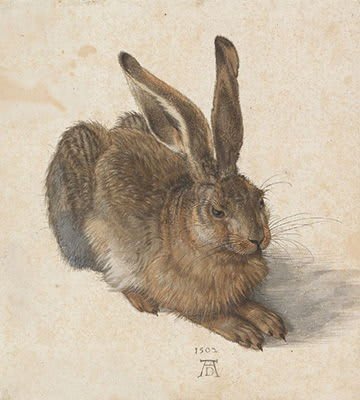
The Young Hare - In this work, the artist captured the hare in a fleeting moment of quietness. The slight turn of its ear and the eye that fixes the observer indicate that the animal has noticed us. Its hind legs are folded, ready to jump. The incredible detail and care in this study of a small wild animal are a precursor to the detailed scientific illustrations that influenced and endure as an extremely accurate and sensitive representation of one of the common creatures of nature. The prominent monogram and date indicate that the artist perceived the drawing as a complete work in itself, not as a sketch.
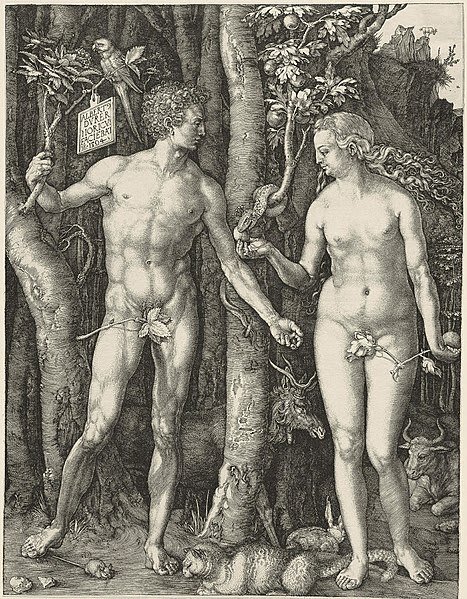
Adam and Eve - This famous engraving features figures based on classical nudes, proportions, and poses that were idealized by Greek and Roman artists of the time. The wild foliage behind the couple recalls the German forests with which the artist would have been familiar, thus placing Italian figures in their local environment. Adam holds a small branch with a plaque attached to it, which boldly proclaims the artist's name in Latin - "Albert Dürer of Nuremberg," reinforcing his German pride.
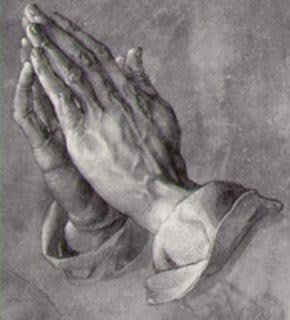
Hands in Prayer is a print by Albrecht Dürer, probably one of the most reproduced images in the world and has become an international symbol of piety and Christianity to this day.
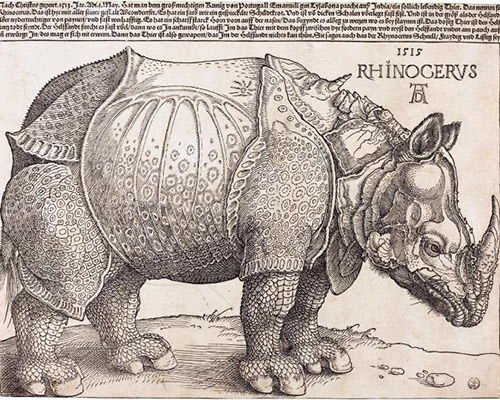
The Rhinoceros - This woodcut presents the artist's interpretation of an Indian rhinoceros. The representation of the animal became popular across Europe. The choice of woodcut technique instead of copper engraving, which was more laborious and expensive, allowed for a more practical and rapid reproduction. The date, the title 'Rhinoceros', and the signature appear in the form of Dürer's monogram, located above the animal's head to the right. An inscription at the top reads in translation: "On May 1, 1513, a living animal called a rhinoceros was brought from India to the great and powerful King Emanuel of Portugal in Lisbon. Its form is here represented, it has the color of a turtle and is covered with thick scales. It is like an elephant in size, but lower in legs and almost invulnerable. It has a sharp, pointed horn on its nose, which sharpens on stones. The stupid animal is the mortal enemy of the elephant. The elephant is very afraid of it because, when they meet, it runs with its head down between its front legs and pierces the elephant's stomach and strangles it, and the elephant cannot defend itself. Since the animal is so well-armed, there is nothing the elephant can do with it. It is also said that the rhinoceros is fast, lively, and cunning."