
The Renaissance Movement
The Renaissance Movement
The Renaissance is a period that defines the art produced in Europe, succeeding the dominant Medieval Art of its time. It was a movement that opposed the ideals imposed by the Church, advocating for the use of Reason during an era of profound transformations that established the principles now governing much of the world we know.
This period is characterized by a humanistic vision rooted in optimism, individualism, and naturalism. This naturalism involved the glorification of the human and natural, in opposition to the divine and otherworldly focus of the Middle Ages.
The Renaissance artist was an interpreter of changing values: humanity became the center of the universe, leading to the emergence of the term “Humanism.”
We can divide the period into three phases: Trecento, Quattrocento, and Cinquecento, corresponding to the 14th, 15th, and 16th centuries, with the latter two often referred to as the High Renaissance.
Characterized by the awakening of new conceptions in sciences, philosophy, architecture, painting, and sculpture, it aimed to promote a return to the great Greek and Roman civilizations. It rejected the recent medieval past, with its architecture and Gothic art. For them, beauty depended on criteria such as balance, symmetry, and rationality.
The Renaissance spanned many centuries, but it reached its zenith during the time of Michelangelo.
Giotto, the artist who lived and worked in Florence between 1267 and 1337, is considered a precursor. He depicted figures and landscapes with great realism, in a typically naturalistic style. Giotto’s influence on subsequent painters, particularly Masaccio, introduced sculptural realism and solidity of form, principles of Renaissance painting that, perhaps, found their finest expression in the monumental figures of Michelangelo and Leonardo da Vinci.
Considered one of the richest periods in Art History, the Renaissance saw the emergence of its greatest geniuses, such as Michelangelo Buonarroti, Raphael, and Leonardo da Vinci, known as "The Holy Trinity of the Renaissance."
Considering the most characteristic aspects of the Renaissance, we find Humanism, which was far more individualistic than that of the classical era. In this regard, Leonardo da Vinci is a quintessential Renaissance man, as this ideal found its fullest realization in him more than in any other personality.
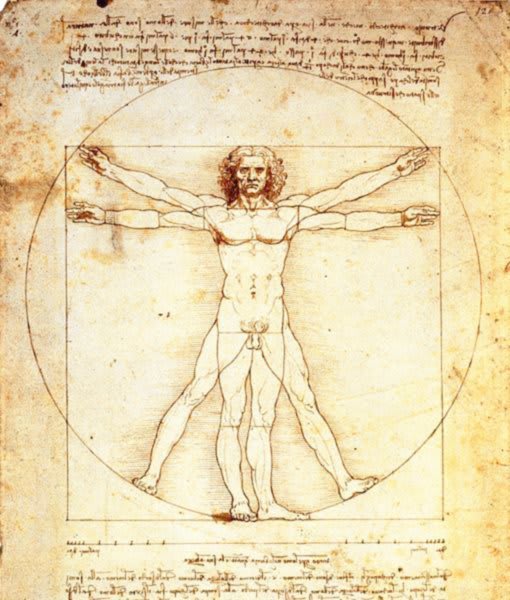
The rediscovery of the human body's mathematical proportions in the 15th century by Leonardo da Vinci and others is considered one of the great achievements leading to the Italian Renaissance. "The Vitruvian Man" serves as a prime example of this.
GENERAL CHARACTERISTICS:
- Pursuit of perfection in painting and sculpture, revisiting Greco-Roman culture;
- Valorization of human artistic and intellectual capacities (Anthropocentrism);
- Interest in and appreciation of cultural and scientific aspects;
- Humanism, valuing humanity as the center of the universe;
- A fondness for ostentation;
- Especially in painting, there's a predominance of horizontal over vertical in compositions.
PAINTING
We highlight the artist Giotto di Bondone, a painter considered a precursor of the Renaissance. His religious frescoes can be found in many churches across Italy. This painting depicts Jesus' entry into Jerusalem.
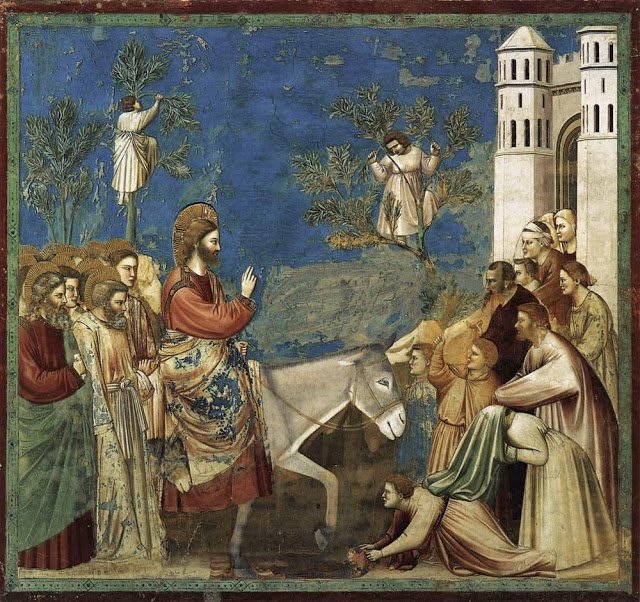
Two distinct differences mark the painting of this period: the use of perspective to create the illusion of depth and volume in artworks. And the widely employed "chiaroscuro," a strategy often used in coloring to highlight important elements and obscure secondary ones, a technique also known as sfumato.
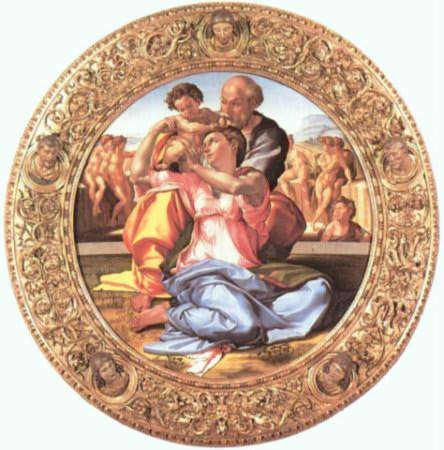
Circular paintings became popular in 15th-century Italy. Here we highlight two examples with the same theme:
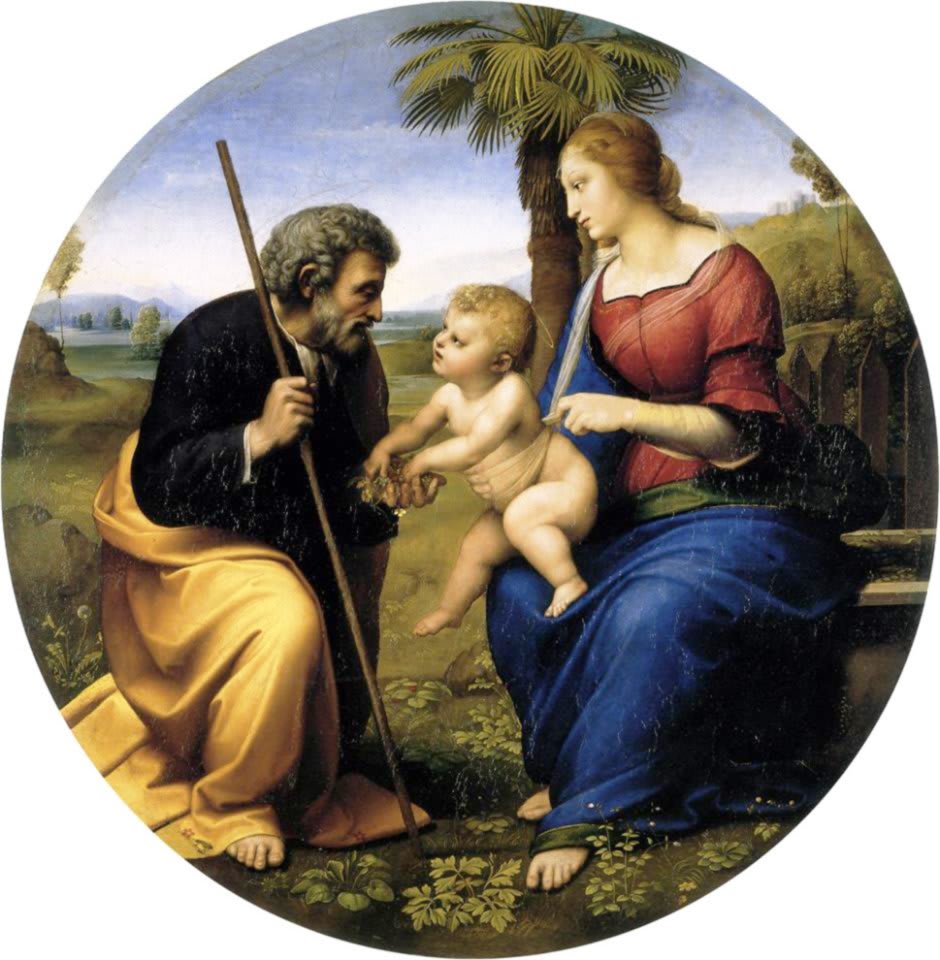
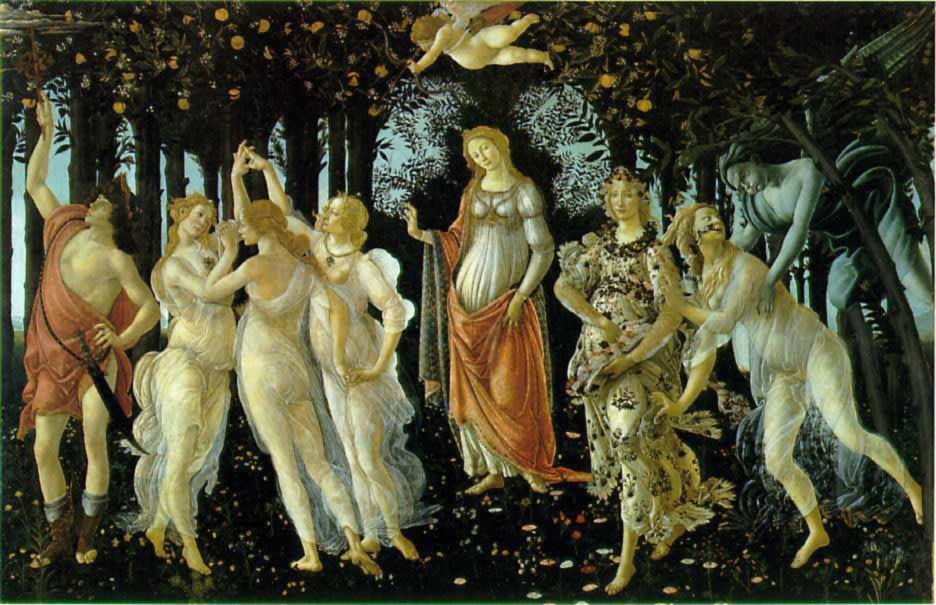
We also highlight Sandro Botticelli. One of his most characteristic and important Renaissance works is Primavera, a painting inspired by pagan mythology, notably featuring the goddess Flora and The Three Graces:
SCULPTURE
Considering the aspects of Humanism, sculpture is the artistic modality that best represents Renaissance art. It was during this period that sculpture gained more independence, largely being placed on a base, which allowed observers to appreciate it from all angles.
To emphasize humanism and, in contrast to Christian faith, the nude was widely used to highlight perfect proportions, revealing muscles in their human form and reflecting naturalism.
Principal sculptors: Michelangelo and Donatello
Michelangelo was 23 when he sculpted Bacchus, managing to combine the slender build of a young man with the contours of a woman. The sculpture depicts Dionysus, the god of wine in Greek mythology. It features an open mouth, a squinting gaze, grape clusters on his head, a wine glass in his right hand, and a tiger skin in his left.
Dated between 1496-1497, it is made of marble and measures 2.3 meters in height.
ARCHITECTURE
During the Renaissance, architects realized that the origin of classical construction lay in Euclidean geometry, which used the square as the basis for their works. To achieve harmonious construction, they also applied the use of perspective in their designs. This was also evident in palaces, which were built with flat, square layouts, often featuring a central, equally square courtyard to bring light to the internal windows of the building.
Principal architects: Filippo Brunelleschi and Donato Bramante
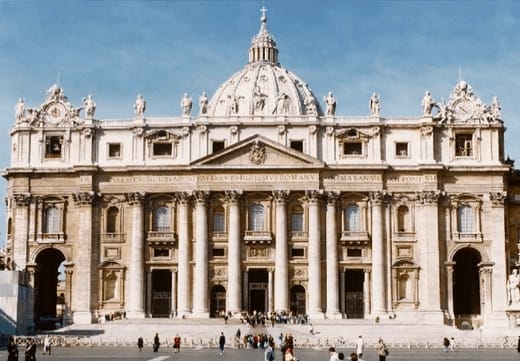
Bramante designed the gigantic dimensions of St. Peter's Basilica; its construction began in 1506, and the work was continued by Michelangelo Buonarroti, whose contributions extended far beyond architecture.
St. Peter's Basilica is the largest and most important religious building of the Catholic Church. It is one of the most visited Christian sites in the world.