
The Vitruvian Man - Leonardo da Vinci
The Vitruvian Man - Leonardo da Vinci
Article Index
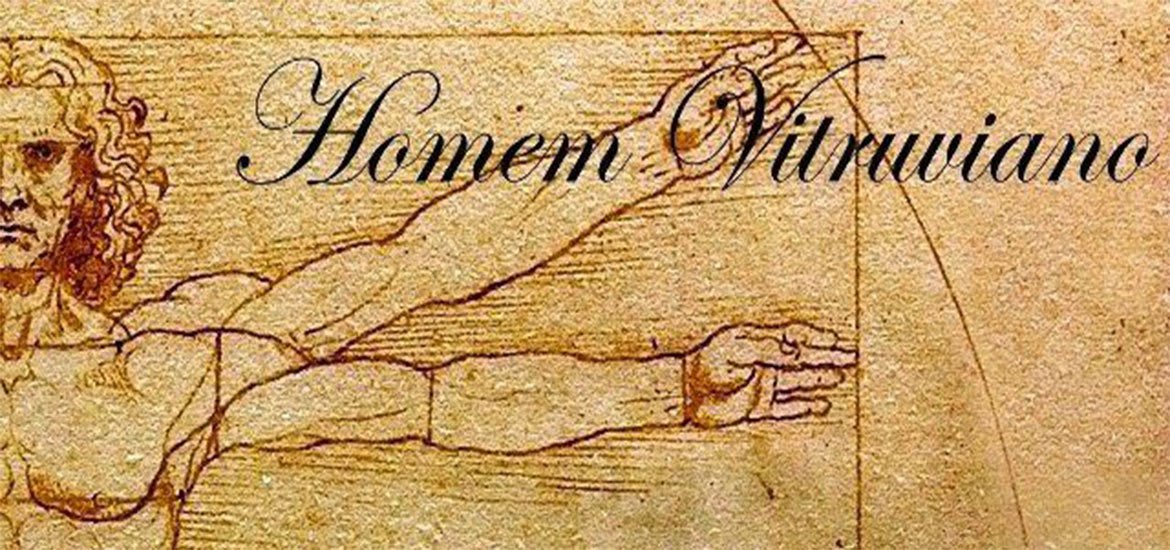
The Vitruvian Man is one of the most famous and iconic works of Leonardo da Vinci, created around 1490.
In this drawing, Da Vinci explores the proportions of the human body according to the principles described by the Roman architect Vitruvius in his treatise 'De Architectura'.
The work represents a nude man in two superimposed positions with his arms and legs extended, inscribed in a circle and a square.
The Renaissance Search for Harmony and Proportion
The Vitruvian Man is a lasting symbol of the Renaissance search for harmony and proportion, representing the intersection of art, science, and humanism.
The Vitruvian Man of Leonardo da Vinci, based on the work of the Roman architect Vitruvius from Ancient Rome, demonstrates the divine proportion, or the perfect proportion, in relation to the human body.
During the Renaissance, it was intended to represent people and objects in a more perfect way than they were in reality, and thus, this magnificent work, represents the human form in a state of physical perfection.
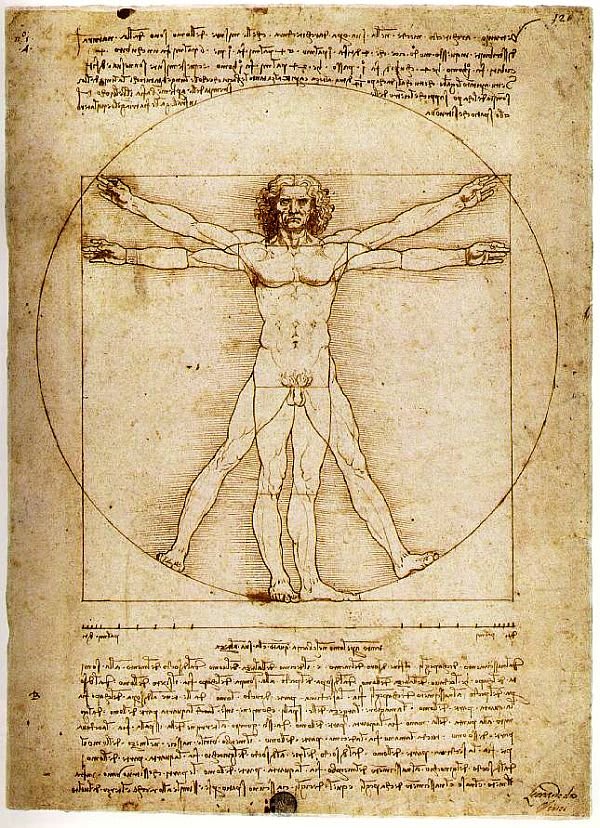
The drawing depicts a man in two different positions, one inscribed in a square and the other in a circle.
The navel of the man marks the center of the circle while his genital organs mark the center of the square.
The Ideal Proportion of the Human Body
The circumference touches all the fingers of the hands and feet of the extended limbs, while the height of the figure corresponds to eight times the height of the head.
The total length of the extended arms is equal to the height of the man, just like seven times the size of his foot, and also equal to the height of the man.
These are just a few examples and principles that govern the Vitruvian Man, a classic representation of the ideal proportion of the human body, created by Leonardo da Vinci based on the writings of the Roman architect Vitruvius.
This masterpiece not only illustrates the harmony and symmetry of the human body but also reflects the Renaissance search for understanding and precise representation of nature and the world around us.
Leonardo used this study in his paintings, believing in a specific proportion directly between the members and the height.
Da Vinci was considered the first naturalist who sought to find the key to extending and depicting anatomical aspects in a mathematical way.
Most of Leonardo's studies and experiments related to the Vitruvian Man helped his inquiries into perfect art.
If he could not capture exactly the proportions, perspective, or how a shadow is projected in a particular light, he could create scientific experiments and, methodically, take measures to resolve them and, thus, capture the image perfectly forever.
VIDEO - The Vitruvian Man in 3D animation
Credits: Henrique Minuzo


