
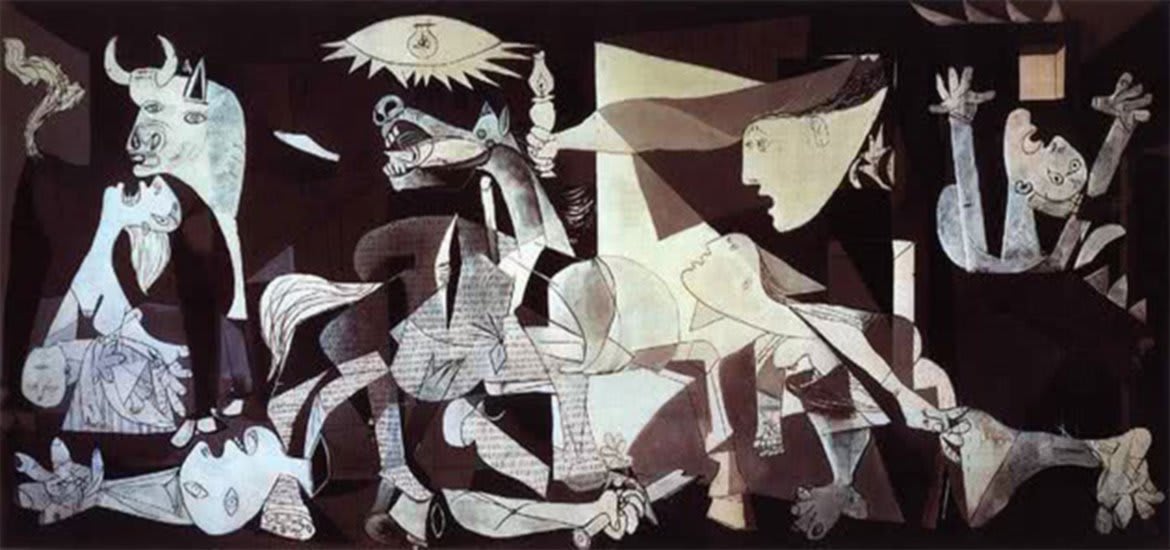
Analysis of the Painting Guernica, Pablo Picasso
Analysis of the Painting Guernica, Pablo Picasso
Considered one of the most important works produced in the 20th century, Guernica, by Pablo Picasso, is not just a painting; it's a historical document.
In a certain moment, it speaks about itself and in that moment, we can identify traits of a distant era, analyze political, cultural, and social aspects of a tumultuous period.
- What message did the painter want to convey??? He was definitive in his poem where he relates the horrors he portrayed on that canvas:
"Cries of children, cries of women, cries of birds, cries of flowers, cries of beds, cries of trees and stones, cries of bricks, furniture, cars, chairs, curtains, pots, cats, and paper, cries of smells, which spread one after the other, cries of smoke, which prick the shoulders, cries that cook in the big chair, and the rain of birds that flood the air."
In the early 1937, in the midst of the Spanish Civil War, the master of Cubism, Pablo Picasso, received a commission from the Republican government of Madrid for a mural to be displayed at the Espanhol Pavilion at the International Exposition held that year in Paris. But Picasso, in his own words, was going through "the worst time" of his life, both personally and artistically. By the end of April, when the bombing of Guernica occurred, the artist was without inspiration, until he learned of the event.
Every artistic expression is deeply linked to History. On the canvas, the artist deposits all his consternation. The work, still current, is present in the memory of humanity.
To better understand this painting, it is first necessary to know what was happening at the time the artist painted this masterpiece:
In 1936, Hitler signed a pact of friendship and cooperation with the Italy of Mussolini. Germany and Italy intervened in the Spanish Civil War, supporting the totalitarian forces of General Francisco Franco, who fought against the Spanish Republic, representing the popular forces. By supporting Franco, Nazism could test its arms in Spain, rehearsing military actions that would be used in World War II. Germany used the city of Guernica as a testing ground, massacring its population. On April 26, 1937, the bombers of the Legião Condor reduced the Basque town of Guernica to ashes. The three-hour air raid cost the lives of 1,645 innocent civilian lives.
The news of the tragedy, during the May 1st parade in 1937, in Paris, was the inspiration that Picasso sought. Immediately, the artist picked up his brushes, under the attentive gaze of his companion, the photographer Dora Maar. The violent episode was immortalized in Picasso's canvas-denunciation, which shows the horrors of that bombing.
Pablo Picasso was always attentive to social injustices. Engaged, he fought against Francoism and Nazism. When a representative of Hitler's embassy in Paris visited him during the exhibition at the Republican Pavilion, and the man, observing the painting, asked if Guernica was his work, Picasso replied: No, the work is yours!
ANALYSIS OF THE WORK
A work of art for a modern artist like Picasso always fulfills a social function.
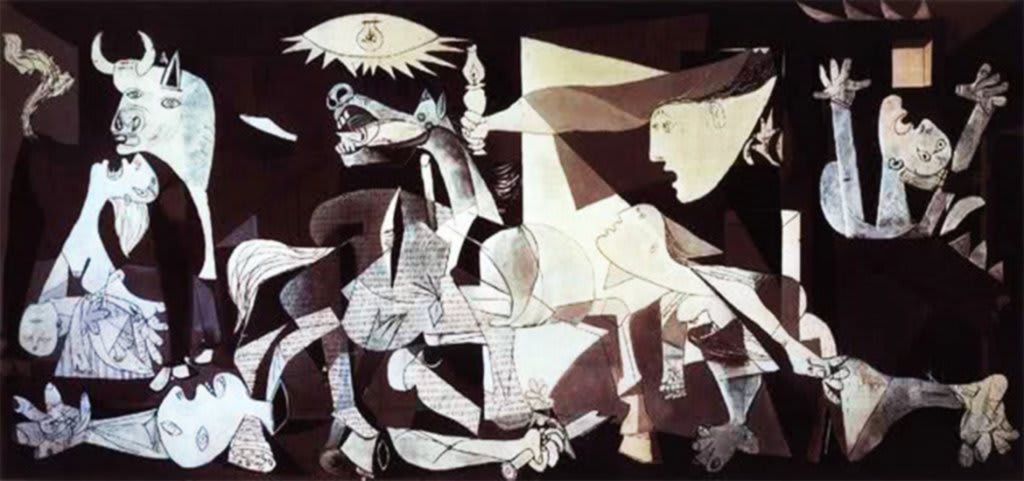
Upon observing the canvas, we find figures that express affliction, pain, insecurity, suffering, such as the woman with the child in her arms and the horse. Picasso used only neutral colors, as he could not opt for bright colors with so much horror and destruction caused by the war. Some figures, such as the flower, the bull, and the hand holding a lamp, are symbols that are loaded with meanings, which refer to diverse interpretations. These figures, in the context of the work, give us the idea of the struggle, the violence in the village, and at the same time represent the beginning, the hope of a people who was massacred.
Many historians believe that the man with open arms, located on the upper right side of the canvas, was inspired by a painting by Goya, also a Spanish painter who, in 1808, painted "The Three of May", where he depicts a tragic circumstance that occurred in Spain, the execution of Spanish civilians by the army of Napoleão Bonaparte.
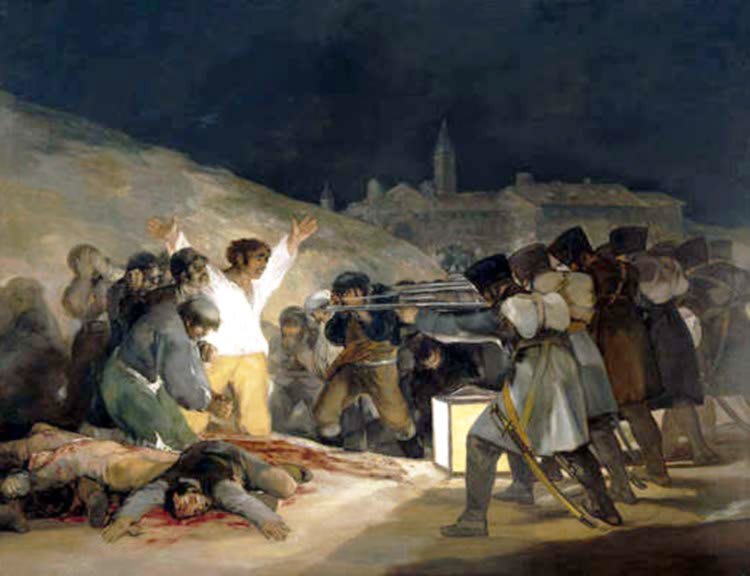
By analyzing the two works, we can establish an analogy, in the similarity between the paintings, but with a detail: in Guernica, the man's arms are directed upwards, in an attempt to stop the bombs falling from the sky, in desperation. Goya makes a reference to Jesus Christ, who also died with open arms, showing that social injustices are repeated.
Although the painter emphasized the realistic character of the scene, it cannot be doubted that it is also an invitation to surrealism. Some scholars defend that Guernica belongs to expressionism, or, as Picasso would prefer, a journey through realism with touches of metaphor.
The painting was exiled for more than forty years in New York, at the request of Picasso while Franco was in power, the canvas only returned to Spain in 1981.
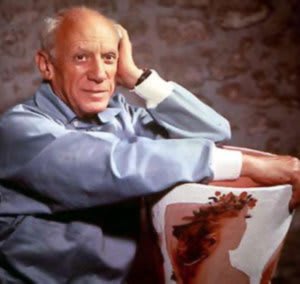
Pablo Diego José Francisco de Paulo Juan Nepomuceno Maria de Los Remédios Críspin Crispiano Santíssima Trinidad Ruiz y Picasso,
was more than the greatest modern artist – he and his multifaceted work embody the very spirit of the 20th century. Cosmopolitan, he began with French impressionism, Spanish figurative painting, and African primitive art. Multiple, he painted, sculpted, made lithographs, designed ballet sets, and still found time to invent Cubism and date... With each new passion, his art gained a new impulse, so we can consider his work as autobiographical.
Learn more about Pablo Picasso .... click here


