
Antoni Gaudí: A Life in Works — The Evolution of a Singular Style and Its Enduring Early Legacy
Antoni Gaudí: Biography and Works: The Evolution of a Singular Style and His Early Legacy
Gaudí's early works, created during his formative years and the period immediately following, already stood out for their meticulous detail, their embrace of geometry, and the clear influence of mechanical considerations in structural calculations.
During his university education, Gaudí authored several projects, among them a university pavilion in 1877.
Immediately after graduating from the Barcelona Provincial School of Architecture in 1878, Gaudí designed in a style blending Victorian influences with the Moorish or Mudéjar style — a fusion of Muslim and Christian art, quite common in Spain.
These involved vibrant surfaces crafted from molded stone or brick, ceramic panels, and metal structures adorned with floral or reptilian motifs, as can be observed in this construction within Park Güell:
 Antoni Gaudí: Biography and Works" class="wp-image-16618" style="width:796px;height:auto"/>
From 1902 onwards, Gaudí’s projects transcended conventional architectural styles, developing his distinctive original mark, known as Balanced Architecture – a structure designed to support itself, without internal or external supports, just as the architect himself stated: exactly like a tree stands tall.
During his most prolific period, masterpieces followed one after another, including: the Bellesguard Tower, Park Güell, the restoration of the Cathedral in Palma de Mallorca, the Colònia Güell Church, Casa Batlló, Casa Milà (La Pedrera) and finally, the Expiatory Church of the Sagrada Família.
Surprisingly, the magnificence of Antoni Gaudí’s architecture coincided, as a result of a personal decision by the architect, with a progressive withdrawal of the man himself. Gaudí, who in his youth attended theaters, concerts, and art exhibitions, transitioned from an elegant young man of refined taste to neglecting his personal appearance, eating frugally, and distancing himself from social life, all while dedicating himself ever more fervently to a religious and mystical sentiment.
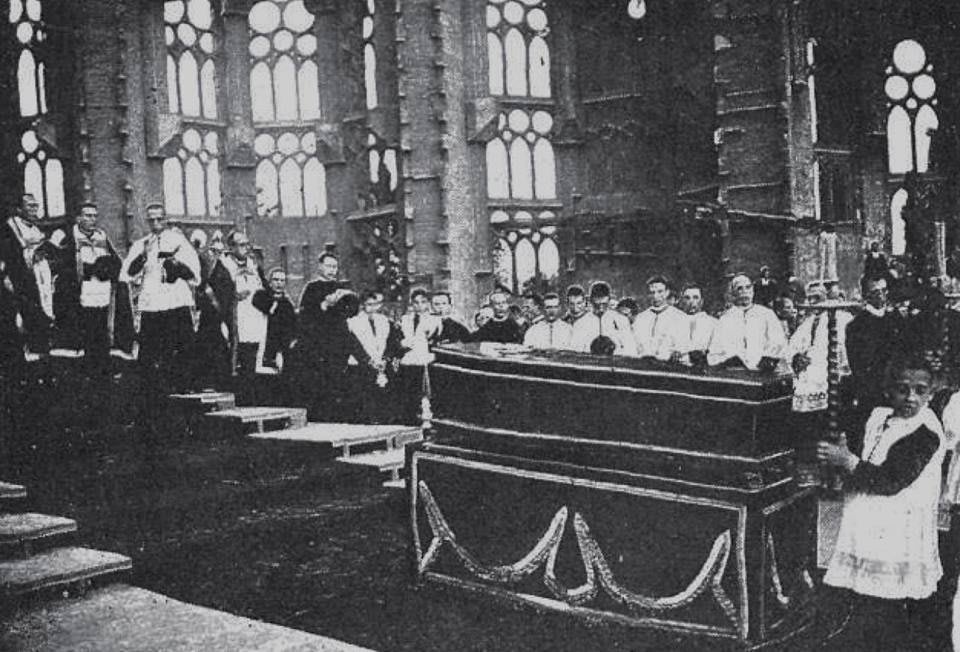
Gaudí tragically passed away on June 10, 1926, after being struck by a tram while making his nightly pilgrimage to the Sagrada Família, from the Church of Sant Felip Neri. After being hit, he lost consciousness, and no one suspected that the disheveled old man without identification was the renowned architect. He was taken to Hospital de Santa Cruz, where he was later recognized by the Priest of the Sagrada Família. He was buried two days later in that same church, following a funeral attended by a multitude of people: most of Barcelona’s citizens turned out to bid a final farewell to the most universal architect the city had ever known.
Gaudí, the architect who shaped Catalonia with his ultra-colorful mosaics, unusual designs, a tremendous aesthetic sense, and, of course, a touch of madness... no matter which of his works or where it stands, all of them are proof of the existence of a grand master, misunderstood in his time, yet celebrated by future generations and regarded as one of architecture's true maestros.
It's evident that Gaudí and his work will continue to haunt the imagination of future generations, for whom this great architect might officially come to be known as Saint Antoni Gaudí.
MAJOR WORKS
To understand the rest of this journey, continue with our next article: Antoni Gaudí: Biography and Works: The Masterpieces That Shaped Barcelona and the World.


