Biography of Francisco de Goya and His Major Works: Artistic Legacy and Annotated Gallery
Biography of Francisco de Goya and His Major Works: Artistic Legacy and Annotated Gallery
Goya's broad, visible brushstrokes were a landmark.
They paved the way for the spontaneous style of Impressionism and solidified the essentially Spanish themes of his art.
Édouard Manet, for instance, felt this influence directly.
He drew inspiration from Maja Desnuda to create his daring Olympia.
Manet was equally, if not more, audacious in his radical reinvention of the classical nude, presenting her as a modern courtesan.
Still from Manet, his fragmentary painting The Execution of Emperor Maximilian makes a direct reference to another of Goya's masterpieces.
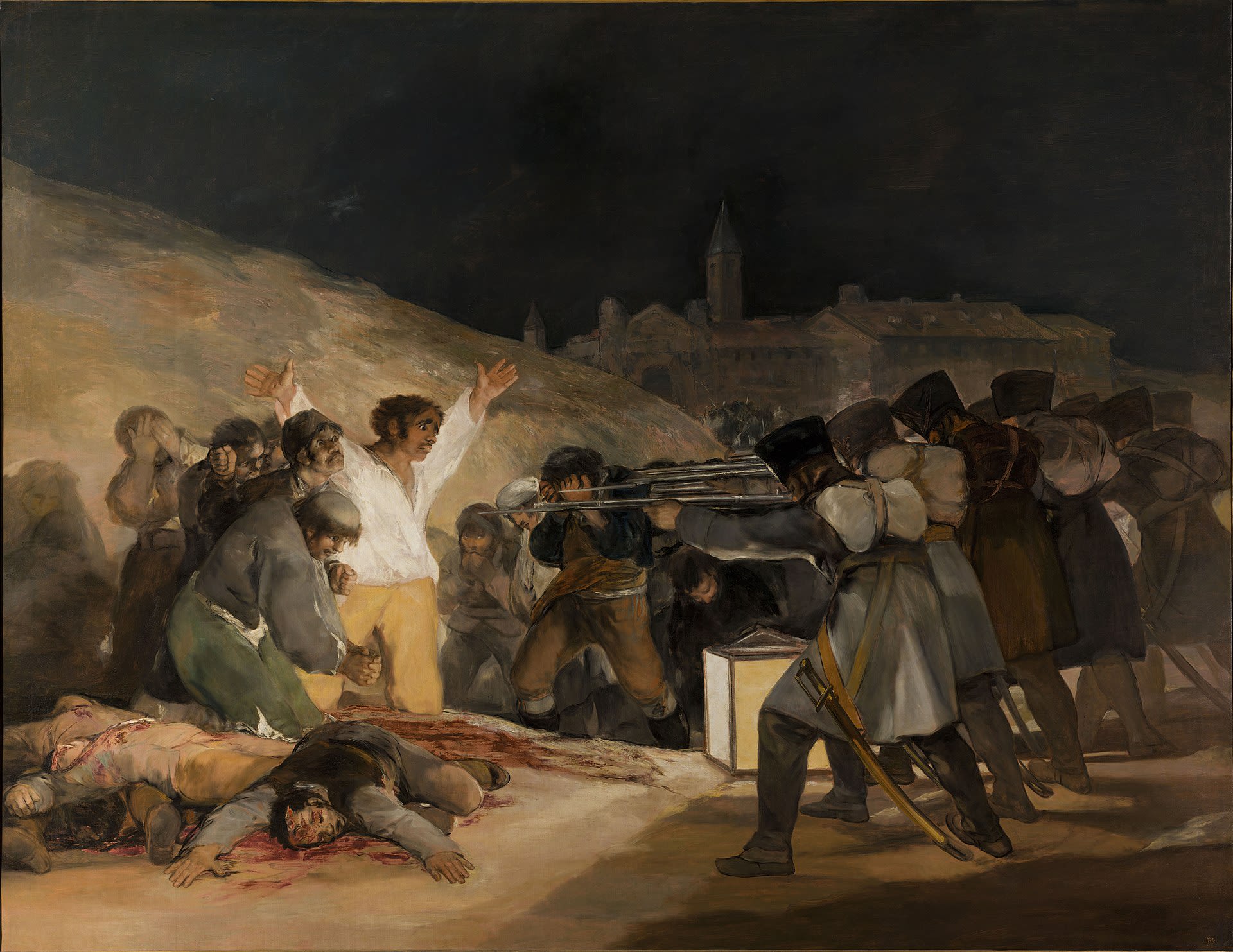
We are talking about Goya's The Third of May 1808.
Manet echoed both Goya's moral outrage and formal composition, even though his sympathies lay with the Mexican executioners, not the assassinated emperor.
Goya's politically engaged, subjective, and imaginative art was a crucial leap.
It represented a significant step towards Modernism.
In his engravings, Goya was a fierce critic of the events of his time.
He addressed themes such as war, corruption, social ills, and deeply rooted superstitions.
This critical spirit would later inspire another Spanish genius: Pablo Picasso.
Picasso's masterpiece, Guernica, is a clear example of this heritage.
Picasso also revolted against contemporary injustices, depicting the fascist bombing of a Spanish village during World War II.
Goya's legacy has a surprising reach.
It extends to Surrealism.
Surrealist artists delved into his etchings and the famous Black Paintings.
The dark and dreamlike themes of these works were a deep source of inspiration.
Even Salvador Dalí created his own version of Caprichos in 1973, a gesture that underscores Goya's timeless relevance.
But the true depth of his vision is revealed in every canvas he touched.
GALLERY - ANNOTATED ART
Goya was an artist of great contrasts and intense internal conflicts.
He embraced the ideals of the French Revolution but despised the tyranny imposed by the new emperor Napoleon.
This duality was reflected in his works, which display a dark and trenchant vision of the society and politics of his era.
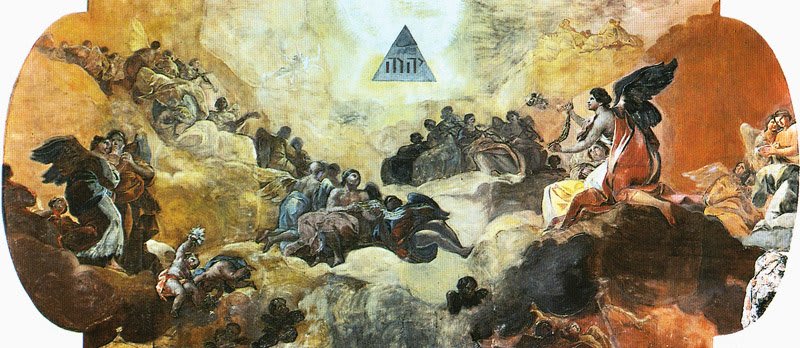
Adoration of the Name of God
In 1772, Goya returned from Italy to Zaragoza.
One of his first tasks was to execute a grand fresco in the Basilica of Our Lady of the Pillar.
The painting, which depicts the Adoration of the Name of God, exhibits striking characteristics of late Baroque Catholic religious painting.
In it, two groups of angels are arranged to frame a central source of light.
This light highlights an equilateral triangle, enveloped by a radiant glow, which contains the symbol of God the Father, with his name written in four Hebrew letters.
The Dance on the Banks of the Manzanares
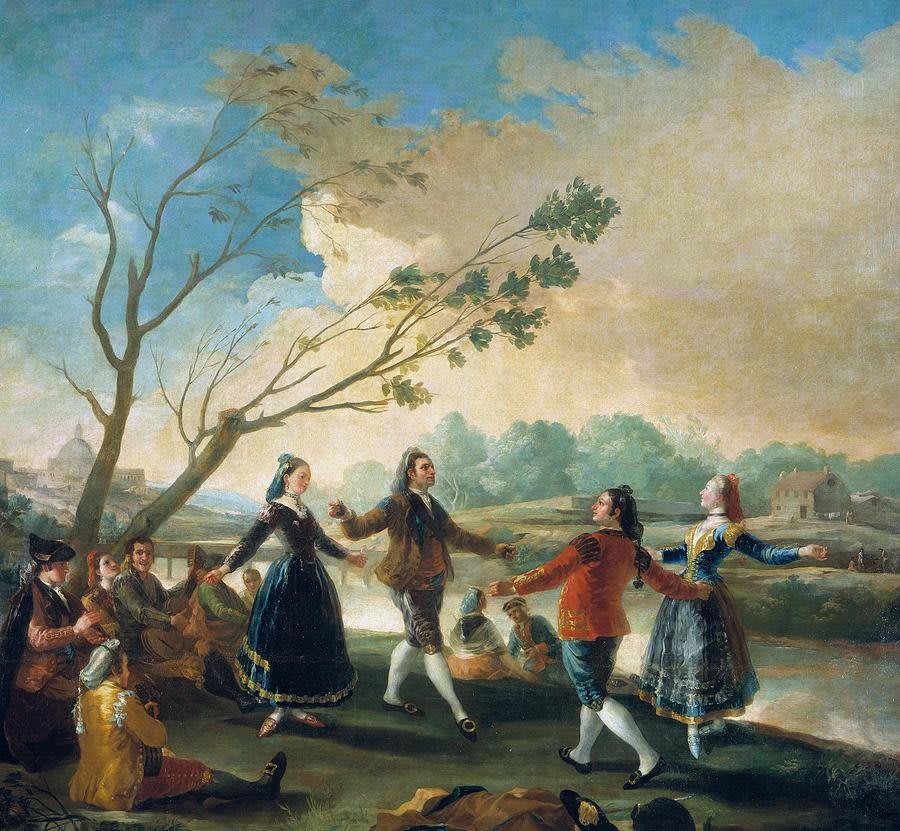
The municipality of Manzanares, in Madrid, is a region of unique beauty.
Tourists from all over the world are drawn to its charms, especially the Castle of Los Mendoza, erected in the 15th century.
In this work, Goya captures the idle class enjoying a serene day by the river.
Themes such as traditional bullfights, tavern brawls, and common people dancing bolero or fandango were common in his canvases.
These scenes, however, could serve as parody or, more intentionally, to veil the horrors of the war that plagued the era.
The Parasol
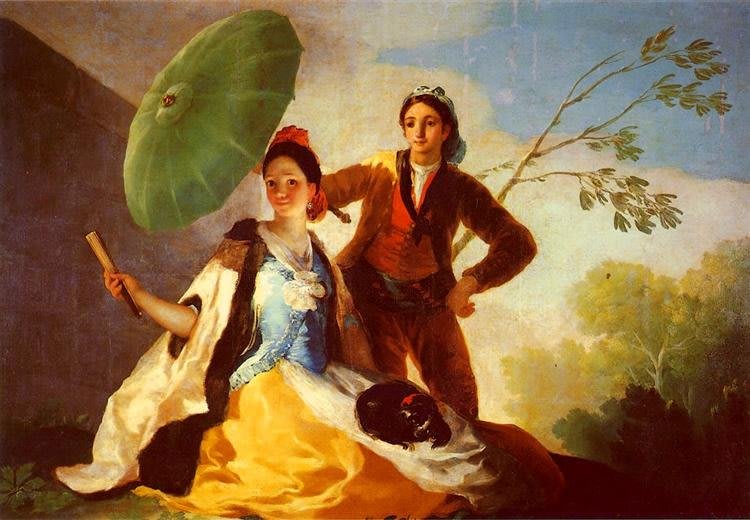
This canvas stands out as one of the most significant from Goya's early phase.
During this period, the artist received an important commission: to provide designs for the Royal Tapestry Factory of Santa Bárbara.
Goya, here, exhibits a clear influence of classical Italian painting, visible in both theme and style.
The inspiration for the work springs from "galant life," portraying a typical aspect of 18th-century European court attire.
The painting's atmosphere is subtly permeated by a certain eroticism, even if the chivalrous gesture is an act of pure courtesy.
The grace and elegance of the composition shine in the delicate play of shadows on the young woman's face, a detail that extends throughout the work.
Christ Crucified
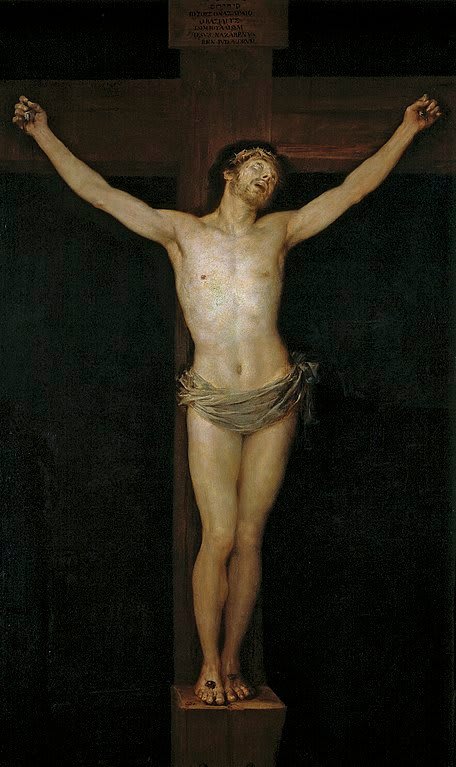
In this work, the crucifixion of Jesus Christ is depicted following the precepts of the neoclassical style.
Jesus is positioned against an intense black background, with his head gently tilted to the left.
Perhaps he is looking upwards in a dramatically restrained manner.
To innovate, Goya chooses to focus on expression rather than explicit drama.
Interestingly, there is no sign of blood spillage in the painting, a choice that modernized it for the time.
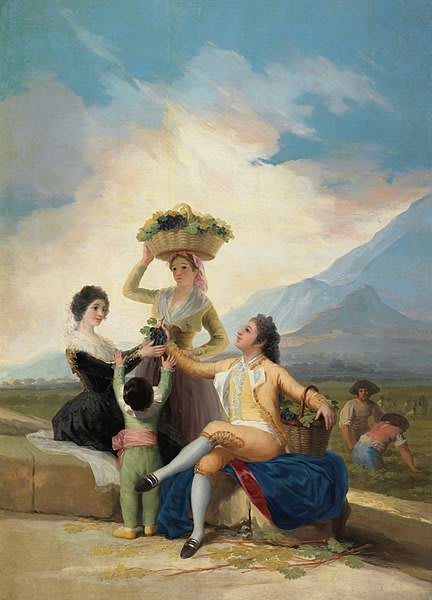
The Grape Harvest
This composition is recognized as one of the most beautiful and celebrated in Goya's entire output.
Its pyramidal structure and figures, which evoke ancient statuary, demonstrate Goya's in-depth study of classical artistic tradition.
The original drawing that brought this painting to life was created for one of the tapestries.
This tapestry was intended for the dining room of the Prince of Asturias, in the grand El Pardo Palace.
El Aquelarre or Witches' Sabbath
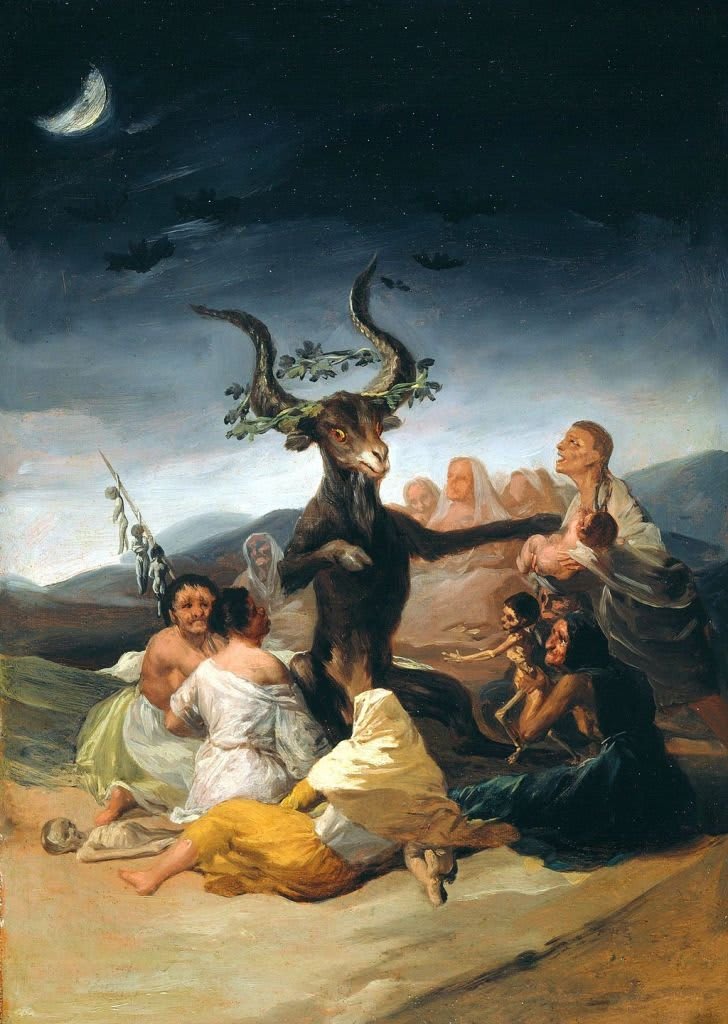
This painting is one of the works that make up a smaller collection.
Goya executed it between 1797 and 1798, with the aim of decorating the recreational palace of the Dukes of Osuna, near Madrid.
The scene depicts an Aquelarre ritual, where a prominent goat in the center symbolizes the devil.
Female figures, young and old, are seen feeding the "Great Goat" with children, a disturbing image.
The dark tones of the work, the setting, and the nocturnal landscape were carefully chosen to evoke a nightmarish feeling in the viewer.
In this painting, and throughout the series to which it belongs, the predominance of somber tones in nocturnal settings is striking.
Coincidentally, Goya was working on his series of 80 engravings, Caprichos, during the same period of this work's execution.
The theme of witchcraft was quite popular among Spanish intellectuals, friends of the painter.
In addition to this one, five other paintings with similar themes enrich the collection.
Charles IV of Spain and His Family
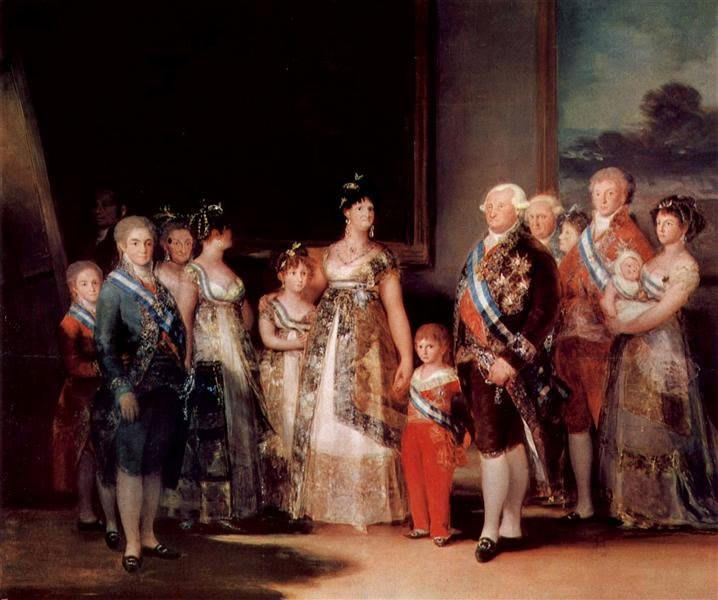
This grandiose portrait presents Charles IV, King of Spain, in life-size.
Beside him, other members of the royal family display luxurious attire and dazzling jewels.
Goya masterfully employs colors to picturesquely capture the skin tones, garments, and hair of the characters.
Queen Maria Luisa of Parma occupies the center of the canvas, in an affectionate gesture, embracing her daughter Maria Isabel and son Francisco de Paula.
An unknown woman is also present, next to the girl.
It is speculated that she is the fiancée of the king's eldest son, Ferdinand VII.
Although some suggest Goya used the work to satirize royalty, this interpretation has been largely rejected by many art critics.
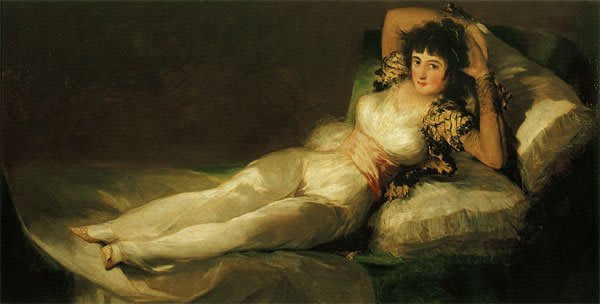
The Nude Maja and The Clothed Maja
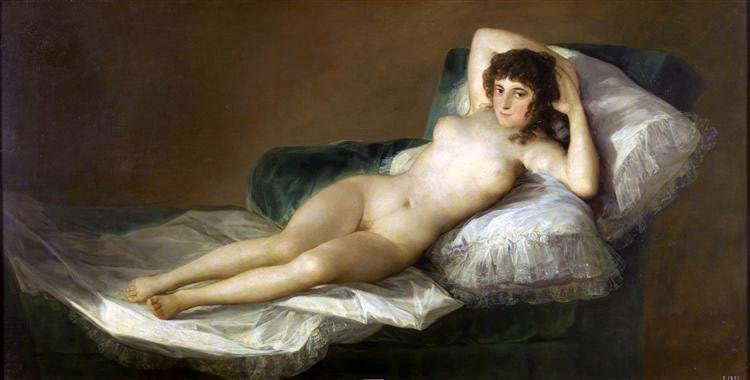
This is, indeed, an extremely daring presentation for its time.
The work depicts a naked woman, elegantly reclining on a bed, surrounded by soft pillows.
Her eyes are fixed on the viewers in a seductive and direct manner.
There are speculations about the model's identity: some believe it to be the Duchess of Alba, a rumored love interest of Goya.
Others, however, identify her as the mistress of the then Spanish Prime Minister, Manuel de Godoy.
Subsequently, Goya created a sister work, a painting of the same lady, but this time, fully clothed.
To delve deeper into this intriguing story, learn more about Goya's famous Majas.
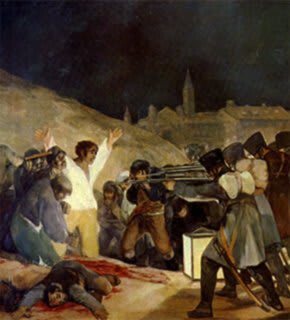
The Executions or The Third of May 1808
This painting is widely considered one of the first truly modern depictions of war.
Its power profoundly impacted future works by renowned artists.
Among them, Édouard Manet, with his work The Execution of Emperor Maximilian.
And also Pablo Picasso, who created Massacre in Korea.
To delve into the details and history of this iconic work, click here to learn more.
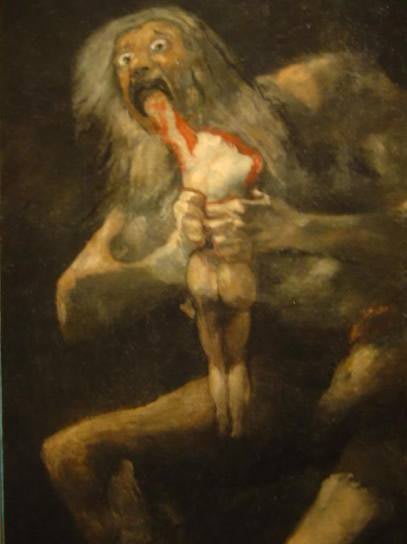
Saturn Devouring His Son
This is, without a doubt, one of the most celebrated of Goya's Black Paintings.
The work presents a profoundly frightening theme, where Saturn is shown devouring one of his own children.
The painting has been the subject of various interpretations over time.
Some see in it a literal recreation of the famous Greek myth.
In this myth, Saturn consumed each of his children shortly after birth, driven by the fear of being overthrown by them.
Other critics, however, analyze Saturn's nudity, disheveled appearance, hysterical nature, and aggressive behavior from a more political perspective.
They suggest that the figure may represent Spain's autocratic state, which tormented its own citizens, or even be an allusion to the brutality of the French Revolution.
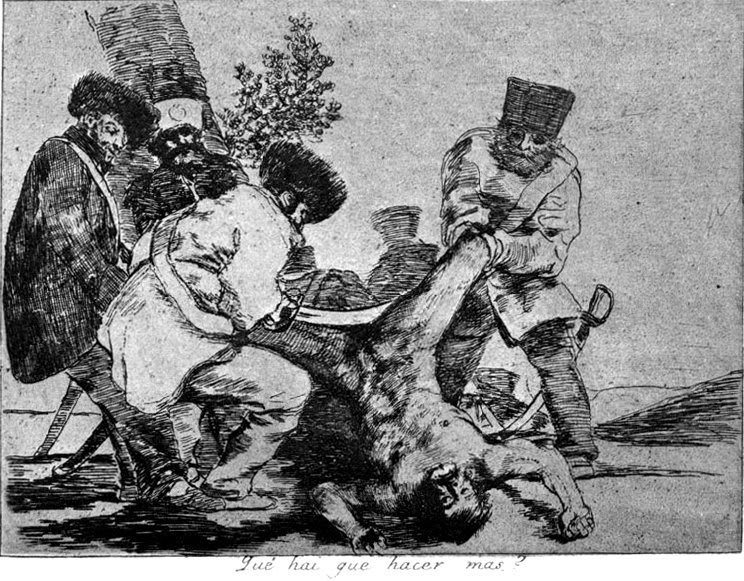
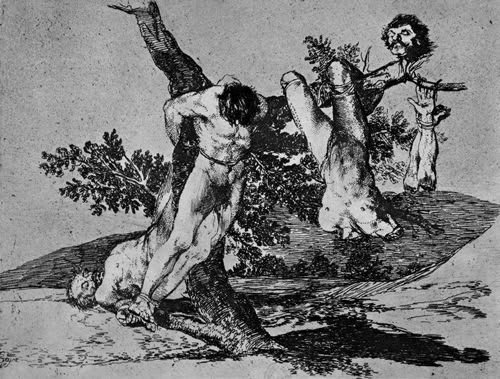
Comprising 82 engravings, the series "The Disasters of War" is a brutal and unforgettable testament by Goya.
It vividly and rawly narrates the horrors of the Napoleonic invasion of Spain.
More than that, it documents the desperate uprising of the population against French domination.