
Biography of Joaquín Sorolla: Childhood and His First Steps in Art
Biography of Joaquín Sorolla: Childhood and His First Steps in Art
Joaquín Sorolla was a renowned Spanish painter celebrated for his realistic and impressionistic works depicting everyday life, landscapes, portraits, and historical scenes.
His oeuvre includes portraits of prominent figures of the era, such as the Spanish royal family, as well as captivating scenes of beaches and fishermen.
He is considered one of the most significant Spanish artists of the late 19th century and early 20th century.
BIOGRAPHY
Joaquín Sorolla y Bastida was born on February 27, 1863, in Valencia, Spain. A year later, his only sister, Concha Sorolla, was born.
Both children were orphaned in 1865 when their parents, Joaquín Sorolla Gascón and María Concepción Bastida Prat, succumbed to a cholera epidemic. Consequently, the children were raised by their maternal aunt and uncle.
His uncle, a locksmith, attempted to teach the trade to his young nephew. However, while Sorolla performed his tasks, his true interest lay in drawing.
In 1876, following the advice of his high school principal, his uncle enrolled him in evening classes at the School of Crafts of Valencia.
Two years later, driven by his burgeoning interest in painting, he was enrolled in the Superior School of Fine Arts of Valencia.
During this formative period, Sorolla already displayed a realistic tendency, heavily influenced by Valencian marine painters. However, he had yet to fully define his personal style.
In 1881, he completed his studies and met the painter Ignacio Pinazo, who, upon returning from Italy, introduced a novel approach to light, influenced by Impressionism in his pursuit of lighting effects. Sorolla swiftly adopted this style.
At the Academy, he encountered another student, the son of Antonio García, a well-known photographer.
This connection led to him working for García, developing photographs.
This relationship would significantly impact his personal life, as García was the father of Clotilde García, who would later become Sorolla's wife.
In 1881, Sorolla submitted three Valencian seascapes to the National Exhibition of Fine Arts in Madrid.
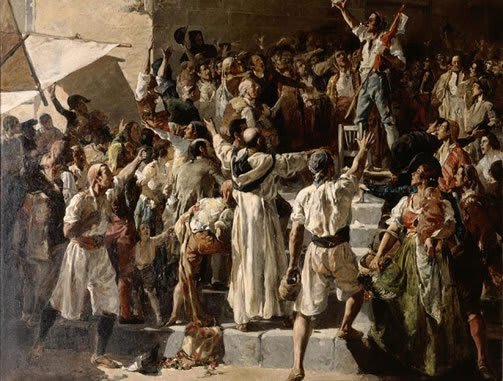
In 1884, the Provincial Council of Valencia organized a painting competition, awarding Sorolla a scholarship to Rome to further his studies. The mandatory theme was the War of Independence of 1808. Sorolla presented The Cry of the Palleter, a work depicting the national hero—a straw vendor—inciting the populace to join the uprising against Napoleon.
The painting deeply impressed the jury, securing him the scholarship.
He moved to Rome in early 1885.
To delve into the rest of his journey, continue with our next article:


