Biography of Luiz Sacilotto and His Work
Discover the life and art of Luiz Sacilotto, a renowned Brazilian artist of the 20th century.
Join me on a journey through the life and work of Luiz Sacilotto, one of the most important Brazilian artists of the 20th century.
Sacilotto's biography reveals not only a talented artist but also a thinker who played a crucial role in the development of concrete and abstract art in Brazil.
His fascinating story and contributions to the art world are essential to understanding the evolution of Brazilian and international art.
As you delve into his history, you will discover a universe of shapes, colors, and ideas that profoundly impacted Brazilian and international art.
The Brazilian artist Luiz Sacilotto, world-renowned for the importance of his work, was a great follower of Abstract Art and is considered one of the main representatives of Concretism.
When I first opened the books on geometry, I came across triangles, rectangles, and circles.
I learned that those shapes served a purpose.
But I also noticed that they were beautiful.
They gradually captivated me.
I realized over time that their development could lead to surprising and extraordinary results.
I believe that every person should have something fundamental in their life.
For me, it's working with those shapes.
BIOGRAPHY
Biography of Luiz Sacilotto: Born on April 22, 1924, in São Paulo, Brazil, to Italian immigrant parents, Luiz Sacilotto grew up in the city of Santo André, a major industrial hub in the country.
He spent his childhood in the city's streets and set up his atelier-residence there.
In the 1940s, he studied painting and decoration at the Instituto Profissional Masculino do Brás, a São Paulo neighborhood, where he graduated in 1941.
The following year, he enrolled in the Escola Técnica Getúlio Vargas, specializing in painting.
In 1944, he began working at the Indústria Hollerith do Brasil as a designer and metal escutcheon designer, simultaneously developing his artistic career, which passed through the figurative phase and gradually evolved into abstraction.
Biography of Luiz Sacilotto: During World War II, from 1944 to 1945, Sacilotto was conscripted into the FEB (Brazilian Expeditionary Force), 2nd Tank Battalion, in Rio de Janeiro's Vila Militar, where he stayed for nine months.
With the war's end in 1945, he returned to São Paulo and resumed his artistic activities and job at Hollerith do Brasil.
Biography of Luiz Sacilotto: In 1946, he left his job at Hollerith and started working at the Jacob Ruchti Architecture Office as a designer and project designer in São Paulo.
In the 1950s, he participated in six São Paulo Biennales (1951, 53, 55, 57, 61, and 67) and several international exhibitions.
In 1951, Sacilotto married Helena Adamastor, daughter of Hamashita Shun'Ichi, the first Japanese immigrant to settle in São Paulo, adopting the name José Adamastor.
In 1952, he participated in the "Rupture" exhibition at the MAM - São Paulo Modern Art Museum.
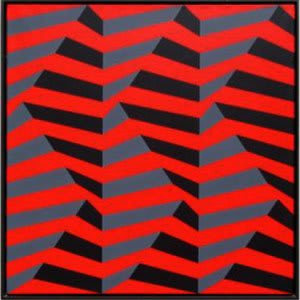
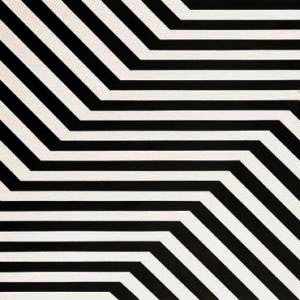
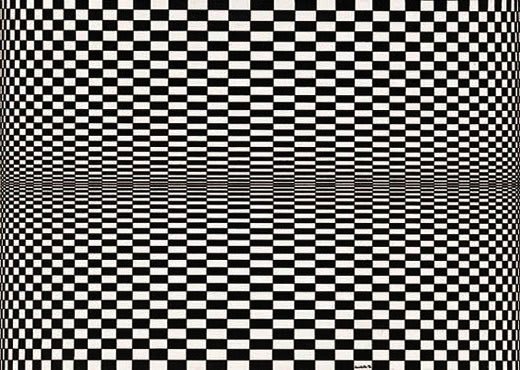
The repetition and optical games are the fundamental points for the construction of Sacilotto's work, which remains linked and related to the means of production, marking his origins in the ABC region's industrial hub, São Paulo.
In the 1960s, Sacilotto reduced his production due to the 1964 Military Coup.
Disappointed with the country's political situation, he temporarily interrupted his artistic production and resumed it in 1966.
As one of the pioneers of Brazilian Concretism, a movement that included the approximation of art with industry through mass reproduction, it was expected that Luiz Sacilotto, a draftsman, sculptor, and painter, would also venture into printmaking.
This incursion began in 1954 through Hermelindo Fiaminghi, his fellow movement member and experienced graphic arts professional.
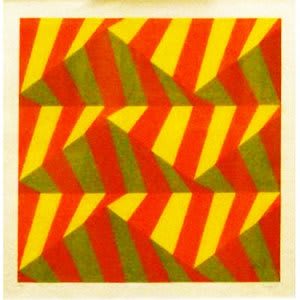
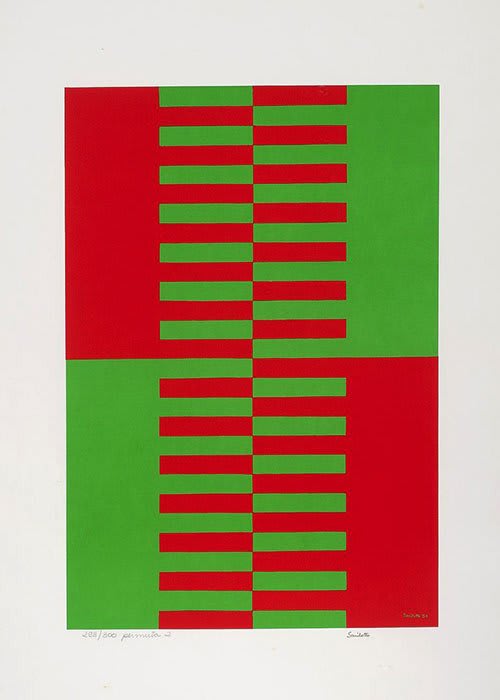
In the print below, for example, Sacilotto places red alongside its complementary color, green, in pigment.
These two colors form the most vibrant pair among complements.
The rigorous shapes and flat colors establish an intriguing dialogue between them, drawing our gaze and inviting us to constantly switch between the four main rectangles within the larger rectangle.
Sacilotto's works do not include images of people, animals, or landscapes, but they concretize a certain way of thinking.
It would be impossible to analyze each one in a short space of time.
The observer must venture to discover the logic and poetry of each one for themselves.
A work that has its foundations in the beauty of pure form, flat color, competent modulation between the elements used, and dynamic relationships between background and form.
In fact, Sacilotto used the laws of structure preconized by Max Bill, consisting of alignment, rhythm, progression, polarity, internal logic of development and construction.
His work reconciles rigor and freedom exemplarily, a condition that has led to the emergence of consistent and durable works in all art segments.
BIOGRAPHY OF LUIZ SACILOTTO: DEATH AND LEGACY
In 1994, the artist suffered a stroke and temporarily interrupted his artistic production.
He resumed in the following year and, in addition to continuing to paint, began working with collages.
Sacilotto produced for over six decades, leaving a significant body of work.
He passed away on February 9, 2003, in São Bernardo do Campo due to respiratory problems.
His legacy and inspiration, the result of a life between paints, canvases, and various materials, continue to live on.
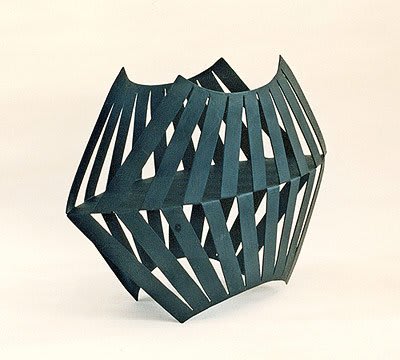
He left behind approximately 1,500 pieces, including paintings, sketches, drawings, prints, sculptures, and other works, including public art installations.
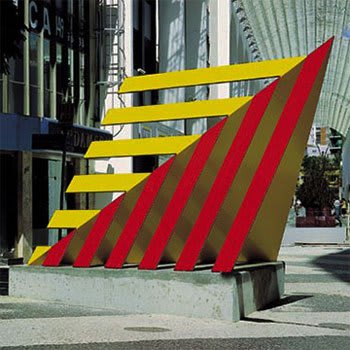
Aside from having works in Spain and the United States, Sacilotto is also responsible for leaving his hometown, Santo André, more beautiful.
The city's main street, Rua Coronel Oliveira Lima, was transformed into a "calçadão" with tiles reproducing his works.
Some of his works are scattered throughout the city for the population to see.
He is considered the city's greatest treasure.
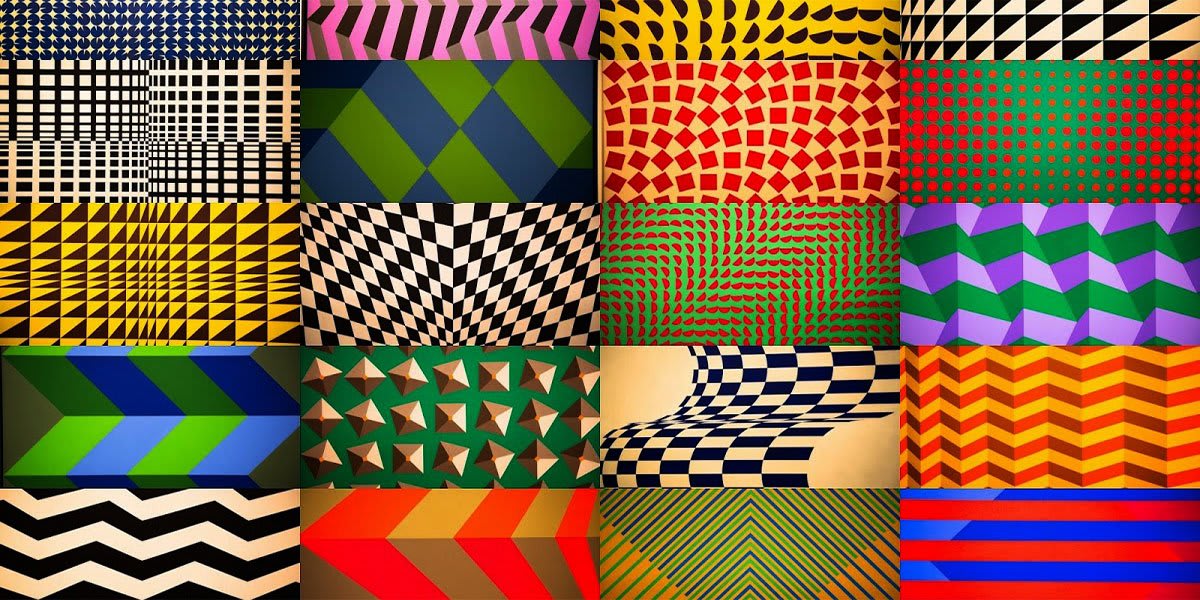
"What makes Luiz Sacilotto a masterpiece? The modulation between the sizes and shapes of the geometric areas, the filling of these areas with two colors that are known to be magnificent when appearing side by side." (Frase de Enock Sacramento retirada do site www.sacilotto.com.br)
BIOGRAPHY OF LUIZ SACILOTTO: GALLERY