Édouard Manet: Biography and Works: Complete Gallery and his Legacy in Art
Édouard Manet: Biography and Works: Complete Gallery and his Legacy in Art
Article Index
Édouard Manet: GALLERY
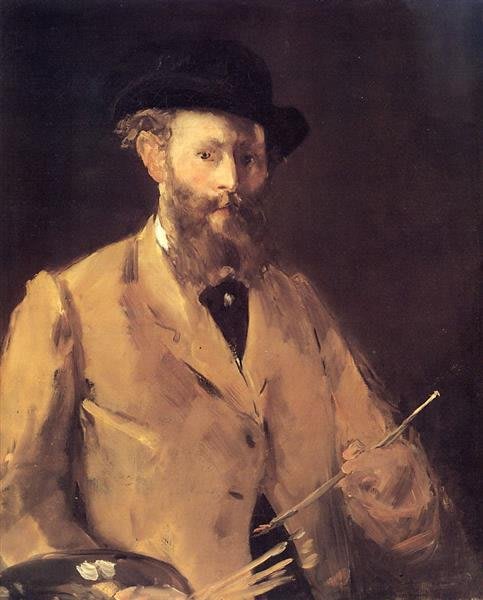
SELF-PORTRAIT (1879)
Édouard Manet, despite often including himself within his scenes, left us this self-portrait as one of the few direct representations of himself.
In this work, he appears in a brown coat and cap, holding a brush and palette—elements that truly define his essence as a painter.
Although the brush is in his left hand, logic suggests a mirrored image, as Manet was, in fact, right-handed.
But a hidden secret lies within this canvas: X-ray analysis revealed that the artist painted over an earlier profile portrait of his wife, Suzanne Leenhoff Manet.
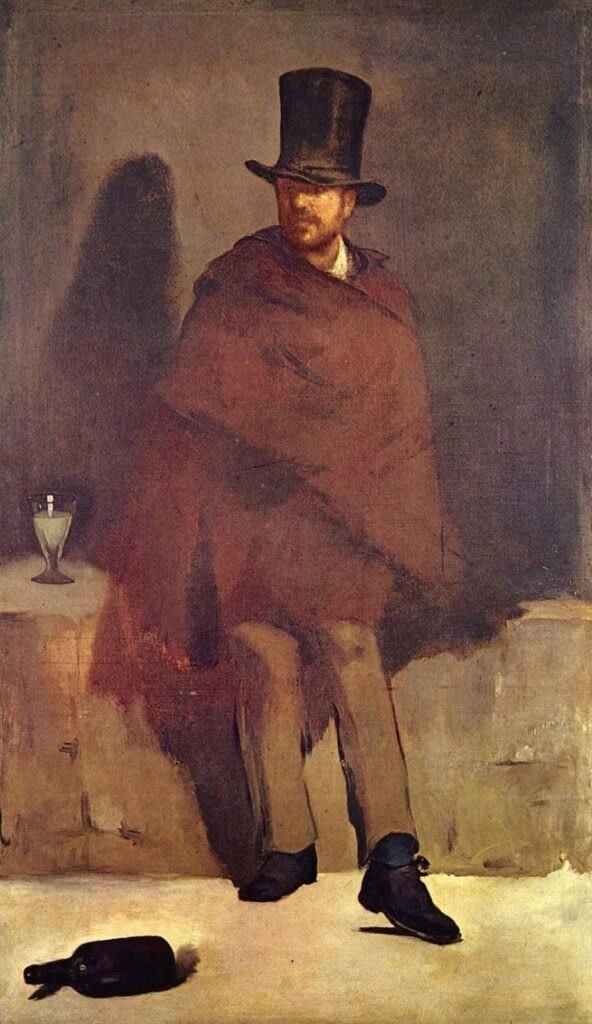
The Absinthe Drinker
This work was the first that Manet dared to submit to the prestigious Paris Salon.
In it, the artist depicts an alcoholic, a figure often interpreted as a raw reflection of modern Paris at the time.
Never before had the lower class been represented on such a monumental scale, which led the Salon jury to reject it without hesitation.
Curiously, a solitary and powerful vote stood out in its favor, coming from the respected Eugène Delacroix.
It was the only vote. The great master perceived that this absinthe drinker, with his unexpected elegance for a mere vagrant, was not what he seemed.
Manet's street vagrant, in fact, wore a dignity reminiscent of Raphael's characters.
Long before Manet redefined the portrayal of social reality, other masters were using light and shadow to capture the gravity of the human condition. The Anatomy Lesson of Dr. Tulp by Rembrandt
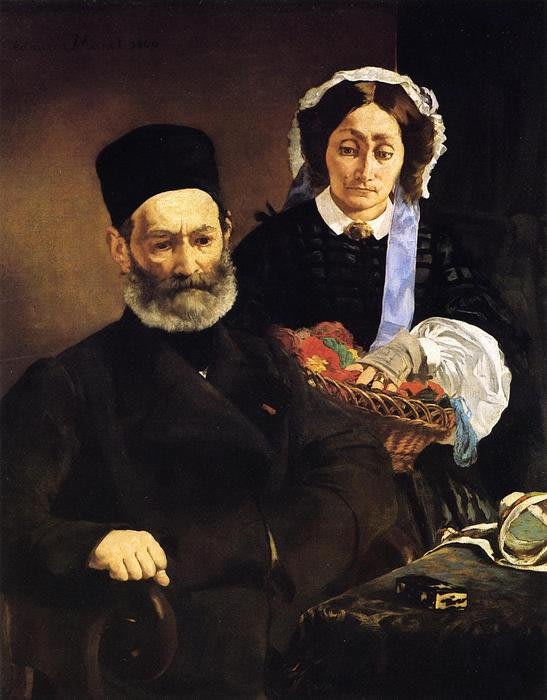
Portrait of Monsieur and Madame Auguste Manet
In this double portrait, Manet immortalizes his parents, erecting a true monument to the bourgeois conservatism of the traditional Parisian family.
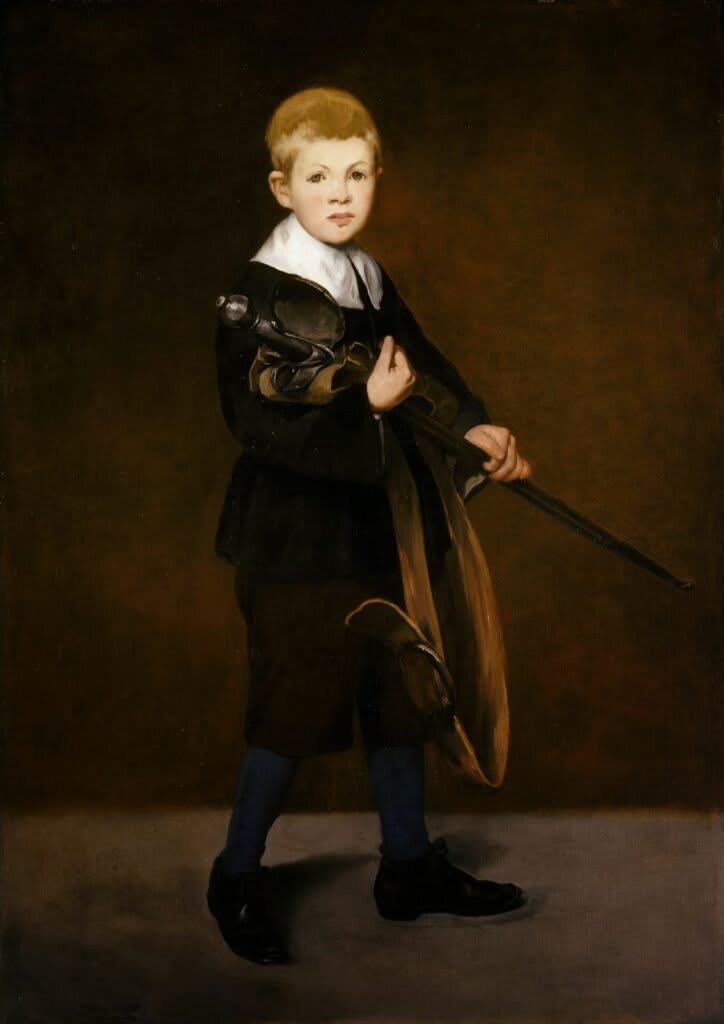
Boy with a Sword
This work is a portrait of Leon, in which Manet depicted him holding a sword as a prop, dressed in 17th-century attire.
It's a clear homage to the great Spanish painters of that period, with special emphasis on Velázquez, an artist Manet greatly admired.
Manet's Gaze: Portraits and Provocations
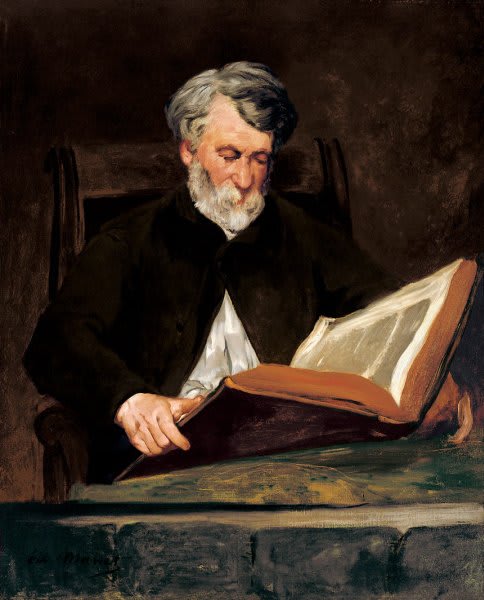
The Reader
In this portrait, Manet captured his friend Joseph Gall, also a Parisian painter.
The grand volume of the book suggests an ancient work of great cultural significance.
The artist's palette here is remarkably muted and restrained, lending a particular atmosphere to the scene.
The deliberate absence of detail in the attire adds a timeless quality to the portrait, as if the moment transcends fashion.
Despite the restraint, Manet's lively and creative brushwork is visible in the model's left hand, rendered with quick, almost abstract marks.
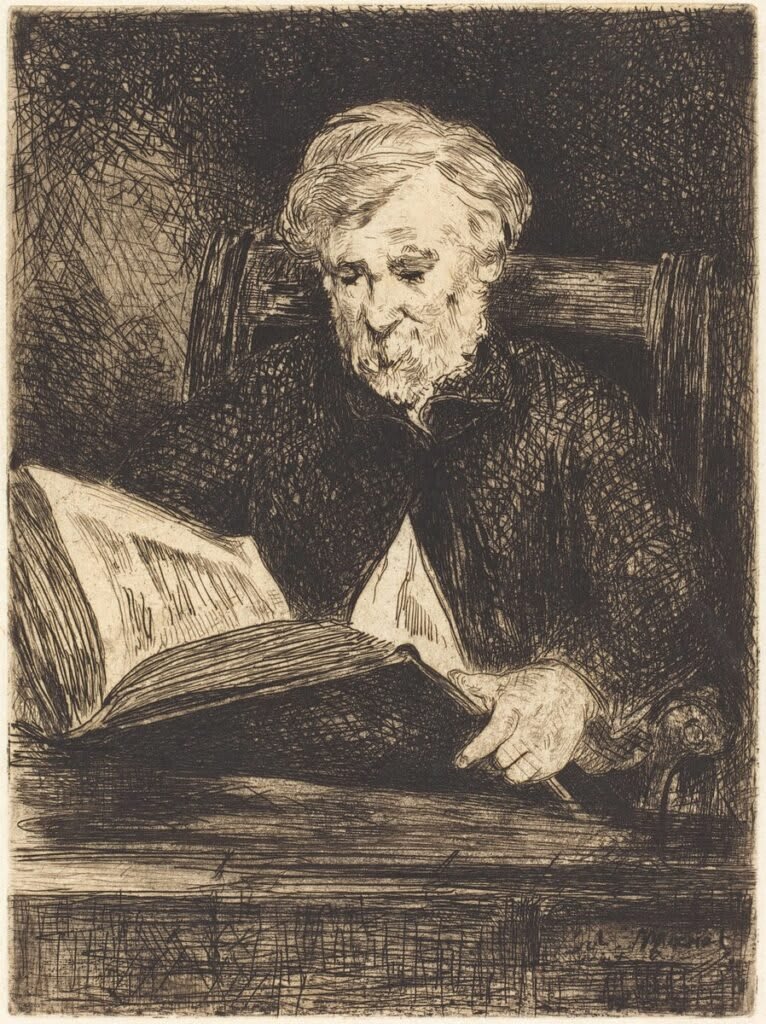
The same work, "The Reader," was also conceived by Manet as an impressive etching.
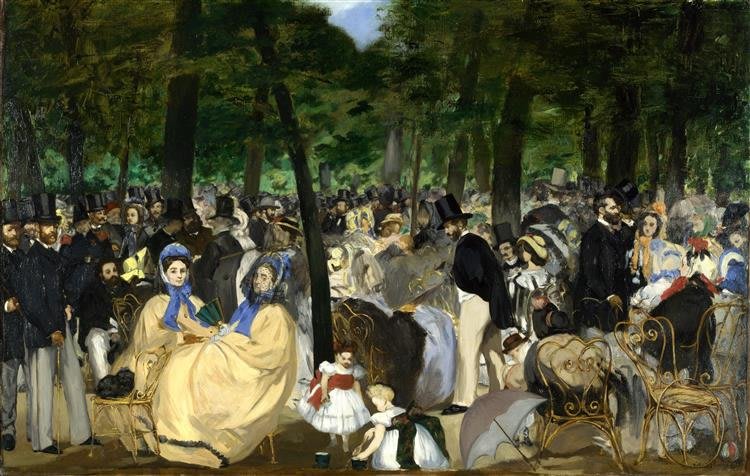
Music in the Tuileries Gardens
This work marks one of Manet's earliest forays, clearly revealing the influence of masters like Frans Hals and Diego Velázquez.
His rapid and visible brushstrokes led some critics to deem it "unfinished" at the time.
Nevertheless, the painting is an authentic and vibrant representation of the effervescence and lively gatherings in the Tuileries Gardens.
Manet, who loved depicting scenes of leisure and social interaction, included many of his friends, as well as a self-portrait, amidst the bustling scene.
Among the illustrious figures we can identify are Charles Baudelaire, Théophile Gautier, Henri Fantin-Latour, Jacques Offenbach, and even his own brother, Eugène.
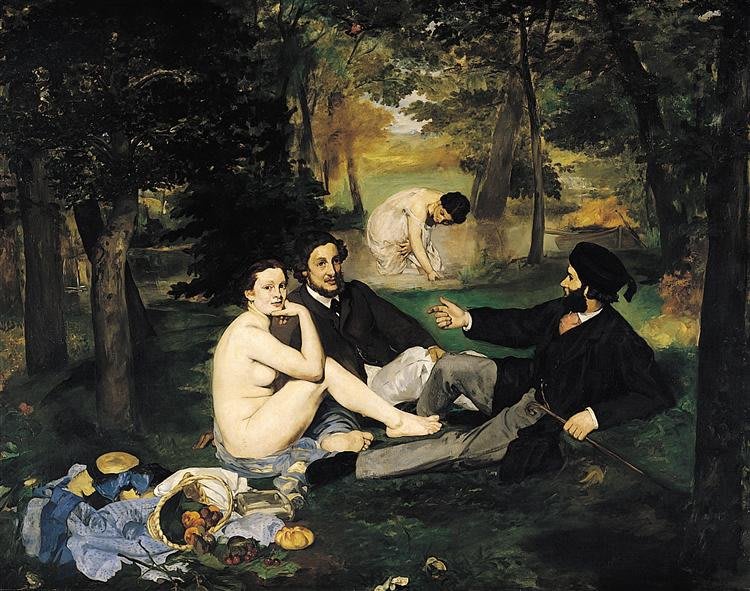
Le Déjeuner sur l'herbe (The Luncheon on the Grass)
This painting sparked an immense scandal when it was exhibited in 1863.
Manet shocked audiences by placing a nude woman alongside fully dressed men in the same scene.
The work's affront to the morals of the time wasn't limited to the explicit and contrasting nudity.
The use of familiar models for the figures in the composition further intensified the controversy.
But Manet's next work was about to explode with even greater force, challenging all boundaries:
To learn more about this important painting, which is Manet's masterpiece, click here
"Olympia" and the Revolution of Manet's Art
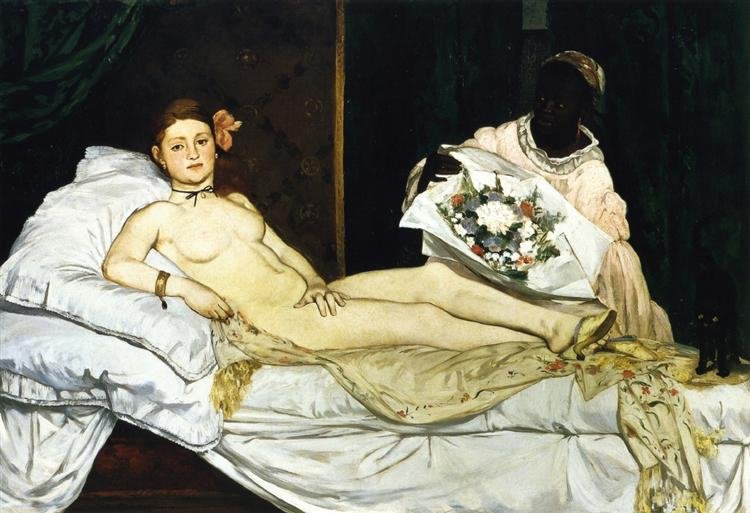
Olympia
The exhibition of "Olympia" at the Paris Salon in 1865 caused an immediate and overwhelming sensation.
The work was promptly censored and labeled "immoral" and "vulgar" by the most conservative critics.
However, "Olympia" was also greatly praised by progressive voices, such as French writer Émile Zola, who considered it Manet's masterpiece.
Manet drew inspiration from classics like Titian's Venus of Urbino and Giorgione's Sleeping Venus.
Contrasting with tradition, by depicting the nude woman with a flower in her hair, jewelry, and sandals, and alongside a fully clothed maid, Manet further accentuated the central figure's nudity.
Olympia's direct and confrontational gaze was a direct affront to the superficial modesty expected of women at the time.
This tradition of using confrontational imagery to challenge social norms would later become a cornerstone for other provocative artistic legacies. Egon Schiele: Maturity, Conflicts, and Lasting Expressionist Legacy
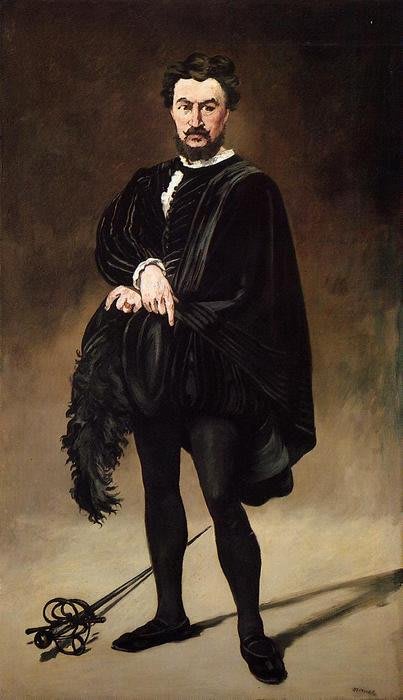
Amidst the effervescence of his career, Manet also gifted us works of profound lyricism, such as The Tragic Actor.
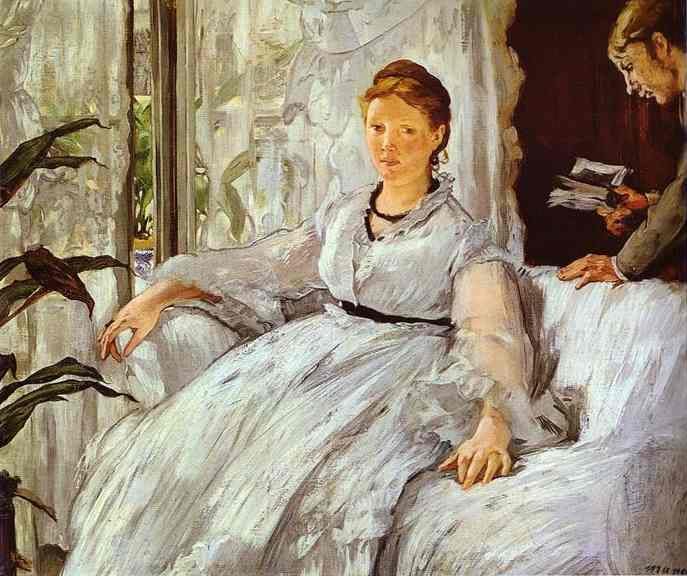
The Reading
In this intimate painting, Manet depicts his wife, Suzanne Manet, seated.
Beside her, their son, Leon, stands absorbed in reading a book.
Leon was a frequent model for Manet, appearing in several of his compositions.
Manet masterfully explored the use of white, visible in the woman's dress, which dominates the scene, as well as in the sofa and curtains, rendered with broad strokes and intense brilliance.
In this work, the artist demonstrated unusual sensitivity, dedicating himself to exploring the nuances and reflections of white tones.
This painting, so dear to Manet, was first presented in 1880, at one of the solo exhibitions he often organized in his studio.
Subsequently, the painting was part of the grand posthumous exhibition of Manet's work, held in 1884, just one year after his passing.
Manet's Fascinating Reverence for Velázquez
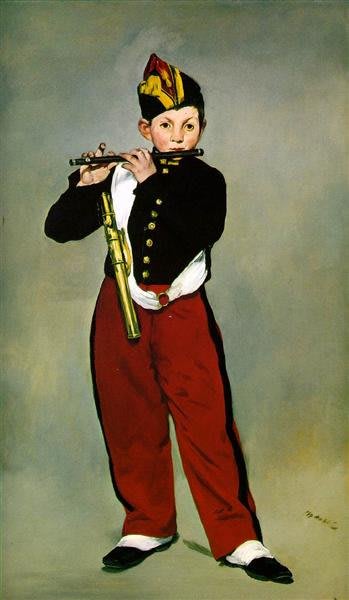
The Fifer
During a trip to Spain in 1865, Édouard Manet visited the celebrated Prado Museum.
There, the art of Diego Velázquez revealed itself to Manet like an epiphany, transforming his artistic vision.
In this painting, Manet presents a uniformed young man, both emulating and subverting the acclaimed court portrait formula of Velázquez.
The composition demonstrates an unparalleled power of synthesis, with a simplification of drawing and contractions of space reaching their peak.
The painting has neither background nor complex planes; the vibrant and solid figure of the young musician stands out strikingly through the ingenious use of contrasting colors.
Portrait of Berthe Morisot
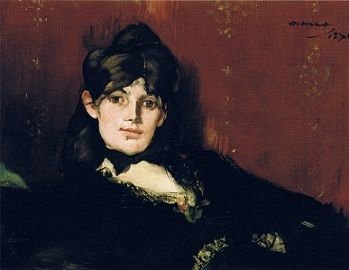
This is one of several portraits that Manet affectionately dedicated to the young and talented Berthe Morisot.
After the work's completion, the artist decided to remove the lower part of the canvas, deeming it incorrect in terms of perspective.
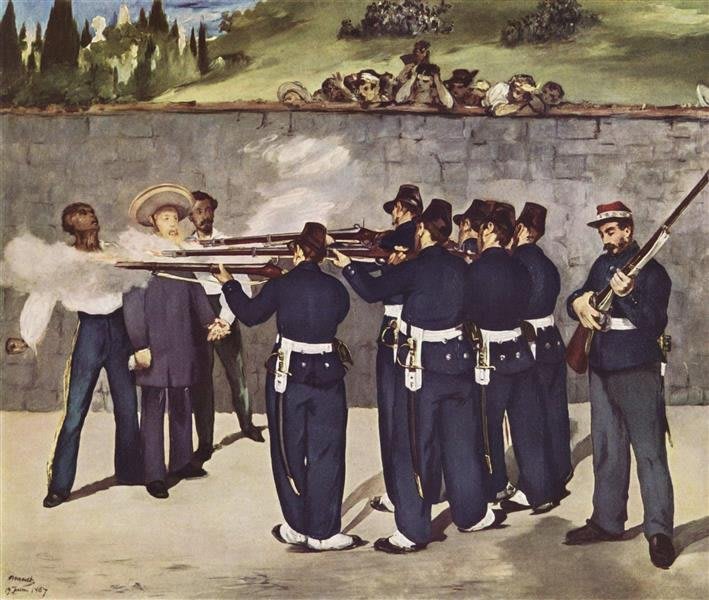
The Execution of Maximilian
Inspired by Goya's iconic work, "The Third of May 1808", Manet tackled an equally dramatic theme.
His painting depicts the execution of Emperor Maximilian I of Mexico by a Republican firing squad.
Manet created several versions of this impactful theme. The first resides in the Museum of Fine Arts, Boston.
Fragments of the second version are gathered at the National Gallery in London, while the final composition is located in the Kunsthalle Mannheim.
The Boston version is the closest to Goya's work, both in its romantic spirit and the warm tones that permeate it.
In contrast, Manet's other versions sought a distinct harmony and color resemblance.
In the composition, there's a crucial difference: while Goya immortalizes the instant when soldiers line up to shoot, Manet freezes the very moment of the firing.
Manet’s deep connection to the Spanish tradition reflects a broader historical movement of artistic influence across Europe. Biography of El Greco: The Greek Origins and Journey to European Renaissance
Scenes of Parisian Life: Manet's Encounters and Enigmas
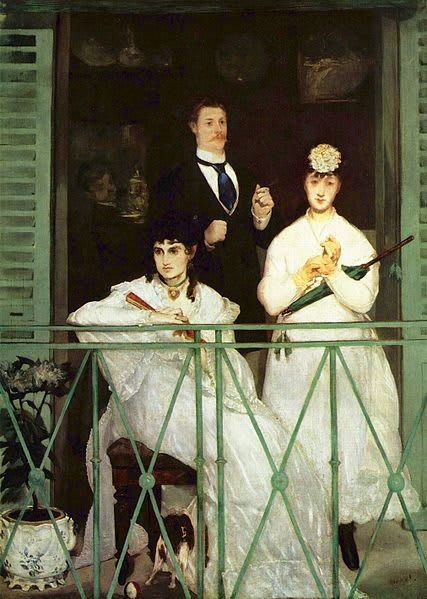
The Balcony
This work is a group portrait, where Manet positions four figures on a balcony, creating an intriguing scene.
To the left, elegantly seated, is Berthe Morisot, a recurring figure in Manet's work.
In the center, we see the painter and friend Jean Baptiste Antoine Guillemet, with a striking posture.
To the right, the violinist Fanny Claus completes the frontal group.
The fourth and final figure, mysteriously obscured in the background, is likely Léon Leenhoff, Manet's only son.
Exhibited at the Paris Salon in 1869, "The Balcony" significantly contributed to the artist's reputation for eccentricity.
The strong color contrast – the intensely black background, faces and clothes in shades of white, the man's blue tie, and the green railings – create an almost palpable atmosphere of "mystery."
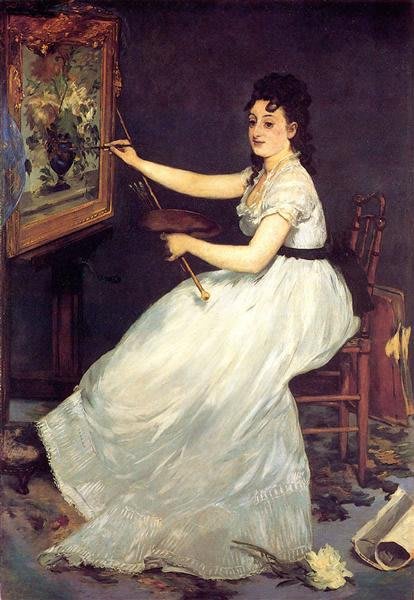
Eva Gonzales
A talented artist in her own right, Eva Gonzales also became one of Édouard Manet's favorite models, appearing in many of his paintings.
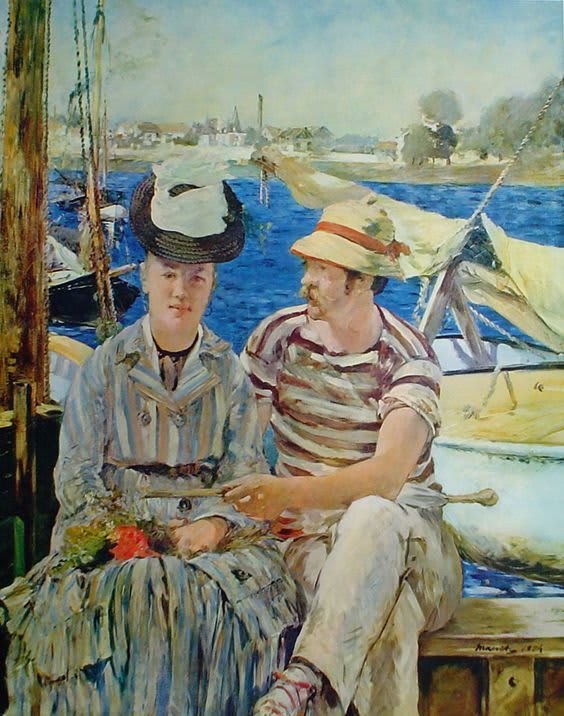
During his stay in Argenteuil, Manet revealed a notable shift in his palette, which became lighter and more vibrant.
During this period, Monet's Impressionist influence on his work is undeniable.
This painting was sent to the Paris Salon and served as a powerful manifesto of the emerging style, especially for those who had not witnessed the group's seminal exhibition in 1874.
Impressionism Meets Manet: The Light of Argenteuil
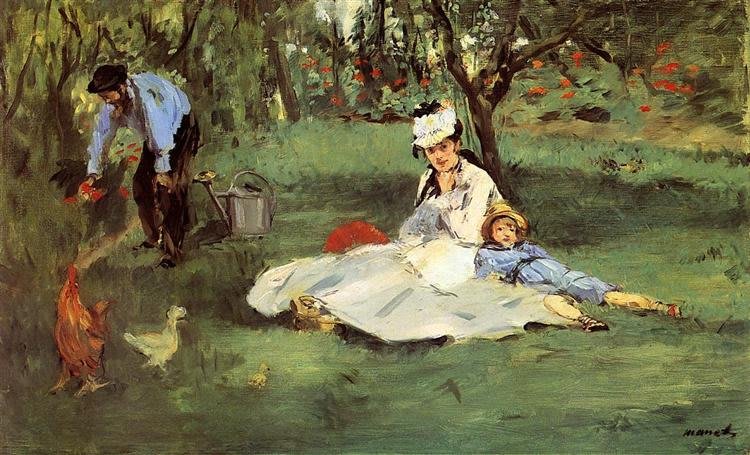
The Monet Family in their Garden at Argenteuil
In 1874, Manet embraced Monet's technique of painting quickly and outdoors, a revolutionary approach.
During the summer of that year, Manet stayed with his family in Gennevilliers, on the opposite bank of the Seine River.
The Monet family, in turn, resided in a house that Manet himself had helped them find the previous year.
In this vibrant group portrait, we can see Camille Monet and Jean, while Claude Monet appears gardening on the left.
This work stands out as one of Manet's most significant experiments within the new style that the Impressionists cultivated when painting en plein air.
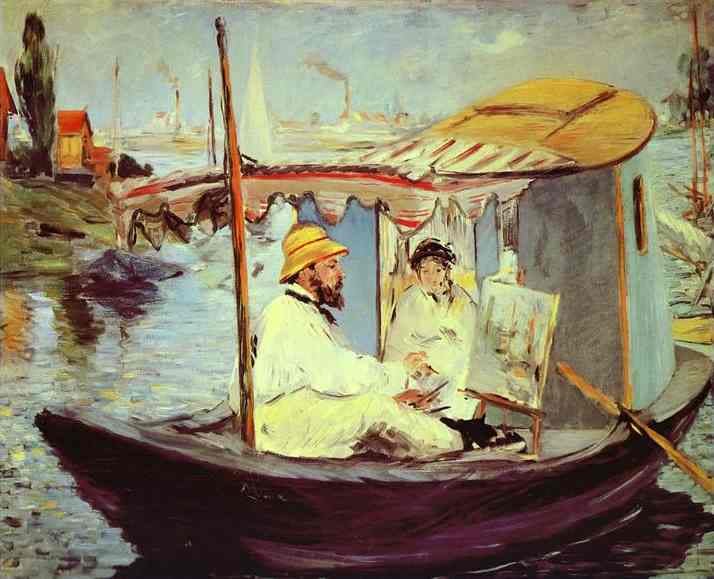
Monet in his Studio Boat
During this period, Manet no longer presented himself as an isolated leader, but rather as an artist whose painting was visibly influenced by Monet and Renoir.
At his residence in Argenteuil, Claude Monet not only painted but also welcomed friends and colleagues, including Édouard Manet.
It wasn't long before Manet decided to capture his friend Monet in action, depicting him in his studio boat, an ingenious adaptation for painting outdoors.
Aboard this boat, Monet navigated stretches of the Seine, ceaselessly seeking new motifs and the ephemeral effects of light.
The work details the boat that Monet built specifically to paint the many scenes he captured from the River Seine.
Inside the vessel, we see Monet concentrated on his work, accompanied by his wife, Camille, who attentively observes her husband's activity.
The style of this painting clearly reveals Manet's absorption of the innovations of his younger Impressionist colleagues.
The water on the left, for instance, is depicted with broad and distinct brushstrokes, using a varied range of colors, a hallmark of the movement.
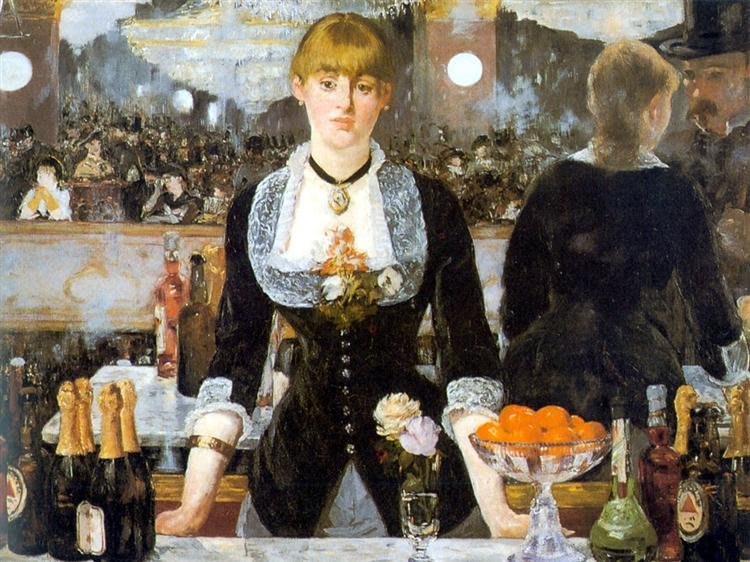
The Last Great Enigma: "A Bar at the Folies-Bergère"
A Bar at the Folies-Bergère
This painting, depicting a vibrant scene from the Folies-Bergère Nightclub in Paris, is widely considered Manet's last great work.
Surprisingly, the artist, already bedridden by his illness, managed to execute it during a brief period of remission.
The painting's composition has generated numerous debates, as at first glance, the background reflection appears to be a mirrored image of the young bartender.
However, closer analysis reveals that the reflection's positioning is incongruent, making it impossible for it to be a mere specular image.
An intriguing theory suggests that the woman in the foreground is, in fact, a representation of what the man in the background perceives as he approaches the counter—a subjective, non-literal view.