
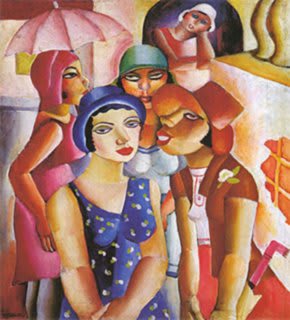
Five Girls of Guaratinguetá - Emiliano Di Cavalcanti
Discover the iconic painting of Brazilian modernism
Article Index
I invite you to explore the work 'Five Girls of Guaratinguetá' by Emiliano Di Cavalcanti, an emblematic painting of Brazilian art.
Created in 1930, this work depicts five young women in traditional attire, highlighting the beauty and cultural diversity of Brazil.
With its vibrant colors and sinuous forms, Di Cavalcanti captured the essence of Brazilian modernism, celebrating everyday life and national identity.
As you contemplate 'Five Girls of Guaratinguetá,' you will be transported to a moment of rich cultural and artistic expression, where the beauty of the Brazilian people is exalted with great mastery.
One of the most famous paintings by Emiliano Di Cavalcanti
'Five Girls of Guaratinguetá' is one of the most famous paintings by the renowned Brazilian modernist artist Emiliano Di Cavalcanti.
This work, in particular, stands out for its vivid and expressive representation of Brazilian women, especially mulatas, a recurring theme in Di Cavalcanti's work.
By depicting fishermen, workers, sambistas, and especially mulatas, Di makes a profound reflection on Brazilian culture, placing it at the center of his artistic production.
His paintings are a visual testament to the richness and diversity of the Brazilian people, capturing not only their physical appearance but also their essence and cultural identity.
The representation of women in 'Five Girls of Guaratinguetá'
In this composition, the girls occupy almost the entire canvas, in different planes, highlighting their expressiveness and vibrant representation of Brazilian cultural diversity.
The way Di Cavalcanti portrays these women is not only aesthetic but also political and social, reflecting his commitment to valuing culture and national identity.
• In the foreground, two of them are seen. On the left, there is the girl in a blue dress and a hat of the same color, facing the observer, while her companion on the right is in profile, although her gaze seems to be directed outside the painting.
• In the middle of the canvas, the other two girls are in the same position as the first two, with a change: the one on the right is facing the observer, and the one on the left is in profile. One of them carries an open parasol.
• In the background, in the upper right corner of the canvas, with her head resting on her arm that is supported by the window, is the fifth girl. She looks outside the canvas, with a distant and dreamy gaze.
All the girls have the same skin tone, except for the one in the blue dress, who has a lighter skin tone and finer features. All five girls wear hats.
The presence of a peeling wall shows that the location where the characters are found is very simple, but still charming.
The painting has strong chromatic contrasts.
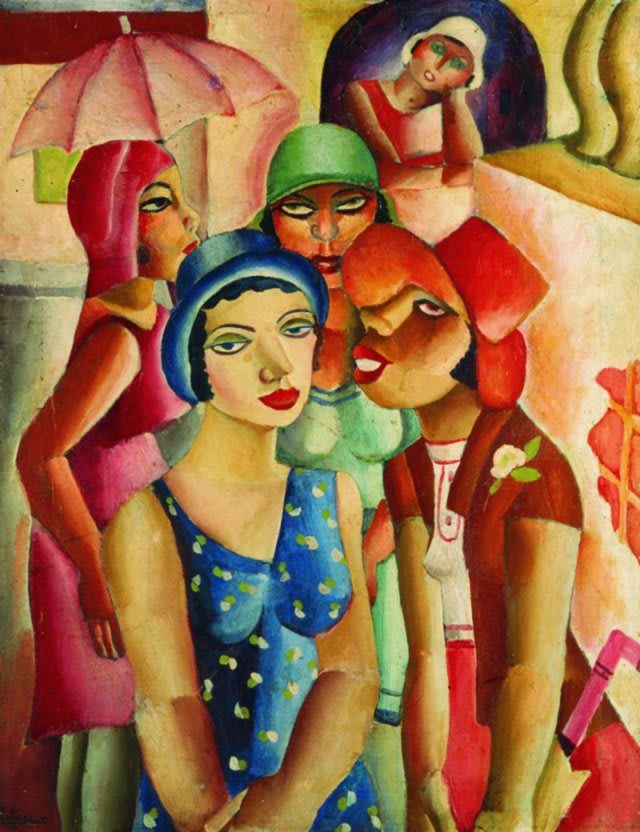
In the 1970s, Di Cavalcanti, celebrated his 75th birthday in Rio de Janeiro, in his apartment in Catete. In commemoration, Five Girls of Guaratinguetá is reproduced on a stamp.