
Gustave Courbet: The Life and Art of a Rebel
Explore the tumultuous life and career of Gustave Courbet, a pioneer of Realism and a master of provocative art.
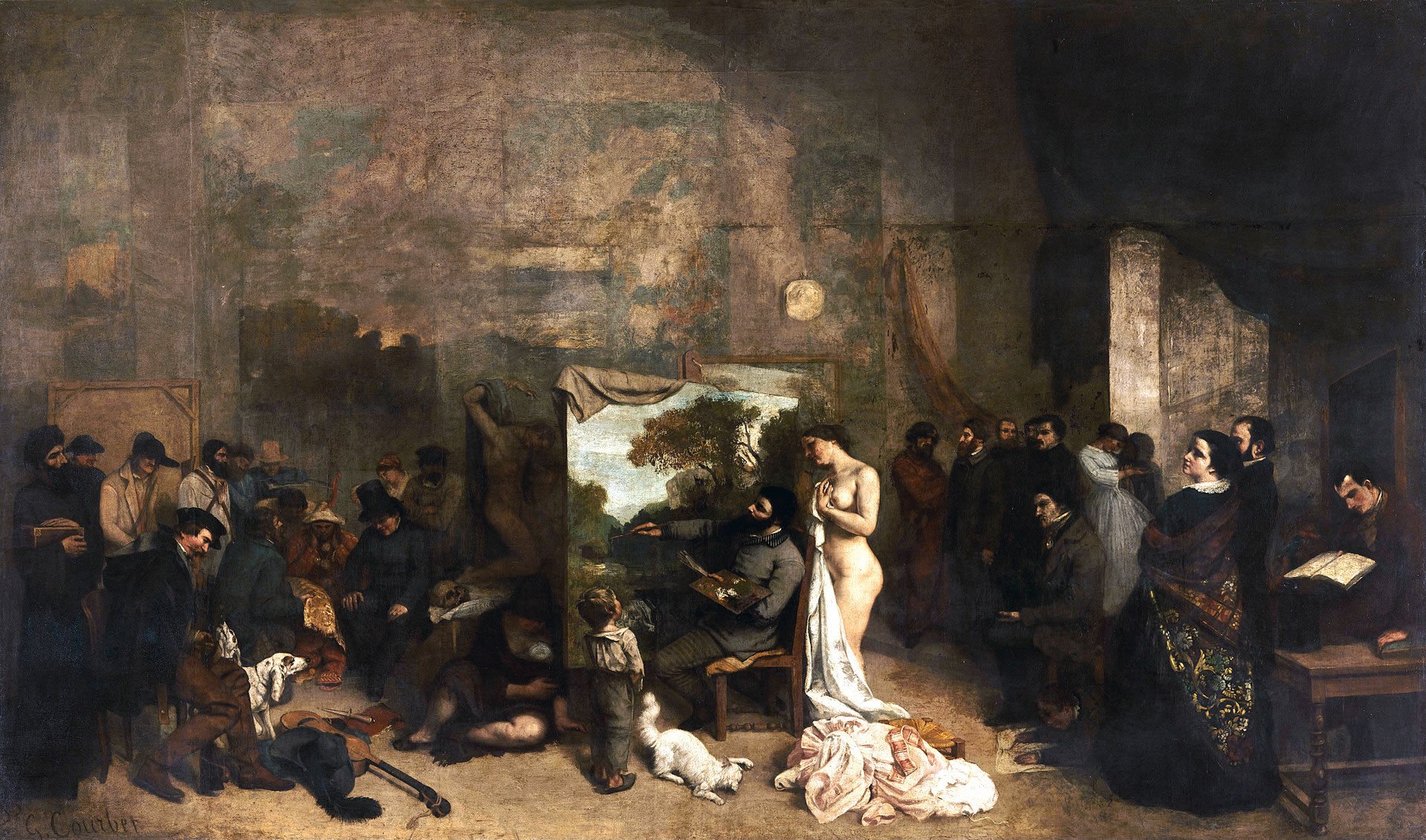
Courbet's greatest achievement during this period was creating the work The Studio of the Artist, a manifesto in which the artist declared his artistic and political choices through his painting.
He also gave this nearly four-meter-by-six-meter canvas the evocative subtitle 'A true allegory that summarizes seven years of my artistic and moral life'.
The jury of the 1855 Salon accepted more than ten of Courbet's paintings, but rejected The Studio of the Artist due to its size.
In response to the rejection of his painting, Courbet built his own 'Pavilion of Realism' at his own expense.
Outside the official event, he organized his own exhibition, which included the painting, A Burial at Ornans, so that his work would be accessible to all society.
The 1860s: Courbet's Rebellion
During the 1860s, Courbet focused on erotic nudes, hunting scenes, landscapes, and seascapes.
At this time, he rebelled even more against Neoclassicism in order to promote his new vision, inspiring modernists.
His final series of marine landscapes pointed the way for the impressionists.
Courbet's nudes of this decade challenged the norms of his time and, in some cases, remain contentious to this day.
These paintings of the nude foreshadowed the raw eroticism of some early 20th-century painters, such as Egon Schiele.
In 1870, the artist was awarded the Legion of Honor, the highest French order of merit.
Courbet rejected the honor, writing an open letter in which he stated that 'honor is not in a title or a ribbon, it's in actions and motivations for those actions. I honor myself by staying true to my principles throughout my life.'
Courbet never married, often claiming that his art did not give him time for relationships.
There are reports that he proposed marriage to a young woman, declaring in a letter that, if she accepted, she would be envied in all of France, and even 'would be reborn three times without ever finding a position like this'.
However, the woman refused, remaining single for the rest of his life.
The End of Courbet's Career
When the French Empire was finally crushed in the Franco-Prussian War, Courbet was elected president of the Commission of Republican Arts under the short-lived Paris Commune.
In 1871, he was sent to prison, accused of destroying a column of enemy cannons from Napoleon I, located in the Place Vendôme, in Paris.
The authorship of Courbet's destruction is uncertain, and it is possible that he intended only to move it.
However, the destruction of the column led to his own downfall. Despite this, he spent six months in prison, passing the last part of his sentence in a clinic when he fell ill.
In 1873, after passing through this tragedy, he was forced to pay personally 300,000 francs for the construction of a new column to replace the one that had been destroyed.
Confronted with this impossible project, he imposed his own exile in Switzerland, where he continued to paint, but never returned to France.
Gustave Courbet died of liver disease due to alcoholism.
He died on December 31, 1877, in La Tour-de-Pails, Switzerland, at the age of 58.
Continue Your Journey
To understand the rest of this journey, continue to our next article: Gustave Courbet Biography: A Commented Gallery of Essential Works of Realism.


