
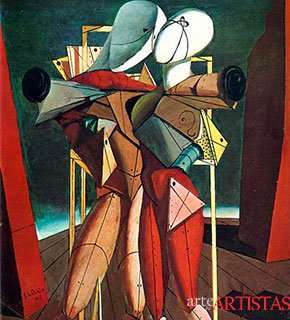
Heitor and Andromaca, Painting by Giorgio de Chirico
Heitor and Andromaca, Painting by Giorgio de Chirico
This painting is considered one of the masterpieces of Giorgio de Chirico. The image represents a doomed marriage relationship. There is much inspiration and influence from mythology, philosophy, Freudian psychoanalysis, and probably from his own experience.
From 1911, in Paris, De Chirico began to frequent the avant-garde circles, remaining always outside any formation and, in fact, discussing with them. In reality, he remained linked to his original culture, the culture of Ancient Greece, with its references to mythology and classical art.
Aside from mythology, he drew inspiration throughout his life from architecture to create works that would attract the observer to a world that was both familiar and unsettlingly disturbing. The key to his work is the love he expressed for classical antiquity.
These elements, however, appear blocked or distant from their context, sometimes mixed with modern elements such as locomotives or chimneys. Many of his paintings feature urban spaces in which human figures are almost always absent and time seems not to flow: they are silent places, with apparently incorrect perspectives, between long shadows and rows of buildings with porticos, like elements of an timeless architecture.
The protagonists of this work are characters from the myth and are therefore represented without faces: Heitor, Trojan prince, son of Príamo, and Andrómaca, his wife, who Homero tells us united by a deep love.
Human figures represented as mannequins are common in De Chirico's works. Being therefore an object of clothing, combined with objects and seemingly random citations, it may allude to the absence of personality of the contemporary man, automaton.
The long shadows suggest the end of midday.
But the story has a bizarre detail: the scenery is deserted, the architectural spaces uninhabitable. In fact, they seem to be stage settings that do not serve to mark the space, but rather to create a magical and surreal atmosphere.
The perspective, recognizable on the wooden floorboards, is not consistent with the rest of the scenery.
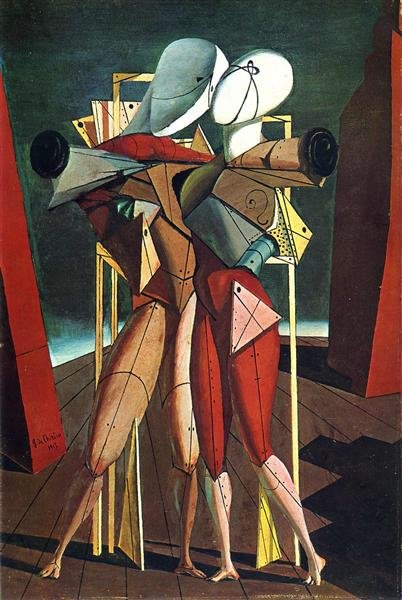
This work is a perfect example of De Chirico's ability to create a parallel world, where reality and fantasy blend in a unique and hypnotic atmosphere.
It is an invitation to the observer to enter this magical world and to get lost in its depths.
A work that continues to fascinate and inspire generations of artists and art lovers.


