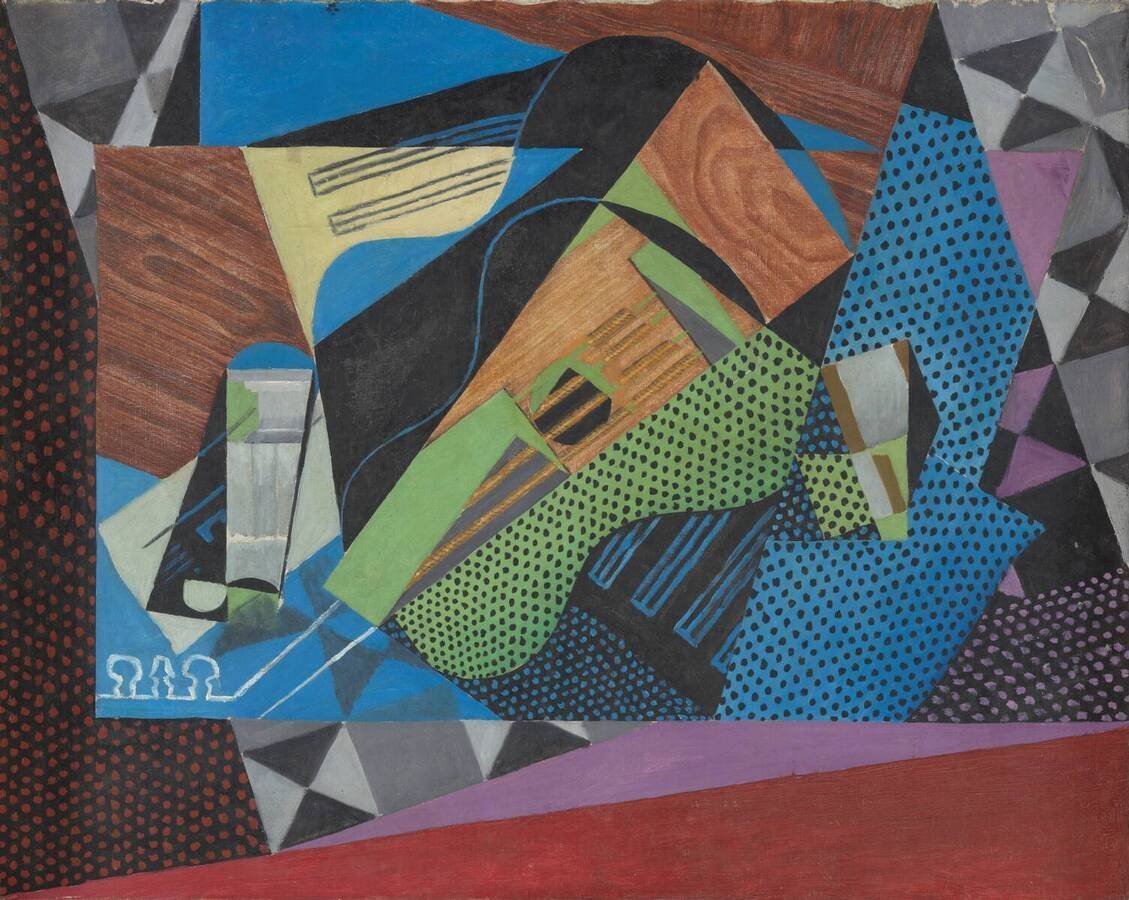
Juan Gris: Analysis of Works and the Planar and Colorful Architecture of Cubism
Juan Gris: Analysis of Works and the Planar and Colorful Architecture of Cubism
Article Index
Portrait of Picasso - This was a tribute by Gris to his mentor, a portrait of his mentor, the founder of cubism. Working mainly in cold tones of blue, gray, and brown, Gris fractures the model's face into a prism of planes and geometric forms that resolve into parallel lines in the background.
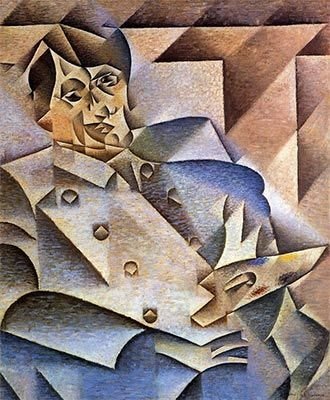
All parts of this image seem to be in motion. While he and his fellow practitioners produced many more chaotic images, elements of the formal portrait, such as the legibility of the model's features, symmetry of the pose, and high-collared jacket (in contrast to a painter's apron), indicate his respect for the subject.
This is entirely in line with the cubist mission, however, in its divergence from traditional representation and effort to capture the dynamism of modern life.
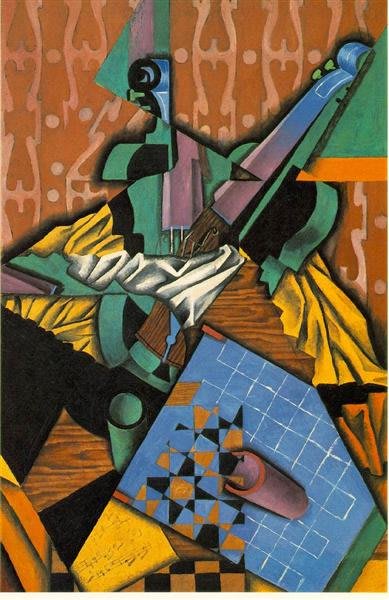
Still Life with Checkerboard Tablecloth - The rich composition presents a small bistro table with a checkerboard tablecloth that almost overflows with a variety of objects: a bottle of red wine, a bunch of grapes, coffee cups, a beer bottle, a strong ceramic pot with preserves, a coaster, and a French newspaper.
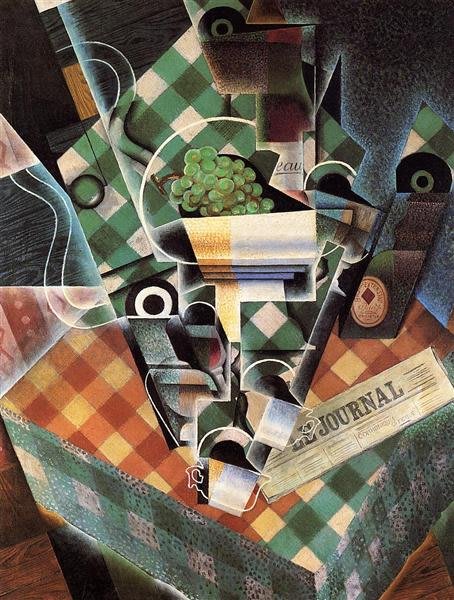
The painting illustrates his genius in promoting the cubist goal: creating something new from the connections between life and art.
Woman with a Basket - We have in this painting a woman holding a wicker basket of vegetables in front of an oval window or mirror.
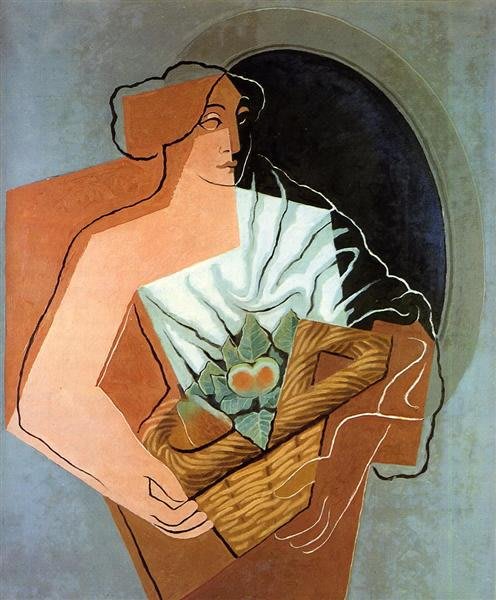
The style of her hair, face, and clothes reminds us of Greek and Roman representations of women, illustrating the renewed interest in classicism and traditional form representation among European painters after World War I.
The basket she holds, an element of still life, reminds us of his previous paintings.
The hidden message here is less obvious, yet more convincing: the oval behind the figure (a window or a mirror) is dark, suggesting the approach of death.
The piece, one of his strongest and most well-known, shows that he remained at the peak of his power until the end of his career.
GALLERY - The artist and his work:
As the artist himself said,
'I prefer the emotion that corrects the rule.'
Despite his radical treatment of the image space, his well-balanced compositions, saturated colors, and traditional themes popularized the avant-garde movement.
Like Picasso and Braque, he incorporated newspaper clippings and advertisements into his work.
While they tended to cut these elements into small pieces, however, he leaves more of the original advertisement and newspaper pieces intact, as if to preserve the integrity of the originals.
As the artist himself described:
'The only technique is a kind of planar and colorful architecture.'