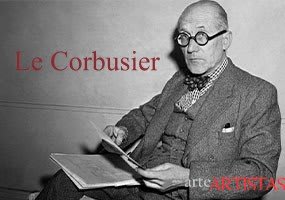
Le Corbusier
Le Corbusier was a pioneering modern architect, painter, and theorist.
Le Corbusier was a pioneering modern architect, painter, and theorist.
He was one of the principal designers who formulated the ideas behind a truly modern and avant-garde architecture during the interwar period.
Surprisingly, he took over four years working in almost asphyxiating conditions.
Charles-Édouard Jeanneret was born on October 6, 1887, in La Chaux-de-Fonds, Switzerland.
His father was a watch engraver and enameler, and his mother worked as a music teacher.
They encouraged their son to study decorative arts in the hope that he would also become a watch engraver.
In 1904, he entered the Advanced Course in Decorative Arts at the School of Art in La Chaux-de-Fonds.
In 1905, Jeanneret, then just 18 years old, designed his first house, the Villa Fallet, a wooden chalet in the mountains with a steep roof and geometric patterns, for a member of the School of Art Council, the engraver Louis Fallet.
In 1907, the artist went to Paris to work for Auguste Perret, a pioneering architect in the use of reinforced concrete.
In 1908, he studied architecture with Josef Hoffman and worked for Peter Behrens for six months.
In 1910, he returned to the La-Chaux-de-Fonds Art School to teach during World War I.
From 1914 to 1915, he developed an architectural model with an open plan, columns, and thin reinforced concrete walls.
These theories influenced his projects for the next decade.
In 1918, he met the painter Amédée Ozenfant, and they established a new artistic movement called Purism.
Together, they published the purist journal L'Esprit Nouveau.
It was during this period that he adopted his professional pseudonym of Le Corbusier, and thus became known and later revered.
In 1922, Le Corbusier presented a urban design plan called Edifícios Vilas.
The residential blocks in Edifícios Vilas and later in his Vila Contemporânea reflected his belief that modern architectural planning could improve the quality of life of city dwellers.
By the end of the 1920s, he began to travel because his services were in demand internationally; in 1929, he visited South America, giving lectures in Brazil, Argentina, and Uruguay.
In 1929, he started working on the Vila Savoye.
This residence provided a clear example of Le Corbusier's five points of architecture, which were published in L'Esprit Nouveau.
The Vila Savoye is also considered an excellent example of the International Style, an architectural style that also represented the first decades of the modern movement.
In 1930, he also became a French citizen and married Yvonne Gallis, a model from Monaco whom he met in 1922.
During this period, he visited the Soviet Union and won the contract for the government building called Centrosoyuz in Moscow, which would be his only building in the USSR (although he also served as a consultant for Soviet urban planning projects).
In 1935, Le Corbusier published a book on urbanism called A Radiant City.
From 1945 onwards, all his projects would be based on the Modulor, a proportional system based on the Golden Section and dimensioned for the human figure.
From 1950 onwards, Le Corbusier not only designed the overall layout of the city but also designed several administrative buildings in Chandigarh, such as the parliament building, a university, a court, and some furniture.
Le Corbusier died suddenly while swimming in the Mediterranean Sea, apparently due to a heart attack, on August 27, 1965.
He was staying in his rustic Cabanon, which he built for himself as a summer refuge in the seaside town of Roquebrune-Cap-Martin, in southeastern France.
He received a funeral in the courtyard of the Louvre on September 1, with a tribute paid by André Malraux, the former French Minister of Culture.
More than fifty years after his death, Le Corbusier still manages to exert influence and spark hatred for his ideas and constructions.
His complex relationships with politics and the sociological dimensions of architecture - as well as his voluminous records and archives - mean that he will continue to be the subject of debates in the coming decades.
PURISMO, a chapter apart...
In Paris, Le Corbusier opened a studio at 20 rue de Belzunce.
The following year, he met the cubist painters Pablo Picasso, Georges Braque, Juan Gris, and Amédée Ozenfant.
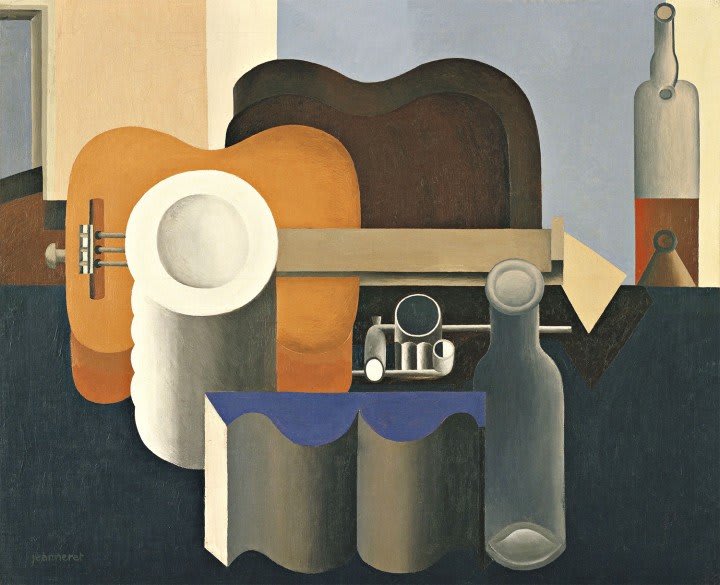
With Ozenfant, he developed the movement in painting called Purism, which undoubtedly received its name from the purity of the geometric forms of the objects depicted in their works (mainly) still lifes.
In 1918, the two artists exhibited their joint works at the Galerie Thomas in Paris, accompanied by the manifesto Après le Cubisme (After Cubism), a criticism of cubism and futurism.
Purism gained even more strength in 1920 with the launch of their magazine L'Esprit Nouveau, in whose first edition he adopted his professional pseudonym of Le Corbusier, probably derived from his maternal grandfather, Lecorbesier.
From 1918 to 1922, it was a period in which he concentrated strongly on his painting and published his ideas on art and architecture in L'Esprit Nouveau.
Le Corbusier needed glasses for a long time and, in 1918, became almost blind in one eye;
as a result, he sometimes joked that his glasses, whose horn-shaped circular frames became almost a trademark, should be half the price.
Gradually, after 1920, he allowed his painting to take a back seat in his architectural practice, although he never completely abandoned the medium.
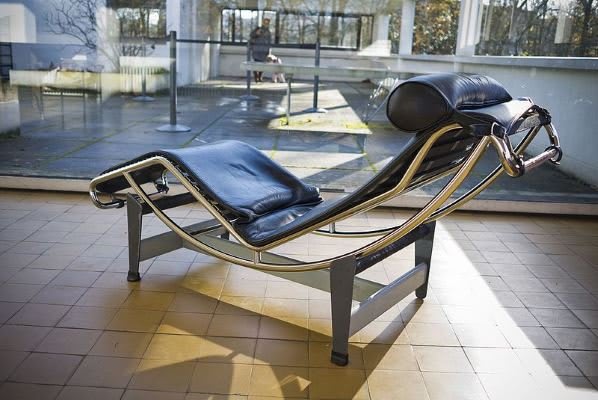
The chair combines geometric purity with ergonomic needs, making use of the then innovative tubular steel structure, present in most modern furniture of the 1920s and 30s. The strong H-shaped base and the elegant curvature of the thin tubular structure support the double-folded cushioned surface to better accommodate the body.
A cylindrical cushion is placed on one side serving as a headrest.
The independence between the base and the tubular steel structure allows for various degrees of reclining, emphasizing the multifunctionality of the chair and, therefore, its ideal degree of utility.
Manufactured by Thonet Freres in Paris, the chaise became an icon of 20th-century design and continues to be produced today by the Italian company Cassina.
ARCHITECTURE AND DESIGN
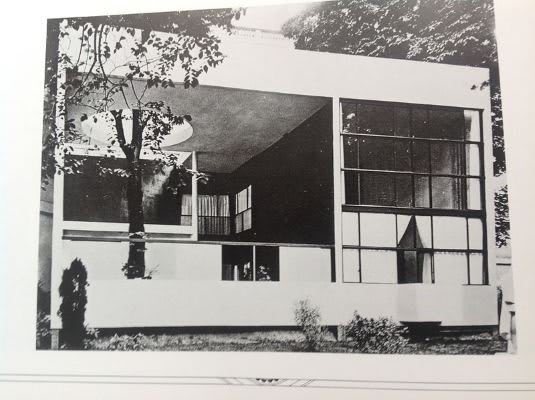
The Esprit Nouveau pavilion served as a manifesto of his ideas on modern architecture.
It illustrated his belief that industry, through the standardization required for mass production, could create the buildings needed for modern life.
He intended to show "the radical transformations and the structural freedoms that allow us to envision urban housing", as well as demonstrate that "comfortable and elegant housing units, these practical machines for living, can be aggregated in long, blocks of apartment-villas."
These would form the primary housing units in his urban schemes, including the Contemporary City for Three Million Inhabitants and his Voisin Plan for Paris, subscribed, like the rest of the pavilion, by a prominent French automobile manufacturer.
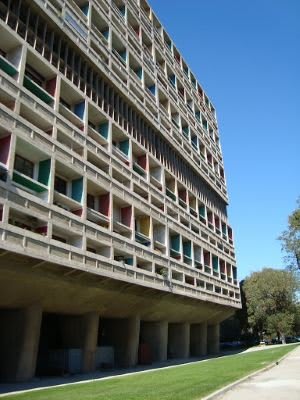
The Residential Unit in Marseille was the first large-scale residential block that Le Corbusier had the opportunity to build.
It was designed to be built as part of a much larger urban redevelopment, like the ones he hoped would be built for completely devastated areas, after World War II.
This construction represents the most complete realization we have of Le Corbusier's idea of community housing, often described as a "city within a city".
Le Corbusier's work with concrete would influence many architects in the following decades, culminating in the design material called Brutalism, which merged in the 1970s.