
Hagia Sophia Basilica
Hagia Sophia Basilica
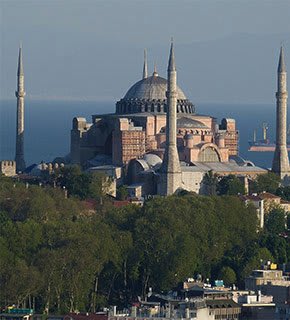
Step inside and discover the majestic Hagia Sophia Basilica in Istanbul, Turkey. Built in the 6th century by Emperor Justinian, this magnificent edifice stands as a landmark of Byzantine architecture and one of art history's most breathtaking creations.
With its imposing dome, dazzling mosaics, and rich, complex history, Hagia Sophia is a potent symbol of Istanbul's profound cultural and religious heritage. A visit here transports you to an era of splendor and grandeur, where art, history, and spirituality converge in a truly unique way.
For over a thousand years, from the dawn of the Middle Ages to the threshold of the Modern Age, the Byzantine Empire held sway over much of the Eastern Mediterranean. Its capital, Constantinople, was destined to play a global role, shining brightly primarily as a spiritual and artistic hub.
Spanning such a long period, the art produced in Byzantium endured various transformations. An initial, formative stage marked its independence from the original Roman core, while simultaneously establishing the elements suitable for a monumental Christian art and a mobile art that emphasized its ideological role.
The transformation of the capital into a great city corresponds to this era, and it was Emperor Justinian I who endowed it with one of its most significant monuments: HAGIA SOPHIA
The Hagia Sophia Basilica, also known as Hagia Sophia, meaning "Holy Wisdom" and dedicated to the second person of the Holy Trinity, was constructed between 532 and 537 by architects Anthemius of Tralles and Isidore of Miletus, under Justinian's direct supervision.
Rectangular in plan, it is dominated by the massive central dome, measuring 31 meters in diameter and 55 meters in height. The lower section of the dome features a series of windows nestled between reinforcing arches that support the colossal structure.
Just a few years after its completion, the majestic dome collapsed due to an earthquake, but it was rebuilt – using the same technique and design. This occurred in the year 558, under the direction of Isidore of Miletus.
The astonishing grandeur of the space created within Hagia Sophia, alongside the chromatic richness of its altars, mosaics, and materials, where symbolic light reverberates, giving credence to the assertion that "what is radiant comes from within," justified Justinian's exclamation upon seeing it completed:
"Glory be to God who has deemed me worthy to accomplish such a work! I have surpassed thee, Solomon!"
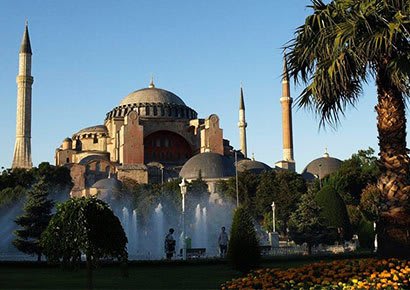
Hagia Sophia is regarded as one of the greatest surviving examples of Byzantine architecture, a splendor of immense artistic value in every aspect. In antiquity, it stood as a monumental architectural achievement, influencing the Orthodox, Catholic, and Islamic worlds alike.
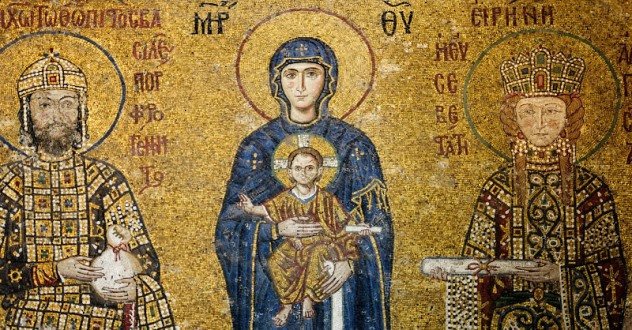
Mosaic - from the Greek MOSAICON - means "art of the Muses", and the artist requires immense patience to execute such a work.
By order of Emperor Justinian, eight "Corinthian" columns were dismantled in Baalbek, Lebanon, and sent to Constantinople for its construction. The basilica's floor is entirely covered with polychromatic green and white marbles, purple porphyry, in addition to golden mosaics. Beyond the immense dome, its four minarets, built of red brick, white limestone, and sandstone, also stand out.
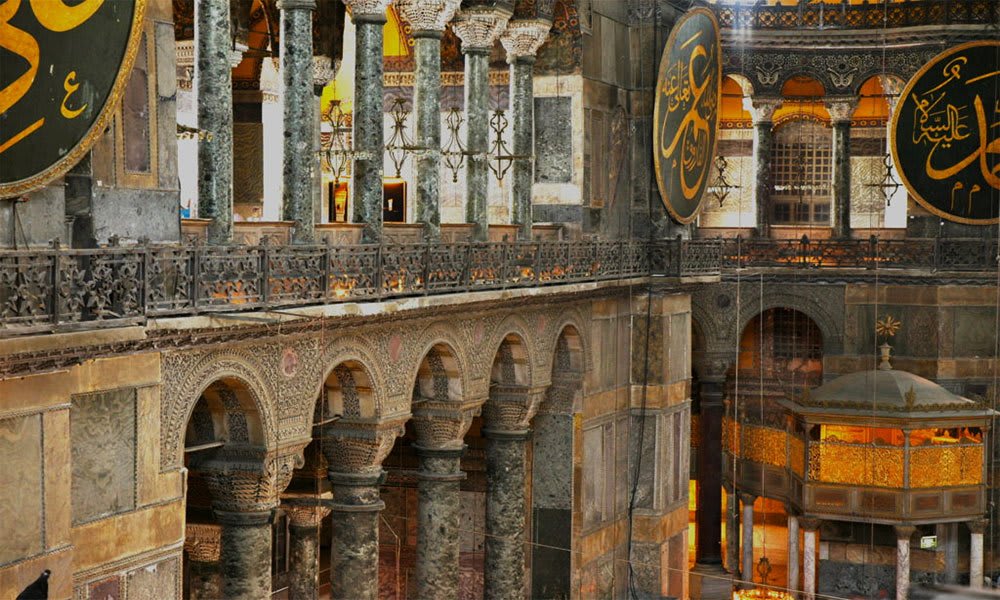
It's worth noting the capitals sculpted on the columns, bearing the monograms of Justinian and his wife Theodora.


