
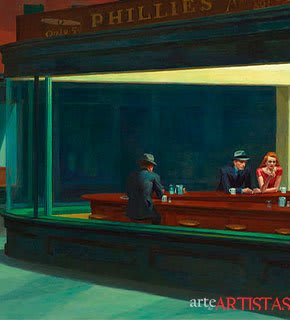
Nighthawks. Edward Hopper
Nighthawks. Edward Hopper
The genius dedicated his soul to painting the ceiling of the world's most famous chapel.

Surprisingly, he spent over 4 years working in almost suffocating conditions.
Nighthawks or Night Hawks is a significant painting by American artist Edward Hopper, widely considered Hopper's most famous work.
It is part of the collection of the Art Institute of Chicago and has remained the most requested and sought-after painting in its collection since its acquisition by the institution.
This iconic work helped define the modernist movement as one of the most recognized pieces of American art from the 20th Century.
According to the diary kept by Hopper's wife, Josephine Nivison, this painting was completed on January 21, 1942, in New York, weeks after the bombing of Pearl Harbor.
For this reason, the work is often seen as an expression of alienation during World War II.
In these turbulent times in history, when everyone was paranoid about another attack and New York continuously carried out blackout drills as a way to practice hiding the city in darkness, in case another air raid occurred.
Hopper began painting it immediately after the attack on Pearl Harbor, and soon after the event, there was a widespread feeling of sadness throughout the country, a sentiment that is portrayed in the painting, while the lights in Hopper's studio remained on.
In January 1942, Josephine wrote a letter to her sister-in-law Marion, the artist's sister, about the new painting: "Ed has just finished a very fine picture – a diner counter at night with three figures. Night Hawks would be a good title. He posed for the two men in the mirror and I for the girl. He was about a month and a half working on it."
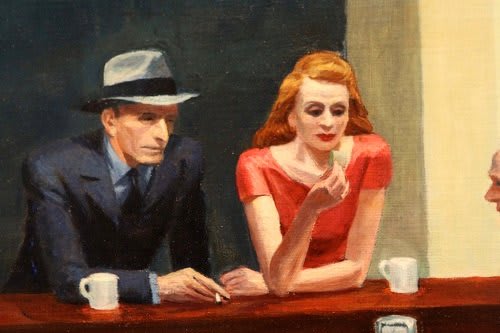
The painting depicts four characters seated in a sparsely furnished diner at night — one woman and three men.
A single light source illuminates the interior of the diner and spills out onto an empty street where the world seems to have shut down.
Placed in ambiguous relationships, none of the four figures interact with one another.
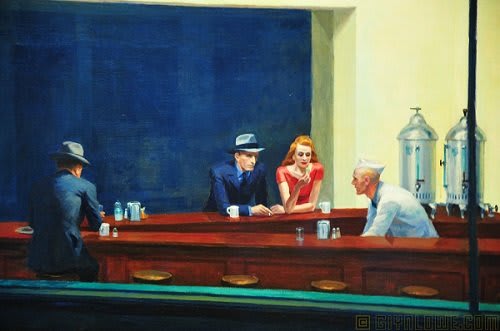
With its simple setting, dramatic lighting, and pervasive stillness, it makes it easier for the observer to place themselves in the scene, on the city streets.
The protagonist of the work seems to be the diner itself, with strong diagonal lines accentuated by the counter and the seats.
However, with no visible entrance, the viewer is excluded from the scene by a seamless glass wedge, allowing them to invade the private world of the diner and its Night Hawks from the street solely through sight.
Hopper was obsessed with light and the way it fell on houses and people through windows, and the colors it created.
The yellowish fluorescent light replaces the sun in Nighthawks, emphasizing the artist's understanding of the expressive possibilities of light playing on simplified forms.
The sign above the cafe announcing cigars for $5 and the cash register seen through one of the exterior windows suggest a kind of everyday American experience.
The scene is silent and serene, further highlighting the intense feeling of isolation.
Hopper stated that the painting "was suggested by a restaurant on Greenwich Avenue, where two streets cross," additionally noting that he greatly simplified the scene and made the restaurant larger.
For decades, the public has tried to locate this specific restaurant in New York, but after extensive research, it's been concluded that it was never a real place.
Many people see it as a fitting blend of the common and often overlooked places that make up a modern city like New York and so many others.
Characterized by an open narrative, this painting embodies the artist's interest in themes of alienation, melancholy, voyeurism, and ambiguous relationships. The term Night Hawks is used figuratively to describe someone who stays up late, and it's a name that can naturally be associated with nocturnal birds, like falcons.
Hopper denied that he purposefully infused this or any of his other paintings with symbols of human isolation and urban emptiness, but he acknowledged and stated that in Nighthawks "unconsciously, probably, I was painting the loneliness of a large city."
An important piece of American culture, the work also has the ability to evoke nostalgia for an America of a bygone era.
However, Hopper's Nighthawks remains relevant today as a subtle critique of the modern world, the world we all live in, where an overwhelming sense of loneliness prevails and a deep desire, yet ultimate inability, to connect with those around us.
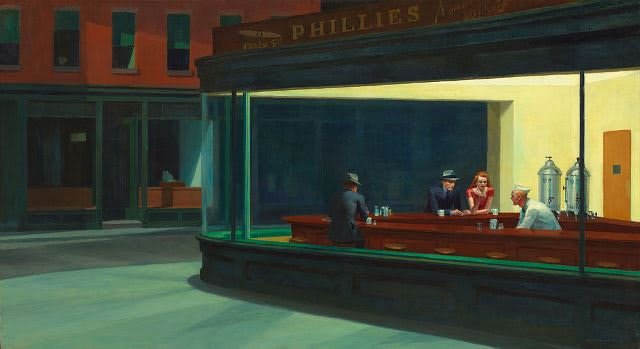
Title: Nighthawks
Artist : Edward Hopper
Year: 1942
Medium: oil on canvas
Dimensions: 84.1 × 152.4 cm
Location: Art Institute of Chicago


