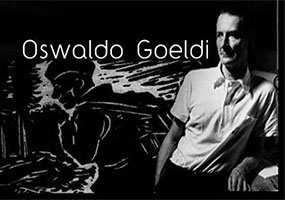
Oswaldo Goeldi: Biography and Work
Oswaldo Goeldi: A Life and Art
Article Index
Oswaldo Goeldi was a prominent Brazilian artist, born in Rio de Janeiro in 1895 and passed away in 1961.
He is primarily recognized for his prints and drawings that depict urban everyday life and somber, melancholic landscapes.
Goeldi studied at the National School of Fine Arts and later in Germany, where he was exposed to expressionism, an artistic movement that profoundly influenced his work.
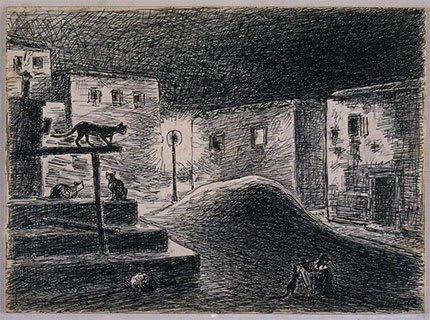
His prints are characterized by a strong contrast of light and shadow, creating dense and mysterious atmospheres.
In addition to prints, Goeldi also worked with painting, illustration, and poetry.
His work is considered one of the most important in Brazilian art of the 20th century, standing out for its originality and emotional intensity.
Oswaldo Goeldi was an artist representative of the expressionist movement in Brazil, influenced by Alfred Kubin, austrian illustrator (1877-1959).
Concerned with the mystery of the world, with the meaning of being and existing, he sought in the landscape the small secrets of existence, secrets that he uncovered at the cost of tears and sweat, at the cost of hard work, more than daily, a work of all hours, with the sun and, above all, with the night.
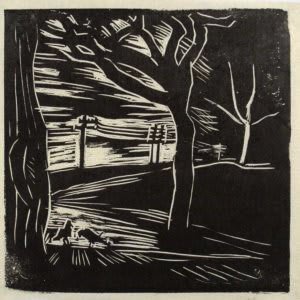
Surprisingly, he took more than 4 years working in almost asphyxiating conditions.
- Ferreira Gullar
"Reality is very appearance, and the strength of the artist is in capturing it." (Oswaldo Goeldi)
Oswaldo Goeldi was born on October 31, 1895, in Rio de Janeiro.
His father was the Swiss naturalist Emílio Goeldi.
After the birth of the child, his parents moved to Belém do Pará, where Emílio Goeldi was doing research in Zoology and Botany.
Goeldi studied in Switzerland at the age of six, but soon abandoned technical studies to enter the Arts and Crafts School in Zurich.
He also did not complete his formation there.
He continued studying on his own and held his first individual exhibition in the Swiss city of Bern, where he met the work of Alfred Kubin, with whom he corresponded for decades.
Goeldi returns to Brazil in 1919.
The First World War had just ended, but Europe was still suffering from the consequences left by it, including psychological ones.
Here in Brazil, he began to work as an illustrator of books and periodicals.
“I felt, more or less, like Gauguin on the island...” (Goeldi- 1919)
Goeldi was seeking his own language during the learning period.
His human experiences were discovering new possibilities of expression within the genre through the work of art.
Experiences that gradually gave his engraving greater communication and impact.
The technique was enriched slowly, it was not by chance that he began to use colors.
And, he used them, not for decorative effect, as traditionally used, but as an expressive element, integrated into the composition.
He himself said:
“I did not make engraving a mechanical form; I still have hopes, I make discoveries, and I engrave with the same satisfaction as 40 years ago.”
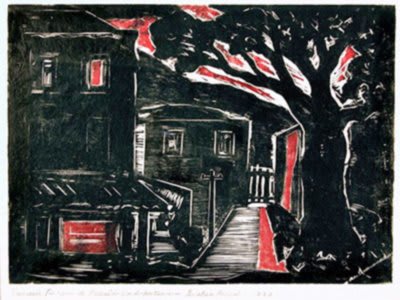
Oswaldo Goeldi lived on the margins of social and family conventions.
He never shared his concerns, nor his aspirations, nor with the few friends he had.
He never got married, had no children.
He died on February 16, 1961, in Rio de Janeiro.
After his death, many tributes were paid in Brazil and other countries.
His recognition was valued, figuring as a reference in the field of engraving, among the most important artists in the world.
Oswaldo Goeldi
: Work
Oswaldo Goeldi can be characterized as an expressionist artist, an artistic movement that took place especially in Germany, at the beginning of the 20th century.
The artist's anguished feelings express a distorted reality, which he shows intensely in his art.
The vision is pessimistic, the world is threatening.
In this work, Goeldi presents a metaphor of social disintegration.
The abandoned self of the beggar with the red heart, lying in front of a huge building, powerless in his condition of total abandonment, represents the characteristic despair of the artist, a quiet unease before the melancholic scene.
(Extracted from the poem 'A Goeldi', by Carlos Drummond de Andrade)