Walls of Memory - Eduardo Kobra
Walls of Memory - Eduardo Kobra
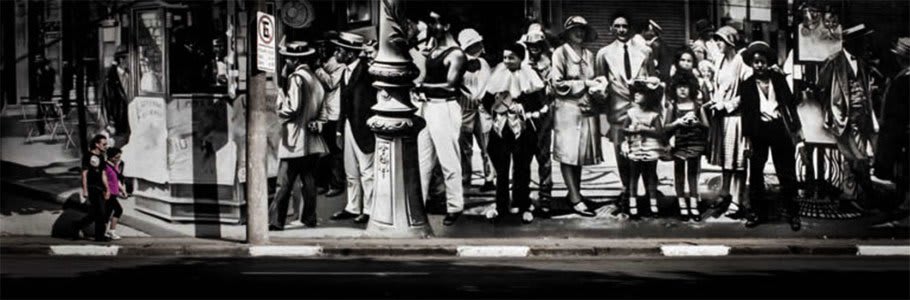
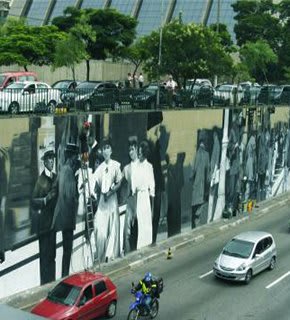
Among the numerous walls covered in graffiti, tags, and posters scattered throughout the city, one stands out - the colossal-scale depictions of a bygone São Paulo, captivating the attention of those navigating the chaotic traffic on Avenida 23 de Maio.
This is the vision and idea sparked by Eduardo Kobra's work, 'Walls of Memory', a renowned artist known for his large-scale murals.
Men and women in hats, represented in shades of black, white, and gray, can be identified from a distance, even if up close, the forms appear simple and even a bit rough, reminiscent of a Monet painting that must be viewed from a distance to reveal its full beauty.
This mural, an impressive 1,000 square meters, was created to commemorate the city's 455th anniversary.
Due to its grandeur, the work is part of the 'Walls of Memory' series, a project conceived by Eduardo Kobra, a native of São Paulo, to catapult him to stardom in the Brazilian contemporary art scene, specifically in street art.
Kobra prefers to be referred to as a muralist, a way to categorize and facilitate the dissemination of his artistic work.
Where did the inspiration for 'Walls of Memory' come from?
The inspiration for the work came after Kobra visited an exhibition in São Paulo that showcased the mansions and trees of Avenida Paulista from the 1920s:
“I realized that almost everything had been lost, which is why I came up with the idea of artistically reconstructing and painting what they had destroyed, creating a window into a city that no longer exists” - Eduardo Kobra
Kobra's work is a nostalgic tribute to a São Paulo that has disappeared, but remains alive through his art, evoking memories of a city that endures in the collective imagination.
The grandeur and complexity of Kobra's mural stand out not only for its technique and scale, but also for its profound emotional impact on viewers.
The work not only celebrates the city's history but also invites Paulistanos to reflect on the past and value what remains of their cultural heritage.