
Paul Cézanne: Masterpieces and the Post-Impressionist Revolution (Part 2)
Paul Cézanne: Masterpieces and the Post-Impressionist Revolution (Part 2)
Cézanne occasionally visited Médan, to see his childhood friend Émile Zola, who had moved there in 1878. This painting, originally belonging to Gauguin, was painted in diagonal brushstrokes, in a dynamic crescendo.
The stay at his friend's house allowed the painter to venture into outdoor work in the surroundings of Auvers. The visits to Médan lasted until the painter's break with the writer, in 1886. In this phase, during which he mainly painted landscapes, the painter imposed his style over the general form used by other impressionists. While they used an aerial perspective, Cézanne preferred to look straight on. For him, the colors and forms on the entire surface of the painting had equal importance.
To further appreciate the evolution of modern art and its groundbreaking figures, delve into the works of: William Turner, the Precursor of Impressionism: Notable Works and Style Analysis (Part 2)

The Village of Médan is one of the main locations where Cézanne painted his landscapes.
Note the importance given by the painter to geometric forms. The volume is the result of fine brushstrokes, green and blue tones, which indicate the play of light and shadow.
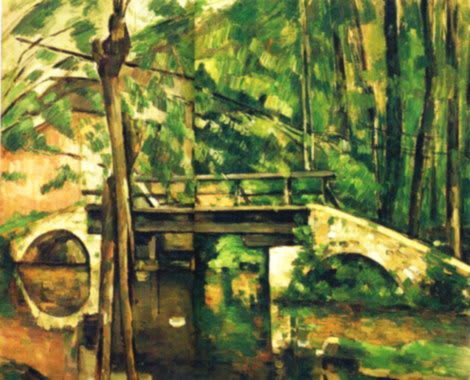
A Bridge at Maincy is one of the most famous landscapes painted by Cézanne.
This theme, which also interested Caravaggio, served as studies of lines and volumes in five paintings by Cézanne. Here the bottle captures the light, divides the space into two symmetrical areas, and emphasizes the contrast between the two players.
Curiosity: This painting by Cézanne is classified by the magazine Super Interessante as one of the most expensive in the world
Just as Cézanne profoundly explored form and color, another revolutionary artist captured his inner world through his intense self-portraits. Discover more about: Van Gogh's Self-Portraits
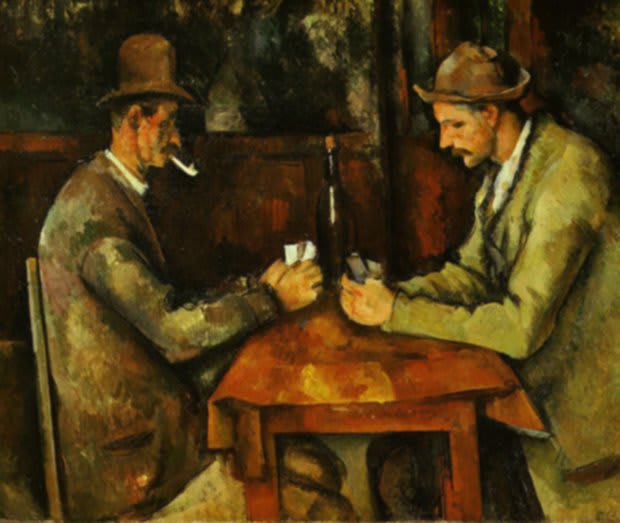
Card Players is one of the main themes that Cézanne painted in his works.
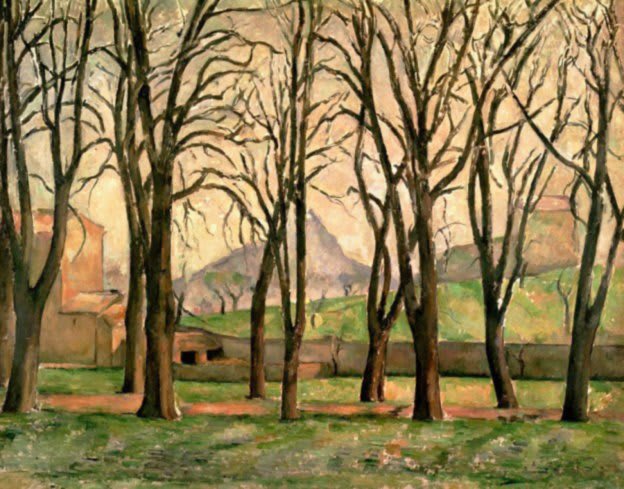
The composition Castanheiras de Jas de Bouffan no Inverno, is one of the beautiful landscapes of the French painter Paul Cézanne.
Nine high trunks of chestnut trees, with their branches intertwined, create a wonderful braid, through which it is possible to see part of the Jas Bouffan farm, property of the painter's family, a house on the hill and the majestic blue mountain, in the background, so loved by him.
By the color of the sky, it is assumed to be a winter day. From his palette, the painter took the dark brown of the trunks, the green of the meadow, which spreads throughout the landscape, the blue of the mountain and the ocher of the houses.