
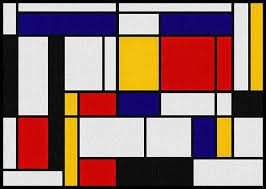
Piet Mondrian: Biography and Works: De Stijl and Neoplasticism
Discover the rise of Piet Mondrian in the De Stijl movement, the development of Neoplasticism, and its evolution into pure geometric abstraction, as well as its global impact on culture and design.
Article Index
Mondrian's unique style of using colored geometric abstractions influenced the development of Modernism and Minimalism in art.
He also had a significant influence far beyond the art world.
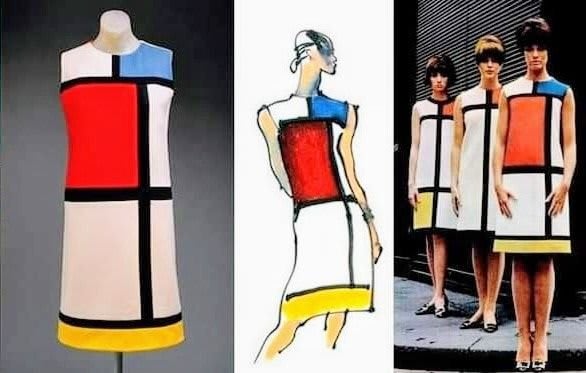
In 1965, Yves Saint Laurent created Mondrian-style dresses for his fall collection.
They became very popular and inspired designs in a wide range of other clothing for the fashion world.
Projects following his style, were included in various album covers and presented in music videos, as well as also in interior and exterior architecture design.
LEGACY
To understand the rest of this journey, continue to our next article: Piet Mondrian: Biography and Works: In-Depth Analysis of his Masterpieces.
De Stijl, was a movement among Dutch artists, architects, and designers who presented an ideal of total abstraction as a model of harmony and order in the arts.
Together, they developed an independent vision of modernism.
With Mondrian as leader, this style of art was called Neoplasticism, or the new plastic art.
For him "plastic" only referred to a new way of representing reality, found on the surface of the painting itself.
Committed to the absolute devaluation of tradition, the artists of De Stijl emphasized the need for abstraction and simplification and limited the elements in their paintings to straight horizontal and vertical lines, right angles, the three primary colors (red, yellow, blue) and the three achromatic colors (gray, white, and black).
The De Stijl movement proved to have a significant international influence on architecture, fashion, typography, and interior design throughout the 20th century.
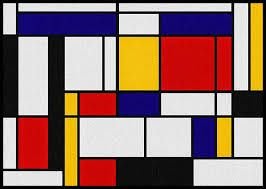
Throughout his life, Mondrian worked on a series of projects that reflected his vision of a more harmonious and balanced society.
He believed that art could be a powerful tool for promoting social and cultural change.
In 1938, before the start of the Second World War, he moved to London for two years.
During this period, the artist met Peggy Guggenheim, a friendship that had a great support from her to the deportation of the Dutch artist to stay in London and later in the United States.
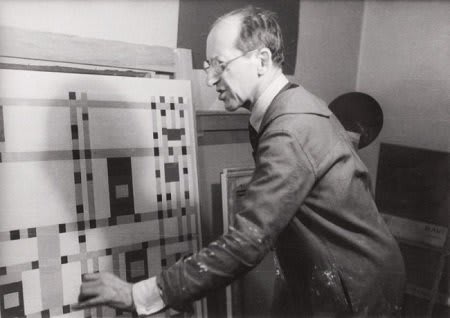
In 1940, Mondrian settled in the city of New York, Peggy Guggenheim exhibited his works in the Art of This Century Gallery.
During this period, he was introduced to the flourishing avant-garde art scene in New York and joined the artists of abstract art.
After the end of the First World War, Mondrian returned to Paris and began creating his iconic abstract paintings for which he is best known.
The paintings of the 1920s are the clearest expression of his ideal of universal purity and harmony in neoplastic expression.
It was only around 1925 that he began to receive recognition for his contribution to modernism, with his paintings being acquired by wealthy European and American collectors.
Mondrian was an indefatigable painter, who sometimes got sick from working too much.
While in his apartment in Manhattan, he mounted large colorful panels on his walls, reorganizing and moving them as he completed his paintings.
He confessed to his friend Harry Holtzman, that the environment in his Manhattan studio, was the best space he had ever inhabited.
Always very dedicated to his work, Mondrian's life reflected the purity and discipline of his art.
He remained single and lived simply with few possessions.
He died in New York on February 1, 1944, of pneumonia, at the age of 71.
In 1985, the Hotel Le Mondrian was opened in Los Angeles with a nine-story painting on one side of the building inspired by the work of this unique artist.


