
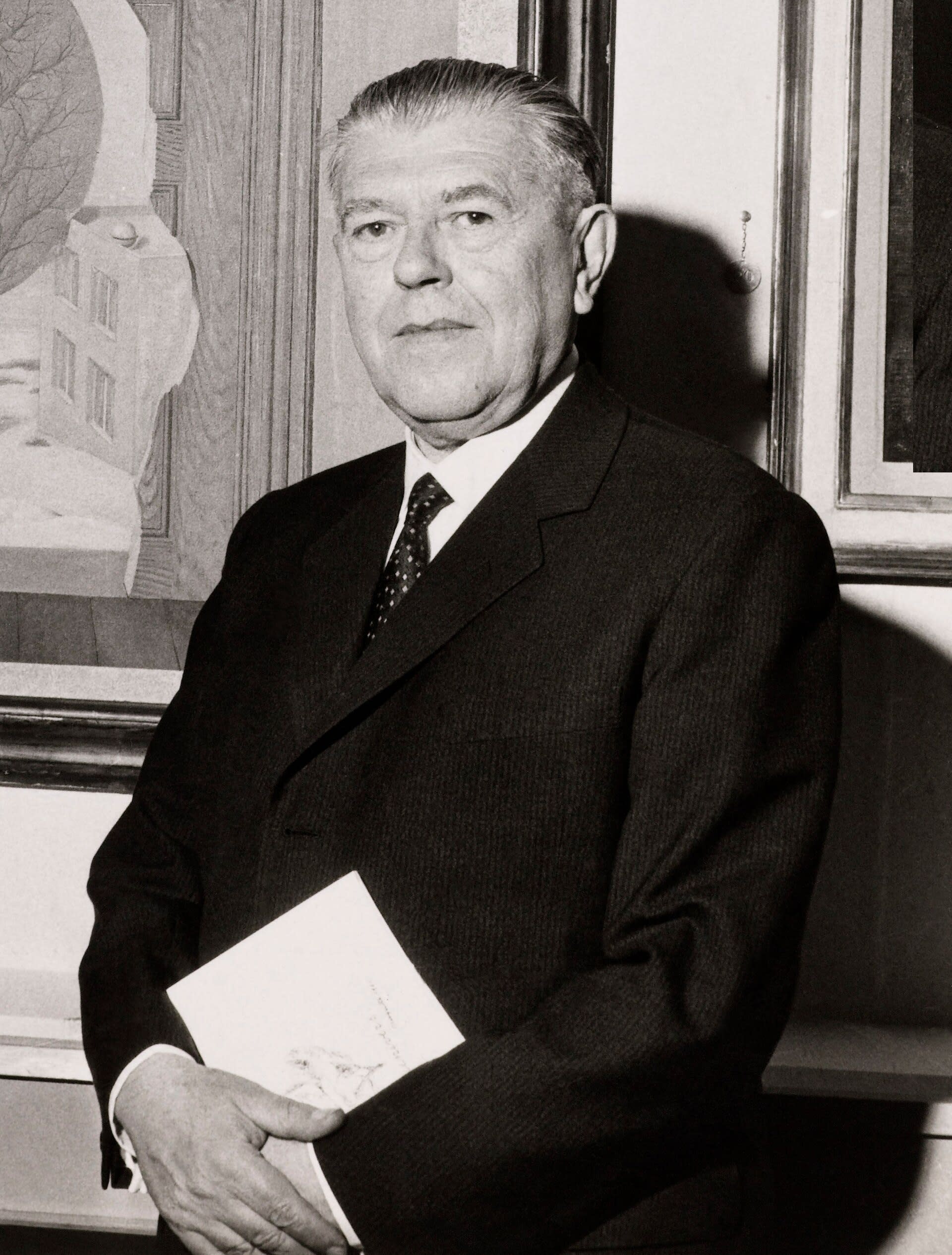
René Magritte: Biography and Works: Life, Early Career, and Surrealism
René Magritte: Biography and Works: Life, Early Career, and Surrealism
Article Index
René Magritte, one of Belgium's most renowned artists, captivated audiences with his playful and thought-provoking images.
His distinctive approach to Surrealism earned him widespread popular acclaim and a prominent place in art history.
BIOGRAPHY: The Making of a Surrealist Genius
René François Ghislain Magritte came into the world in Lessines, Belgium, on November 21, 1898.
He was the eldest of three boys in a financially prosperous family. His father was an industrialist, and his mother was a milliner before her marriage.
Magritte's artistic path was profoundly shaped by two significant events in his childhood.
The first was an unexpected encounter with an artist painting in a cemetery, discovered while he was playing with a friend.
The second, and more tragic, occurred in 1912: his mother committed suicide when he was just 14 years old.
Accounts indicate that Magritte was present when her body was found in a river, an event that would mark him forever.
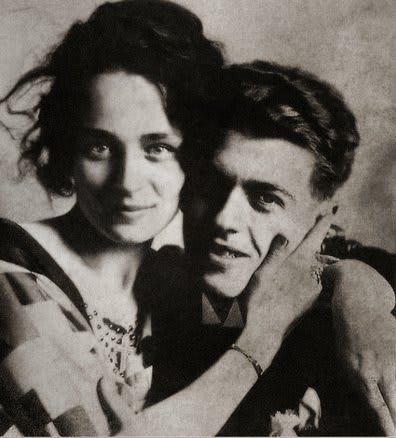
Three years after his mother's death, the young Magritte took his first steps in his artistic career.
In 1916, he enrolled at the Académie des Beaux-Arts in Brussels, a decisive period for his artistic development.
There, he became close friends with painter Victor Servranckx, who introduced him to avant-garde movements.
He was introduced to Futurism, Cubism, and Purism, expanding his artistic repertoire and worldview.
Magritte showed a particular attraction to the works of Jean Metzinger and Fernand Léger, who exerted a strong influence on his early works.
In 1921, Magritte completed his compulsory military service, dedicating one year to the armed forces.
The following year marked an important moment in his personal life: he married Georgette Berger, a young woman he had known since childhood.
To support himself, Magritte began working as a draughtsman in a wallpaper factory.
However, this occupation lasted about a year, after which he decided to venture out as a freelance advertising poster designer.
The Dawn of Surrealism and Fascinating Paris
In 1926, already with some recognition as an artist, Magritte signed a contract with the prestigious Galerie le Centaure in Brussels.
This initial period of his career was a watershed moment, driving profound transformations in his artistic output.
It was in this context that he first encountered the work of the enigmatic Giorgio de Chirico.
De Chirico's art overwhelmingly impressed him, revealing a universe of mystery that resonated deeply with his own vision.
De Chirico's influence became a catalyst, gradually and irreversibly paving the way for Surrealism in his creations.
Between 1927 and 1930, Magritte took up residence in Paris, a crucial period for his immersion in the art scene.
There, he forged strong ties with the influential circle of Parisian Surrealists, led by writer André Breton.
This group included prominent figures such as Max Ernst and the flamboyant Salvador Dalí.
During this time, Magritte began experimenting with essentially surrealist compositions, incorporating more ambiguous and organic forms into his canvases.
However, a growing disillusionment took hold of the artist concerning "dark" themes, such as hysteria and madness, which were often addressed by his colleagues.
In 1930, Magritte's contract with the Galerie le Centaure came to an end, and later that year, the gallery ceased its operations for good.
Given this, Magritte decided to return to Brussels, where he resumed commercial advertising work to secure his livelihood.
Fortunately, by the late 1930s, interest in his work grew exponentially among international collectors.
Important names like Edward James in London began acquiring his paintings, paving the way for his financial independence.
Finally, Magritte was able to almost entirely abandon commercial work, dedicating himself fully to his true passion: art.
However, just as Magritte was beginning to enjoy success and recognition, the world was engulfed by the terror of World War II.
Even amidst the conflict, he persisted in developing his unique style.
In an act of resistance and subversion against the desolation of war, Magritte began to employ an increasingly bright and impressionistic palette.
He himself justified this change in his writings: "The feeling of chaos, of panic, that surrealism hoped to promote, so that everything could be questioned, was achieved far more successfully by those Nazi idiots..."
And he completed with a powerful declaration: "...Against generalized pessimism, I now propose a search for joy and pleasure."
In 1946, Magritte signed a manifesto titled Surrealism in Full Sunlight, marking his official break with André Breton and the Parisian group.
But the artist held an even more radical surprise:
This phase was followed by a brief and daring experiment, a "wild" and intentionally provocative style he dubbed "vache" (cow).
The "vache" style was characterized by vulgar themes and crude colors, often interpreted as a direct parody of the Fauvists.
As Magritte anticipated, his works produced in this style were, indeed, phenomenally unpopular.
However, in the 1950s and 1960s, he returned to his characteristic and globally recognized style.
Towards the end of his life, Magritte achieved tremendous success, with six major retrospectives dedicated to his work in important museums.
DEATH AND LEGACY: Magritte's Lasting Impact
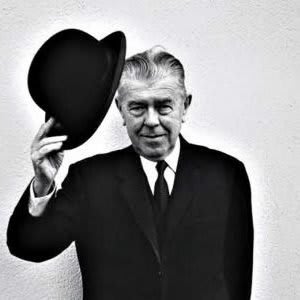
Despite being diagnosed with pancreatic cancer in 1963, Magritte maintained his intense artistic activity.
He even traveled to New York for the retrospective of his work at the renowned Museum of Modern Art, MoMA.
During this same period, the artist explored new media, creating a series of short films starring his wife and producing several sculptures.
After a long and challenging period of illness, René Magritte passed away on August 15, 1967, at the age of 69.
Magritte's death did not diminish his influence; on the contrary, his work had a profound impact on various subsequent art movements.
His work became a clear reference for pop artists, such as the iconic Andy Warhol.
Since then, Magritte's art has been celebrated in numerous global exhibitions, inspiring conceptual art and 1980s painting.
His legacy is recognized for anticipating future trends, standing out for its emphasis on concept over execution.
The close association with commercial art and the focus on everyday objects, exhaustively repeated in his pictorial space, reinforce his originality.
In recognition of his unique contribution, the Magritte Museum was solemnly inaugurated in Brussels in 2009.
GALLERY - COMMENTED ART: The Works That Define Magritte
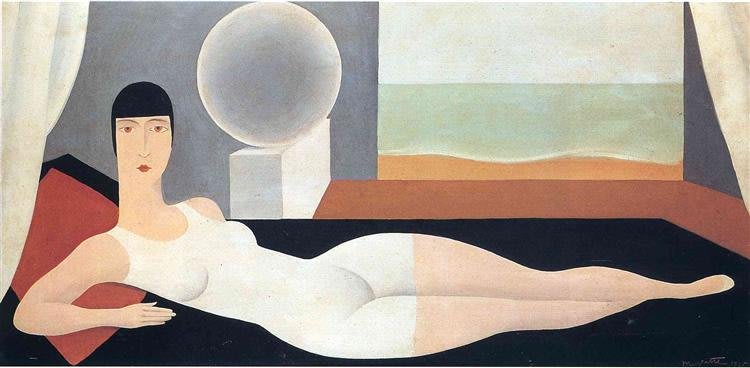
The Bather is an example of Magritte's early works, revealing a strong influence of Cubism and Futurism.
Interestingly, this specific painting is classified within the Art Deco style, showcasing the artist's initial versatility.
Magritte skillfully employed themes of mystery and madness, seeking to challenge ingrained assumptions about human perception.
The painting The Lost Jockey is one of his early works demonstrating this exploration, a theme he would repeat in various future pieces.
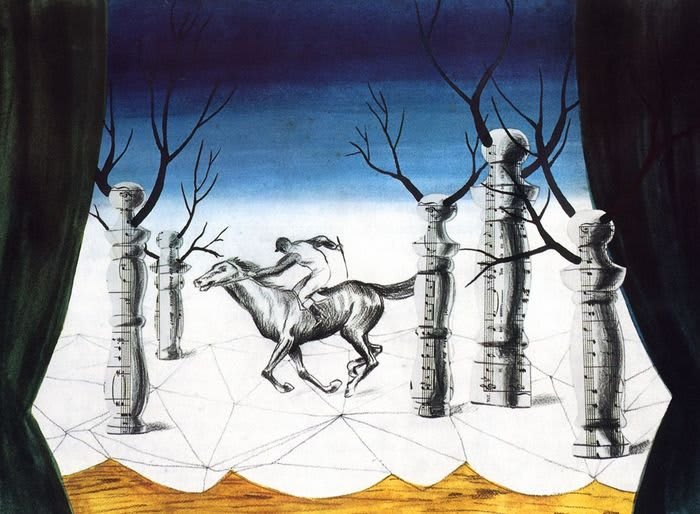
In Magritte's work, we are confronted with symbols that emerge as powerful visual metaphors.
He frequently explored images of figures like the iconic bowler hat, or other everyday objects.
His genius lay in representing them with realistic detail, yet placed in impossible, purely surreal scenes.
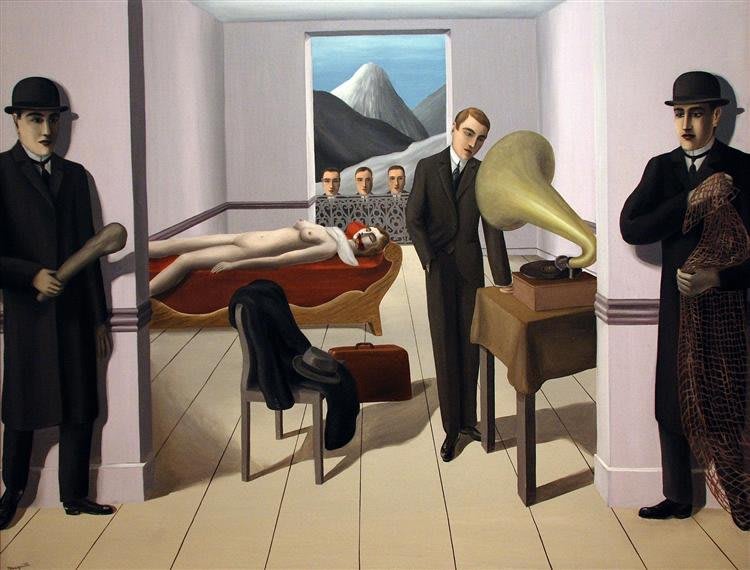
With The Threatened Assassin, Magritte quickly ascended, becoming one of Belgium's most important artists.
His influence was central to the flourishing of the Surrealist movement in his home country.
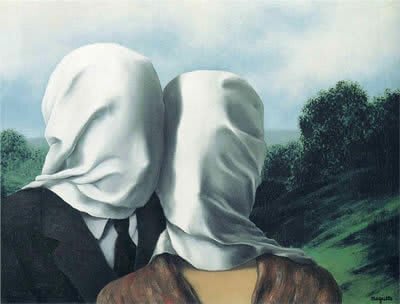
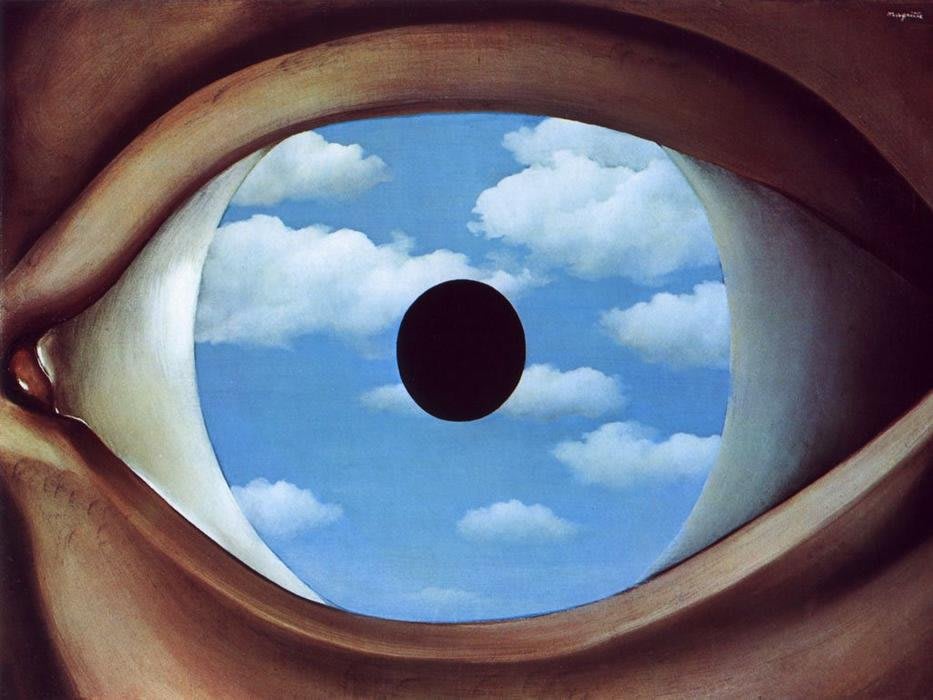
Among his most important and iconic works are The Lovers and The False Mirror.
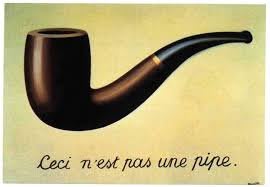
During this same fertile period, Magritte also began audacious experiments with the use of text in his paintings, challenging the very nature of representation.
A celebrated example of this innovation can be seen in his acclaimed work The Treachery of Images, which provokes us to question what we see.
"My work presents visible images that conceal nothing... they evoke mystery, and indeed, when someone sees one of my paintings and asks, what does it mean? It means nothing, because mystery doesn't mean anything either, it is indecipherable."- René Magritte
The False Mirror is one of the most impactful works created in the interstice between the two great world wars.
This dark period saw artists worldwide attempting to assimilate the horrific consequences and conditions imposed by the conflicts.
The use of such a particular part of the human body, the eye, is revealing, challenging the viewer to question their own perception of reality.
Magritte surprises us by removing the pupil from its anatomical position and repositioning it in the vast center of the sky.
The eye, in turn, is contoured by a structure resembling an optical aperture, yet one that transcends mere human flesh.
The painting's composition exhibits remarkable symmetry, in both vertical and horizontal lines, creating a disturbing balance.
The symmetry of colors, with the striking black circle, immediately attracts and captures the observer's attention.
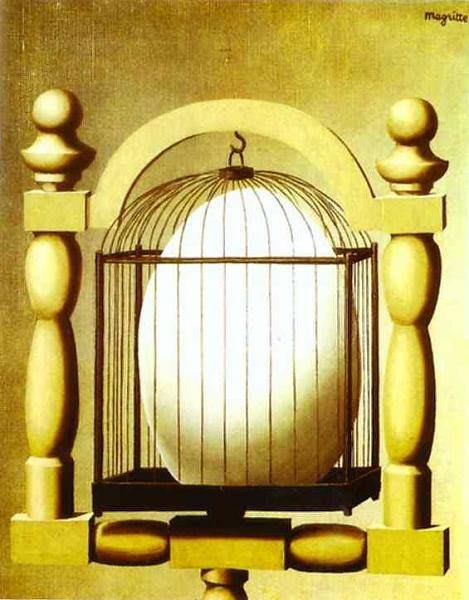
In Elective Affinities, Magritte conveys a profound and disquieting message about human freedom.
The painting suggests that, although people are born free, they are inevitably caged by patterns and conventions that surround them throughout life.
The work finds a perfect echo in the words of Goethe, who, in a famous quote, summarizes this powerful reflection:
"None are more hopelessly enslaved than those who falsely believe they are free."
The title The Human Condition was attributed to two distinct works by Magritte, both widely disseminated and considered pillars of his production.
In them, the image painted on the canvas merges indissolubly with the real image of the landscape, creating a visually seamless transition.
Magritte explored this theme recurrently throughout his career, creating numerous variations on the idea of a "painting within a painting."
His intention was often to conceal what lay behind, inviting the viewer to reflect on the nature of representation. Click here to learn more.
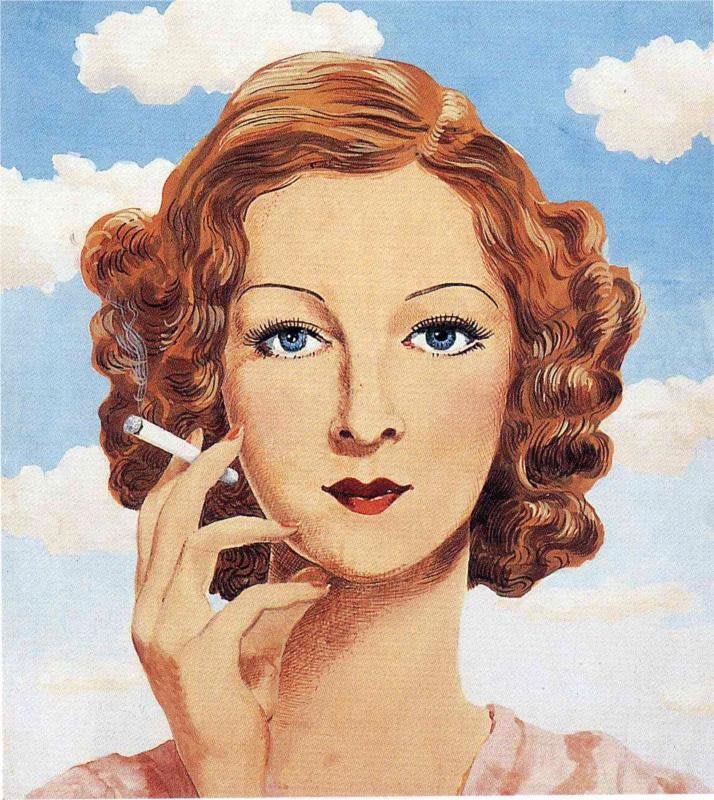
Georgette Berger, Magritte's eternal muse, met him as a teenager in 1913.
A brief and tender romance blossomed, but was brutally interrupted by the advent of World War I.
Fate reunited them in 1920, leading to their engagement and, finally, their marriage in 1922.
The beautiful Georgette was not only his wife but also his model and an inexhaustible source of inspiration throughout his life.
She passed away twenty years after her beloved husband, leaving a legacy of love and art.
To understand the rest of this journey, continue in our next article: René Magritte: Biography and Works: Analysis of Mature Works and Legacy.


