
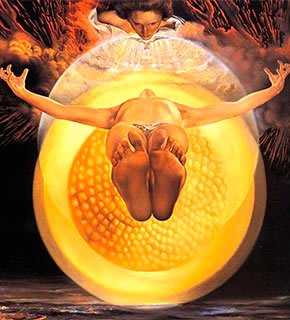
The Ascension of Christ, by Salvador Dalí
The Ascension of Christ, a painting by the Spanish artist Salvador Dalí
The Ascension of Christ is a religious painting by the Spanish artist, Salvador Dalí.
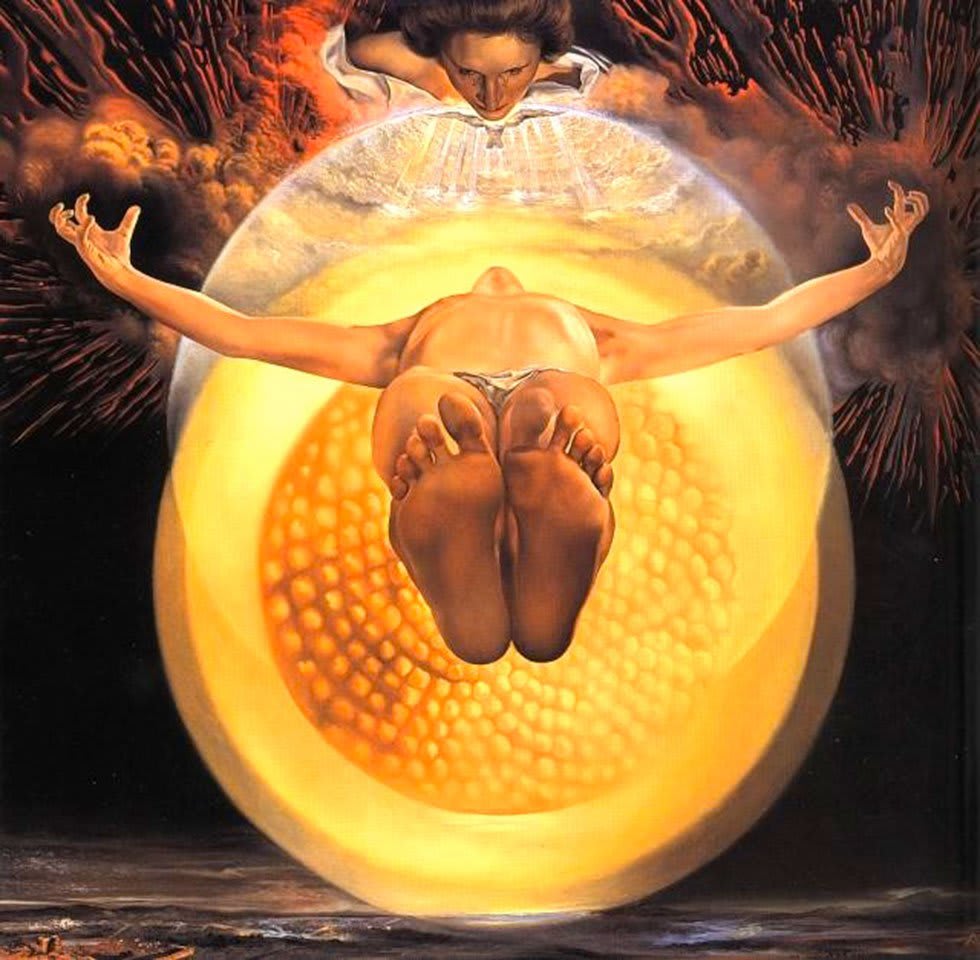
The artist said that his inspiration for creating this painting came from a cosmic dream he had in 1950, about eight years before it was completed.
In the dream, which was in vivid colors, he saw the nucleus of an atom, which we see in the background of the painting; Dalí later realized that this nucleus was the true representation of the unifying spirit of Christ.
But what's even more interesting: is how he played with spatial relationships in his paintings, which we can see in this work in particular.
The Ascension of Christ, also known simply as Ascension, the perspective used, which seems to travel back to a distant vanishing point, is a bit inverted – a hallmark of Dalí's unique vision and perhaps his attempt to confuse us a bit.
In the foreground, there are Christ's feet pointing towards the viewer, drawing the eye inwards along his body to the center of the atom behind him.
The atom has the same internal structure as the head of a sunflower.
Just like in most of the other paintings of Christ represented by Dalí, his face is not visible.
Above Christ is Gala, the artist's wife, who was portrayed as Mary, the Holy Mother, she is crying with tears, mysteriously observing from the heavens, tears shed to perhaps convey the sadness of seeing her son leave the familiarity of the earthly world.
This is a scene that makes us reflect on life and death, and how art can help us better understand these concepts.
This is a work that makes us question the nature of reality and how it can be perceived in different ways.
This is a work that makes us feel the presence of something greater than ourselves.
And this is a work that reminds us of the importance of art in our lives.


