
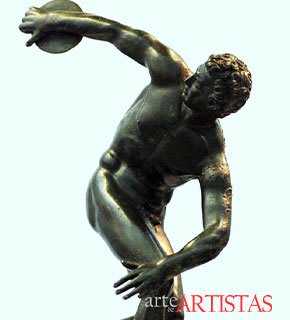
The Discobolus of Myron
The Discobolus of Myron is a bronze sculpture created by Myron, an ancient Greek artist, around 455 BC.
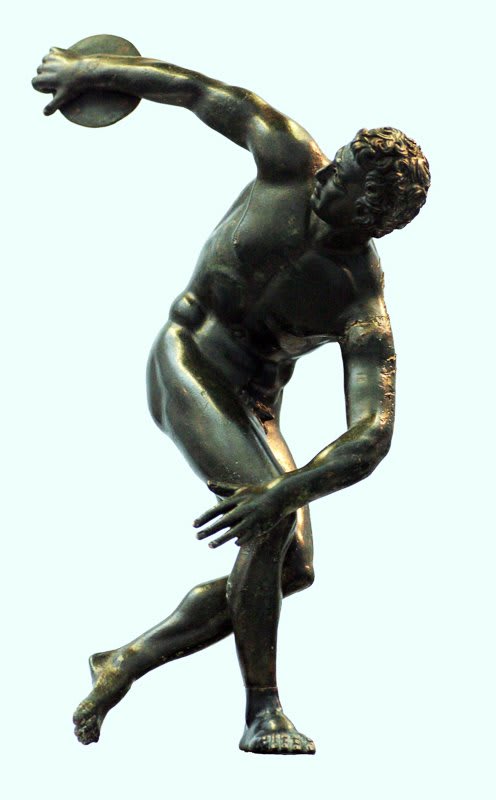
The Discobolus is a bronze sculpture created by Myron, an ancient Greek artist, around 455 BC. It represents an athlete in the moment before throwing the discus.
One of its Roman copies is housed at the British Museum in London, as, like many of the most important Greek sculptures, the original work has not been preserved.
The marble copy of the true mold of a Roman copy found at the Villa Adriana in Tivoli measures about 160 cm in height.
It is certainly Myron's most famous work and one of the most important in ancient Greek art, considered an icon.
It incorporates some of the main ideas related to ancient Greece: the passion for the Olympic Games, the cult of the perfection of the human body, the inner calm, and the search for formal harmony.
The bronze was possibly made for the city of Sparta and may represent Jacinto, the boy loved by Apollo.
The Discobolus has its face and torso leaning forward; the right arm, with the hand holding the discus, stretched back and up to generate momentum, while the left is curved forward, with the wrist touching the right knee.
The knees are bent, the right leg is slightly in front of the other and appears to support the body's weight, while only the toes of the left foot touch the ground.
Myron was very careful in representing some anatomical details, such as the chest muscles, tendons, and swollen veins of the right hand that convey the athlete's effort.
The sculptor shows the body at the moment of maximum tension. However, this does not reflect on the idealized face that expresses only a slight concentration, betrayed by the partially open mouth and a small wrinkle on the forehead.
Behind the figure is a tree trunk, certainly absent in the original bronze, but which had to be added to the Roman marble copy to support the weight.


