
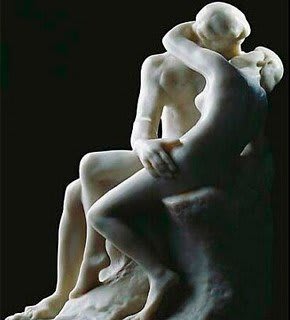
The Kiss, Auguste Rodin
The Kiss, Auguste Rodin
The Kiss is one of the most famous sculptures by the renowned French sculptor Auguste Rodin.
Completed in 1889, this masterpiece depicts a passionate couple in an intimate and passionate embrace.
The sculpture is known for its realistic representation of the human figures, as well as the expression of emotion and love between the two lovers.
The Kiss is an timeless symbol of romantic love and passion, capturing the beauty and intensity of the moment with a unique sensitivity.
The work is considered one of Rodin's greatest achievements and one of the icons of Western sculpture.
The Kiss (The Kiss) is one of the most famous sculptures by the French artist Auguste Rodin produced between 1882 and 1898.
The magnificent marble sculpture where we can observe two naked lovers fused in passion, is simply known as The Kiss.
With slender and flexible bodies, the couple provides a striking contrast with the roughly carved rock on which they are found.
Rodin's lovers seem timeless and idealized: a universal representation of sexual passion, indifferent to everything else.
Three versions of marble in natural size of the sculpture were executed during Rodin's lifetime. The oldest is in the collection of the Rodin Museum in Paris, one of the most romantic destinations in the city, which occupies a prominent position, immediately visible when the visitor enters the space, in the middle of a gallery on the ground floor.
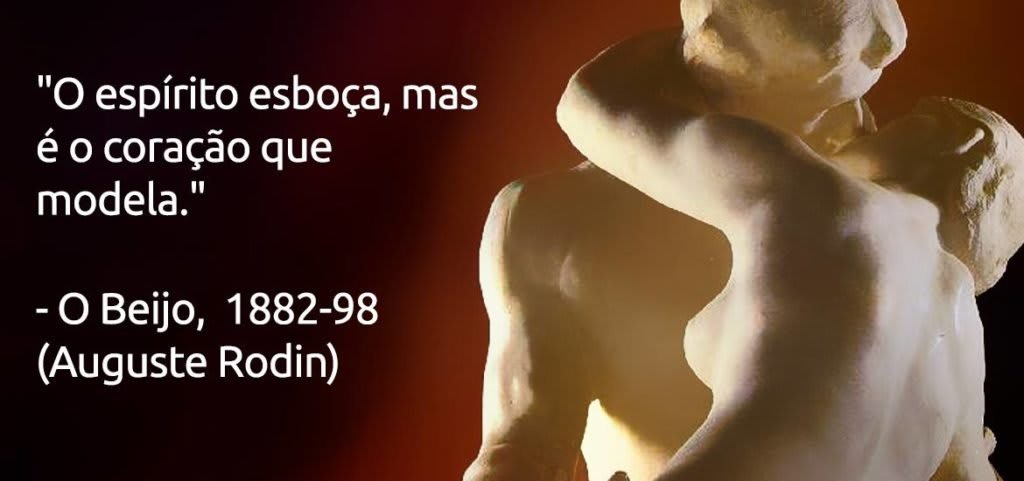
ORIGIN: Inferno of Dante - Condemned lovers
The origins of the sculpture date back to 1880, when Rodin, who had been born in a working-class neighborhood of Paris as the son of a police officer, was approaching his 40th birthday.
At that time, he had established his reputation. In the same year, he was commissioned by the French state for the first time to design a pair of monumental bronze doors for a new museum of decorative arts.
As a theme, he chose the Inferno of Dante. From the beginning, he planned to carve a pair of lovers in relief in the middle of the panel of the left-hand door. Called "Fé", the group would represent the illicit passion of Paolo and Francesca, which Dante found in the second circle of hell, whipped by an eternal whirlwind and a popular theme in 19th-century art.
According to the original 13th-century story, Francesca and Paolo fell in love while reading stories of love. When Francesca's husband, who was also Paolo's brother, discovered them, he stabbed them to death. Rodin decided to depict the lovers in the moment of the first kiss.
Looking closely at the sculpture, we can observe a book in the left hand of the man.
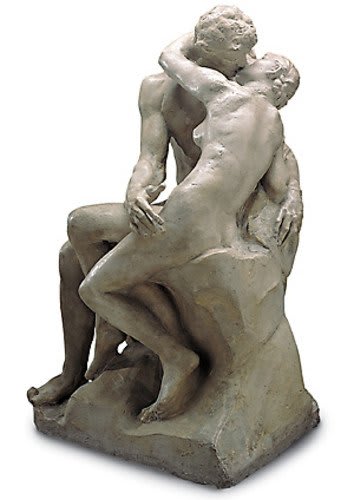
In the mid-1880s, however, the plans for the new museum sank, and Rodin's Doors of Hell, as they became known, were not cast in bronze until after his death. In 1886, however, the artist had decided that his relief of Paolo and Francesca would work better as a large spiral sculpture, and the following year the French state commissioned him to execute the work in marble.
In the following decade, the work remained unfinished in Rodin's studio, while he focused his attention on another project.
In 1898, however, Rodin decided to exhibit it at the annual salon, alongside his monolithic statue of the writer Honoré de Balzac. While the latter sculpture, in which the writer is wrapped in a mantle that covers a strangely formal protuberance, was ridiculed, The Kiss proved to be a public success at the same time. It was quickly copied in bronze in various sizes, and more than 300 models followed.
In 1900, the art collector and specialist Edward Perry Warren asked if Rodin would consider producing a life-size replica of the sculpture, in the best marble possible for his private collection. The French artist agreed and made a contract, specifying his fees at 20,000 francs, as well as the stipulation that the man's genitalia should be completed. The finished piece was delivered in the summer of 1904, but proved to be too large for Warren's house and had to be stored, ignominiously.
During the First World War, Warren lent it to the City of Lewes, a town located in the southwest of England. The sculpture was installed in the Assembly Hall, which was a recreation space for the troops of the army stationed in the city. Regular boxing matches were staged in the hall. But the indecency of its naked protagonists proved so offensive to the local puritans, who feared that it would incite lascivious behavior among the soldiers, that it was surrounded by a fence and covered with a sheet. Two years later, it was returned to Warren, and after his death in 1928, the sculpture became part of the collection of the Tate Museum in London.
The Kiss is not so provocative. If anything, it is a clean and tasteful representation of desire.
Perhaps that's why Rodin himself was dismissive when he called The Kiss a great bugbear sculpture.
Despite appearances to the contrary, the course of true love never runs smoothly, as was the case with Rodin.
It is said that this scene of The Kiss, the sculptor used as inspiration his never-assumed romance with Camille Claudel.


