
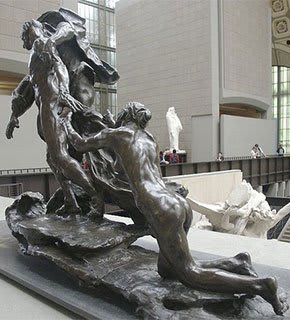
Camille Claudel's Maturity
Explore Camille Claudel's Maturity, a deeply expressive sculpture that reveals the artist's emotional intensity and technical skill.
We invite you to explore Camille Claudel's Maturity, a sculpture that profoundly expresses the artist's emotional intensity and technical skill.
Created between 1893 and 1900, this work depicts a group of three figures that symbolize Claudel's inner struggle and desperation, often interpreted as a representation of her tumultuous relationship with Auguste Rodin.
With impressive realism and a powerful emotional charge, 'Camille Claudel's Maturity' is a work that invites reflection on themes such as love, loss, and redemption.
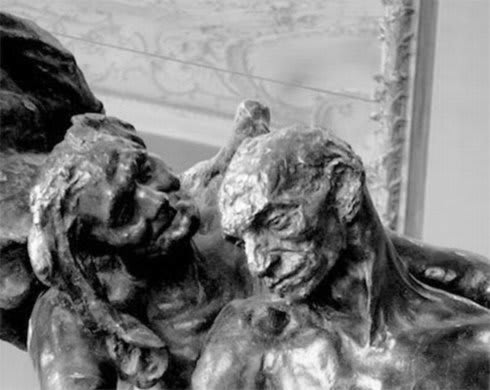
Camille Claudel's Maturity is one of the artist's principal sculptures.
There is a version in plaster and two bronze prints, exhibited respectively at the Musée d'Orsay and the Musée Rodin.
After the breakup between the lovers, Auguste Rodin tried to help her through intermediaries and obtained from the director of the Department of Fine Arts that he commission a work from Camille.
In 1895, she received the commission for a piece that she exhibited in 1899 still in plaster.
However, she did not obtain from the department the request to cast the piece in bronze, which would mean full acceptance.
In compensation, she did not deliver the plaster, which remained stored in her studio.
It was only in 1902 that Captain Tissier commissioned the bronze of the work that became known as “Camille Claudel's Maturity”.
Despite the indifference with which the future looks at the past, of being a symbolic work that makes us think about the time that escapes us, of being a witness to the talent of that passionate and limit-less woman, this autobiographical work that is above all an allegory of the time that passes quickly, is, for the majority who know the history of Camille and Rodin, the painful account of the end of a love affair.
But history keeps a strange detail:
This work that greatly displeased Rodin, who felt exposed, portrays the feeling of defeat of Camille in front of Rose, her mother, in front of the passage of time and death.
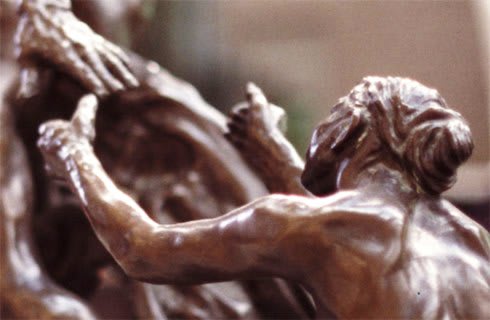
The Suppliant is the detail that composes “Camille Claudel's Maturity”.
The belly of the young woman is swollen, pregnancy is a theme that is repeated in her work, perhaps reflects a hope of connecting with femininity, with the experience of Being and substituting absence by presence.
The sculpture can be interpreted as an allegory of separation showing abandonment.
By exposing the bronze, it was praised, but also criticized for the crudeness that portrayed decay and suffering.
She had obtained a commission after it was withdrawn.
Camille was hurt that Rodin did not intervene in her favor, he seemed not to want the work exposed, leaving it to be seen that he felt personally affected.
- The personal history dissolves before the masterpiece that remains. It doesn't matter the version, it doesn't matter the history behind the creation of the work.
- It doesn't even matter that she put her face in the features of the young woman who implores.
The cruelty of time is also that, what matters is what she left us: a living statue, wonderful, in which the talent of Camille Claudel, independent of Auguste Rodin, was proven.
This work witnesses the cruel abandonment of Auguste Rodin, it marks the breakup of one of the most famous couples lovers in the History of Art.


