
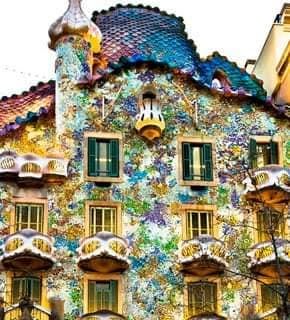
The Expiatory Temple of the Sacred Family
The Expiatory Temple of the Sacred Family, or simply the Sacred Family, is one of the most iconic and unfinished works of the Catalan architect Antoni Gaudí.
The Expiatory Temple of the Sacred Family, or simply the Sacred Family, is one of the most iconic and unfinished works of the Catalan architect Antoni Gaudí.
Located in Barcelona, Spain, the construction began in 1882 and continues to this day, with a predicted completion date of 2026, coinciding with the centenary of Gaudí's death.
The Sacred Family is a masterpiece of Catalan modernism, characterized by its organic forms, surreal details, and a unique blend of architectural styles, ranging from Gothic to Art Nouveau.
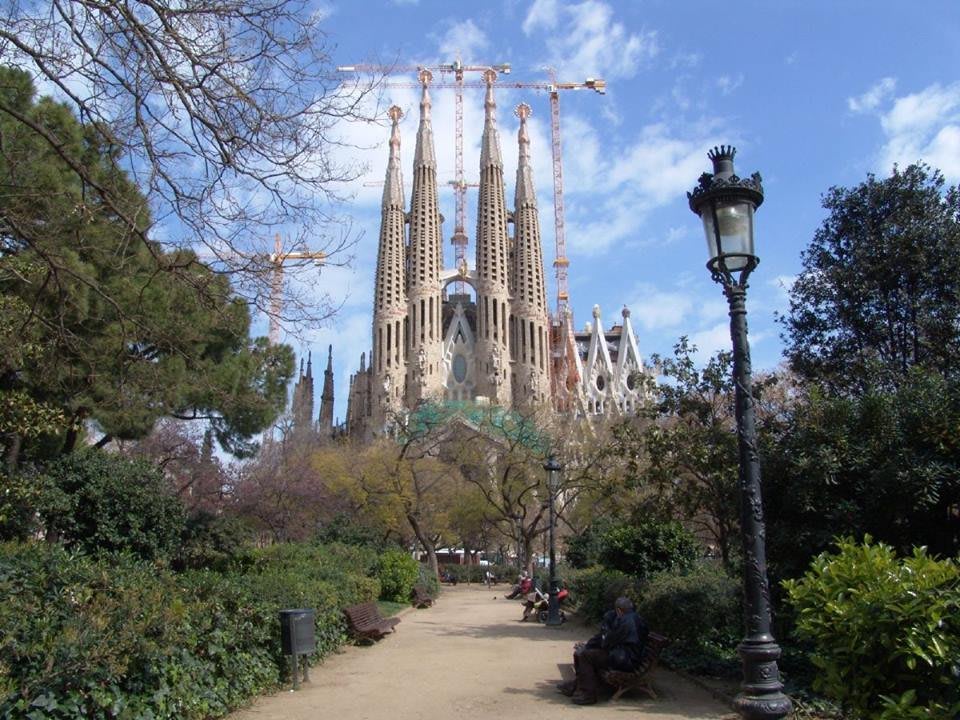
Gaudí once said that the work was an expression of the "divine history of the salvation of man through Christ incarnate, given to the world by the Virgin Mary".
Noticing that he would never see the project completed during his own lifetime and, when asked if this concerned him, Gaudí replied: "My client is not in a hurry".
After completing La Pedrera in 1906, among private commissions, Gaudí worked tirelessly on this project.
In 1911, being a devout Catholic, he spent the next 15 years living and working on the site as a virtual work of reclusion and supervision.
He died in 1926, after being run over by a tram.
From then on, many architects took over the work.
The few models and sketches that Gaudí had in hand were mostly destroyed by Catalan anarchists when they attacked the Sacred Family during the Spanish Civil War.
However, Gaudí left enough to build features such as the naves and the facade of the Nativity that would define later works in terms of style and height.
The anarchists, however, left Gaudí's tomb intact.
For, whatever the rancor against General Franco and the Catholic Church, they knew very well that Gaudí was considered a saint by people of all classes and political beliefs.
Although it was never a cathedral, as soon as Gaudí took over, the Sacred Family was planned as a building the size of a cathedral and can be considered the last great cathedral to be built.
Its plan is similar in design to other Spanish cathedrals, such as Burgos, Leon, and Seville, but in common with the Catalan and other European Gothic cathedrals, it is quite square, as its length is short compared to its width.
It has a wide variety of elements, including double corridors, a cloister with a head of seven apsidal chapels, a multitude of towers, and three portals, each individually decorated and designed.
The original design of Gaudí included 18 towers, representing in ascending order of height the Twelve Apostles, the Four Evangelists, the Virgin Mary, and the highest of all, Jesus Christ.
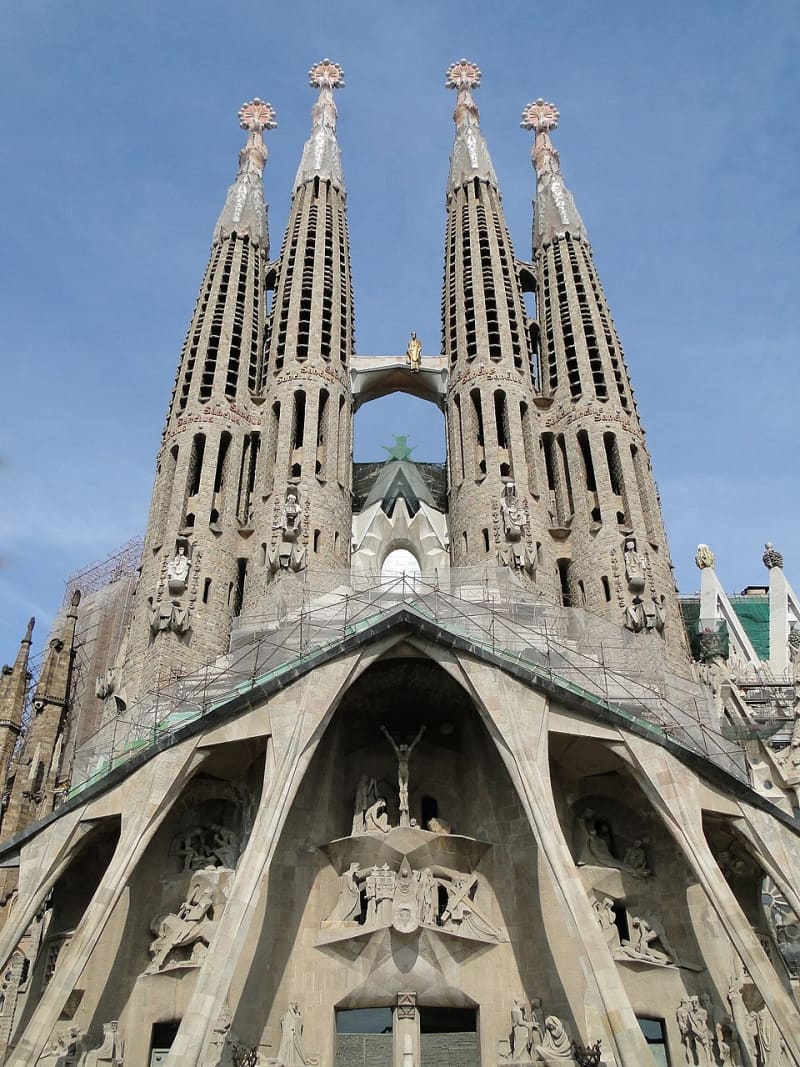
The temple has three large facades - the Nativity Facade, the Passion Facade, and the Glory Facade.
The Nativity Facade, facing east, dedicated to the birth of Christ, was virtually complete when Gaudí died in 1926 and is the facade that shows the most direct influence of Gaudí.
The Passion Facade, facing west, which symbolizes the suffering of Christ, is controversial due to the skeletal designs, including a tortured Christ on the Cross, completed by Josep Maria Subirachs.
In 2002, work began on the Glory Facade, which will be the largest and most ambitious of the three, representing the ascension of Christ to heaven.
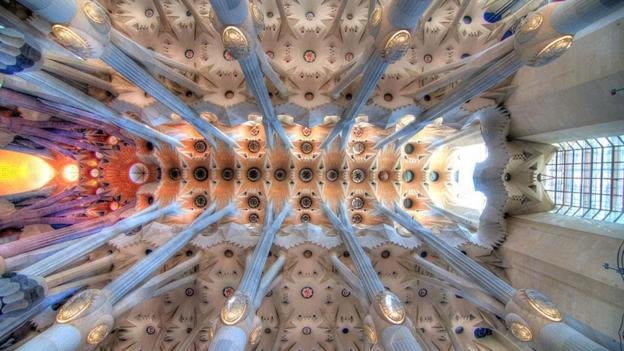
The interior of the Sacred Family is composed of five naves and a three-part transept, forming a Latin cross.
The columns are designed by Gaudí, branching out to support their load, and their constantly changing surfaces are the result of the intersection of several geometric shapes.
None of the interior surfaces are flat, and the ornamentation is extensive and rich, consisting largely of abstract forms that combine smooth curves and irregular points.
Even the work at the level of details, such as the iron grilles for balconies and stairs, is full of meticulous details.
In 1936, the journalist George Orwell wrote in a Homage to Catalonia, mentioning the Sacred Family as "one of the most hideous buildings in the world" and lamenting the fact that the anarchists did not destroy it during the Spanish Civil War.
However, the Sacred Family remains firm....
In 1984, it was declared a UNESCO World Heritage Site and currently attracts around 2.5 million visitors every year, so it seems that the genius architect had the last work in glory, and can laugh a lot at these comments from up there.
The completion date of the temple is scheduled for 2026, coinciding with the centenary of Gaudí's death.
The video below presents sequences filmed from a helicopter with computer-generated animations, projecting how the famous cathedral will look after almost 150 years of initial construction, of a structure that is a worldwide reference as "the most extraordinary personal interpretation of Gothic architecture since the Middle Ages".
VIDEO CREDITS: https://www.hypeness.com.br/


