
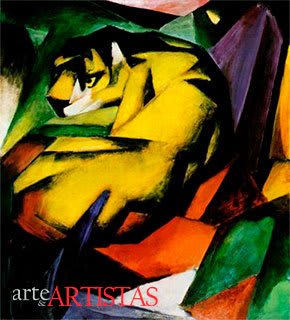
Tiger, Painting by Franz Marc
Tiger, Painting by Franz Marc
Franz Marc, a German expressionist artist, gained recognition for his vibrant animal images, which he used to convey profound messages about humanity, the natural world, and its destiny.
These works demonstrate a new and unsettling sense of unease, tension, anticipation, and imminence, qualities that are evident in the painting Tiger, considered his masterpiece.
Marc depicts the tiger in a moment before the attack; it is ready to break free from anything that is restraining it.
The use of cubist techniques by Marc allowed him to create the unmistakable sense of tension without changing his approach to color or subject matter.
However, his interest in the greater abstraction of the cubists marks a distinct artistic departure.
He shows an obvious debt to the cubism of Pablo Picasso, as it was used as a means to increase realism and feeling,
In the midst of a landscape composed almost entirely of cubist forms reproduced in bright tones of red, green, violet, and orange, the title animal, is seen climbing on a rock.
Perturbed, composed only in tones of yellow and black, is ready to unleash the kinetic force of its massive and muscular body.
Even during this experimentation, Marc never wavered in his interest in bold primary colors and their potential to convey emotion.
The images of this animal seem even more powerful by the block construction of the forms that determine its body.
The entire work is full of tension, with a sense of apprehension, a sense of impending death and suddenness.
In this painting, the sense of security, harmony, and comfort that Marc had projected in his earlier works, such as his famous horses, is now entirely absent.
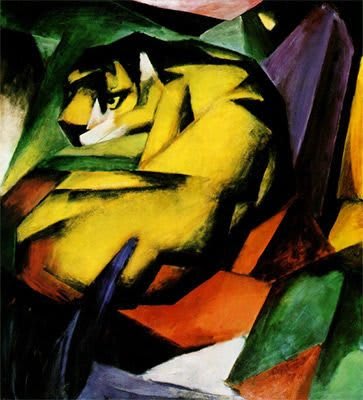
Tiger. Franz Marc. 1912
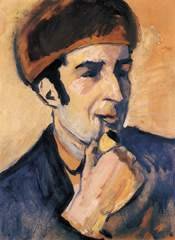
Portrait of Franz Marc. by August Macke. 1910
FRANZ MARC was born on February 8, 1880, in Munich (Germany).
His greatest achievement was indeed to create artworks that, through abstract means, revealed his conception of the general unity and nature's character.
As the founder of the Blue Rider, Marc occupies a place in the theoretical impact of this fundamental movement of future developments, such as Dadaism and Bauhaus.
He and Wassily Kandinsky took an extremely important step in making cubist and fauvist harmonies apply to a high concept of subject matter.
During the war, Marc was forced to rationalize his goal, but the conflicts and resulting issues deeply troubled him.
He enlisted in 1914 with enthusiasm in the German army as a cavalryman.
Writing to Kandinsky, he said about the war: "this is the only way to clean the augian stable of Europe".
In fact, Marc was so enthusiastic that he asked: "Is there a single person who does not want this war to happen?
The trauma of the war for Marc was so great that, in the end, only death could bring him relief.
In this state, his own innocence could be restored.
He was killed in action in the Battle of Verdun on March 4, 1916.


